
Moon Phase Today Boise
On Friday, October 9, 2026, the moon in Boise is a New Moon with 0% illumination. Moon age: 28.9 days.
☽ Best Places to View the Moon in Boise
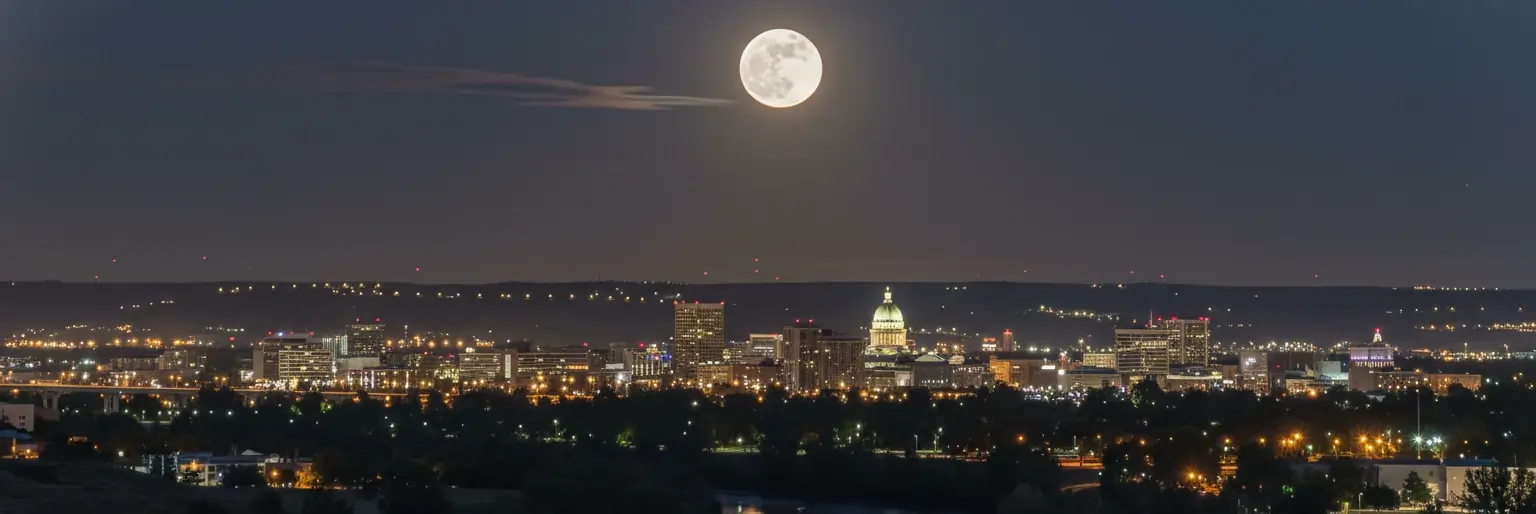
Boise sits at 43° North in the high desert of southwestern Idaho, nestled in the Treasure Valley where the Boise River meets the foothills of the Rocky Mountains. The city is ringed to the north and east by the Boise Foothills — a series of sagebrush-covered ridgelines that rise 500 to 1,000 feet above the valley floor and give the city something most mid-sized American cities lack entirely: a network of elevated natural viewpoints within minutes of downtown. Table Rock, the flat-topped basalt mesa to the east, is Boise's defining landmark and its premier moonrise platform — the moon rises directly behind the downtown skyline from its summit on many dates of the year. Below in the valley, the Boise River and the ponds at Kathryn Albertson Park add water reflections that most high-desert cities cannot offer. Boise rewards the photographer who climbs: the higher you go into the foothills, the darker the sky, the wider the valley, and the more dramatic the composition.
Table Rock
The defining Boise viewpoint and the city's most iconic moonrise platform. The flat-topped basalt mesa rises sharply above the east end of the valley, and from its summit the moon rises directly behind the downtown skyline — the U.S. Bank Building and Zions Bank Tower visible in silhouette — on many dates throughout the year. The large illuminated cross on the summit adds a distinctive foreground element. Access is by foot only via the Table Rock Trail from the Old Idaho Penitentiary trailhead; there is no vehicle access to the mesa. Open sunrise to sunset — the mesa is closed to all access at sunset. Free; park at the Old Pen trailhead.
Camel's Back Park – Hilltop Trails
Camel's Back Park in the North End sits at the base of the Boise Foothills and its hilltop trails rise approximately 100 metres above the valley floor — enough to give a wide, open view across the entire city toward the Snake River Plain beyond. The moon rises over the eastern foothills and tracks above the city glow below. Noticeably darker skies than the downtown parks; popular for full moon hikes with a local crowd that knows the view well. Free, open daily; the upper trails are unpaved and can be muddy in spring.
Military Reserve – Shane's Loop & Upper Trails
The Military Reserve foothill park east of downtown offers a network of trails that climb to overlooks above the Boise River valley. From the upper sections of Shane's Loop and connected ridgeline trails, the moon rises over the downtown skyline with the sagebrush-covered foothills as foreground — a composition that feels genuinely wild despite being minutes from the city center. Dog-friendly and quiet at dusk; darker skies than Camel's Back. Free, open sunrise to sunset; carry a headlamp for the descent and plan to exit before dark.
Hulls Gulch Reserve – Upper Trails
Hulls Gulch Reserve connects directly to Camel's Back Park and climbs to higher elevation than any other trailhead within easy reach of the North End. The upper trails sit well above the valley and offer a panoramic sweep across the entire Boise basin — the city lights spread below and the moon rises behind them into a sky that, at this elevation, is noticeably darker than anything at street level. The most immersive foothills option for photographers willing to hike for the view. Free; unpaved trails, best with proper footwear.
Kathryn Albertson Park – Lake Paths
Kathryn Albertson Park is a 41-acre urban wildlife sanctuary near downtown with a series of ponds and lake paths that give the city's best water reflection shots at ground level. The moon rises over the skyline to the east with the still pond surfaces below doubling the scene — a serene, accessible alternative to the foothills spots for photographers who want reflections without a hike. Open sunrise to sunset; plan to be in position before the park closes at dusk. Free; paved, wheelchair-accessible paths throughout.
Ann Morrison Park – Riverfront
Ann Morrison Park stretches along the south bank of the Boise River just west of downtown and gives wide-open, low-angle access to the city skyline with the river as foreground. The moon rises over the downtown buildings with the Boise River in the frame — on calm evenings the water reflects both the city lights and the moon simultaneously. Large open fields allow for wide compositions and flexible positioning as the moon climbs. Free, open 24/7; the riverfront path connects to the Boise River Greenbelt for extended walks.
◉ Best Times for Moon Photography
📷 Quick Photography Tips
Boise operates on MST (UTC−7) in winter and MDT (UTC−6) during daylight saving time. Idaho observes DST statewide — clocks go forward on the second Sunday in March and back on the first Sunday in November. Apps like PhotoPills or Stellarium set to Boise handle the offset automatically, which is useful given how significantly moonrise times shift across the seasons at this latitude.
For the moon phase in any other city worldwide, visit our Dynamic Moon Phase Calculator on our home page for instant lunar data tailored to wherever you are.
The moon phase today in Boise, ID is shown in detail above — complete with exact illumination percentage, moonrise/set times, and the best local spots to see it. For the moon phase today in any other city or location worldwide, visit our Dynamic Moon Phase Calculator on the home page.
◐ What the Experience Actually Feels Like
There is a particular quality to moonrise in Boise that has everything to do with the mesa. Table Rock sits above the eastern edge of the city like a natural observation deck — basalt flat on top, steep-sided, crowned with a white cross that catches the light from miles away — and from its summit the downtown skyline drops into the valley below you in a way that feels almost theatrical. The moon rises from behind the foothills to the east, clears the ridgeline, and tracks directly above the buildings, and for the first twenty minutes after it appears the entire Treasure Valley glows below in a way that makes it look much larger and more dramatic than anyone who has only seen it from street level would expect.
Boise at 43 degrees north gives the moon a strong, well-defined arc across the sky for most of the year. The high desert air is dry and transparent — clearer than coastal cities, cleaner than the Basin cities further south — and the foothills eliminate the flat, featureless horizon that makes moonrise underwhelming in so many inland cities. Here, the moon rises over something: ridgelines, rock, sagebrush, the dark silhouette of the mountains beyond. The winter full moon rides high and the city lights below are crisp and sharp; the summer moon is warmer but the longer twilight softens the contrast. Both are worth experiencing. They just require different expectations.
What Boise has that most cities its size cannot offer is the proximity of genuine wilderness to the viewpoint. From the upper trails of Hulls Gulch or the Military Reserve, you are standing in sagebrush country — coyotes call in the gulches below, the air smells of dry grass and juniper, and the city is a bowl of light beneath you rather than something you are inside. The moon rises over that scene and the photographs look like they were taken somewhere remote, somewhere requiring effort to reach. The reality is that you drove fifteen minutes from downtown and hiked twenty. That gap between what the images suggest and how accessible the spot actually is — that is what makes Boise's foothills worth knowing about.
"From the upper trails, you are standing in sagebrush country — coyotes call in the gulches below, the city is a bowl of light beneath you — and the moon rises over all of it."
✓ Your Boise Moon Chase Checklist
Before You Go
- Check the moonrise time and phase on this page — the moon's exact alignment with the downtown skyline from Table Rock changes by date and rewards planning over guessing
- Target the 48–72 hour window before full moon if possible — the moon rises during golden hour when the foothills are still catching warm light and the skyline contrast is richest
- Check wind conditions for the foothills — Table Rock and the upper Military Reserve trails are exposed ridgelines where sustained winds are common, particularly in spring
- Note that Table Rock is open sunrise to sunset only — the mesa is closed to all access at sunset, and there is no vehicle access to the top; allow enough time to hike up, shoot, and descend before dark
- Use PhotoPills or Stellarium set to Boise to identify dates when the moon rises centred above the downtown skyline — the geometry from Table Rock is precise and worth targeting
What to Bring
- Sturdy tripod — foothills winds at Table Rock and the upper trails are strong and unpredictable; lightweight tripods will vibrate and blur longer exposures
- A lens between 100–200mm for skyline compression shots from Table Rock — the distance to downtown from the mesa rewards longer glass over wide-angle for the silhouette shots
- A headlamp for any foothills trail — even with sunrise-to-sunset rules, light fades quickly after sunset and having one on the descent from Shane's Loop or Hulls Gulch is essential safety practice
- Warm layers from October through April — high-desert nights in Boise drop quickly after sunset and the exposed ridgeline positions accelerate wind chill significantly
- Proper trail footwear — the upper foothills trails are rocky and uneven; flat-soled shoes are not adequate for the Table Rock trail or the Military Reserve upper sections
- Water and insect repellent in summer — the foothills are dry and exposed, and mosquitoes are active near the river parks and Kathryn Albertson Park ponds at dusk
On the Night
- Arrive at Table Rock 30–45 minutes before moonrise — the sky above the eastern foothills shifts through a vivid amber-to-blue gradient in the final minutes before the moon clears the ridgeline
- At Table Rock, position yourself on the western edge of the summit for the best combined view of the downtown skyline and the valley — the cross is strongest as a foreground element from the north side
- Shoot RAW — the dynamic range between the bright full moon, the lit downtown towers, and the dark foothills requires separate exposures blended in post for a clean final image
- Stay 20–30 minutes after moonrise — the moon climbs quickly above the ridgeline haze and its colour shifts from deep orange to gold to white; each phase produces a different composition
- At Kathryn Albertson Park or Ann Morrison, arrive well before sunset to find the best pond or river position — both parks close at sunset, and reflections are clearest in the final minutes of dusk as the moon rises
? Boise Moon Phase — Frequently Asked Questions
Q. What is the moon phase in Boise, ID today?
The moon phase today in Boise is a New Moon with 0% illumination (moon age: 28.9 days). You can see the exact moonrise, moonset, and calendar in the widget at the top of this page. Boise's coordinates (43.6150° N, 116.2023° W) and its Mountain Time zone are already factored in, so the phase and times shown are accurate for the city without any adjustment needed.
Q. What time does the moon rise and set in Boise today?
Moonrise, moonset, and the time the moon is highest in the sky (transit) all change daily and are calculated live for Boise in the info panel above. Tap any date on the calendar to see the phase and rise/set times for that specific day.
Q. Where is the best place to view the moon in Boise?
Table Rock, the flat-topped basalt mesa east of downtown, is Boise's signature moonrise spot — the moon rises directly behind the skyline from its summit on many dates of the year. For quieter, darker sky views, the hilltop trails at Camel's Back Park and the upper reaches of the Military Reserve and Hulls Gulch Reserve climb well above the valley floor. If you'd rather skip the hike, Kathryn Albertson Park and Ann Morrison Park offer easy, flat access with river and pond reflections.
Q. Why does moon visibility change so much in Boise through the year?
Boise sits at roughly 43° N, so day length shifts with the seasons but far less dramatically than at high-latitude cities. What changes the view most here is the high desert climate: skies are clearest and darkest from late September through March, once summer haze and heat give way to dry, transparent winter air — the same conditions that make the Boise Foothills a favorite for moon photography.
Q. When is the next full moon in Boise?
The date of the next full moon is calculated live and shown in the "Next Full Moon" card above. For a full breakdown of upcoming full moons and their traditional names, see our next full moon guide.
Q. Does Boise observe daylight saving time?
Yes. Boise runs on Mountain Standard Time (MST, UTC−7) in winter and switches to Mountain Daylight Time (MDT, UTC−6) from the second Sunday in March to the first Sunday in November. All times shown on this page already account for the correct offset.
Q. What's the best time of year for moon photography in Boise?
Late September through March offers the clearest, darkest high-desert skies, and the 48–72 hours before a full moon are ideal for catching moonrise during golden hour behind the Table Rock skyline. September and April add mild temperatures and calmer evenings, which help with the river and pond reflection shots at Ann Morrison and Kathryn Albertson Park.
Q. Does this page work for cities besides Boise?
This page is set up specifically for Boise, ID. For the moon phase in any other city or location worldwide, use the Dynamic Moon Phase Calculator on the moonphase.today home page.
✦ Explore Further
Moon Photography Guide
Camera settings, lenses, and techniques for shooting sharp, well-exposed moon shots.
🌕When Is the Next Full Moon?
A running guide to upcoming full moons and what each one is traditionally called.
🌗Why Does the Moon Rise and Set?
The simple science behind moonrise and moonset, and why the timing shifts every day.
🌑How Can There Be No Moonrise One Day?
An occasional quirk of the lunar cycle worth knowing before you plan a Table Rock evening around it.
NASA Moon Phase & Libration Gallery
NASA's Scientific Visualization Studio's daily renders of the moon's exact phase, libration, and orientation, straight from official mission data.