
Moon Phase Today Bogota

☽ Best Places to View the Moon in Bogotá
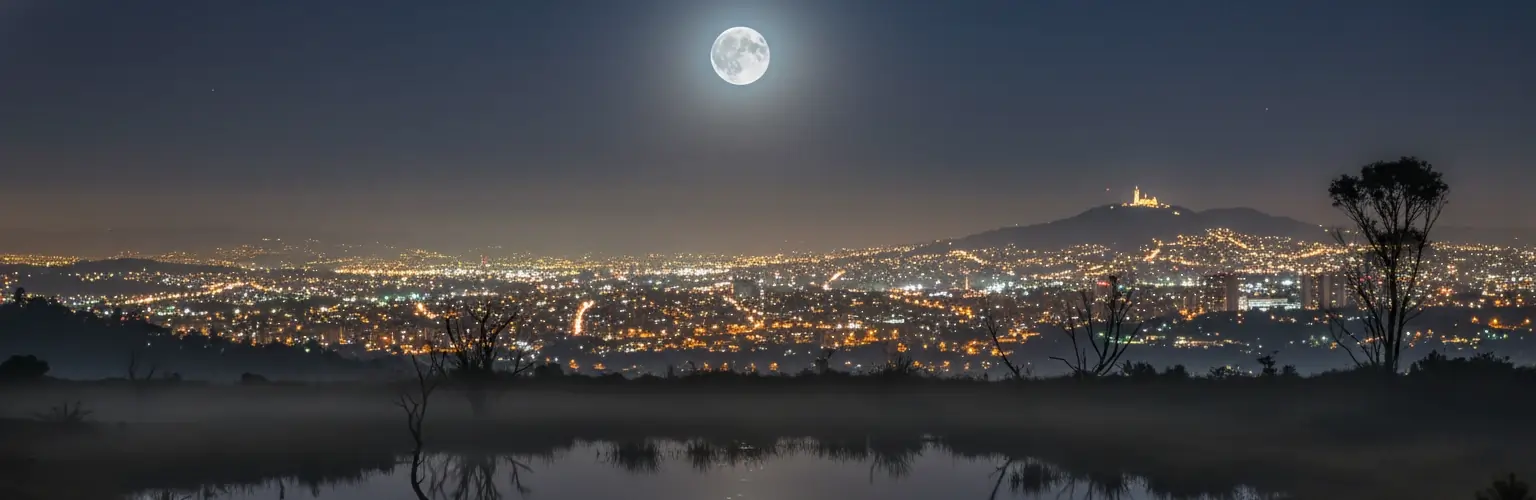
Bogotá sits at 2,640 metres above sea level on a high Andean plateau — the Sabana de Bogotá — wedged between the city grid and the steep eastern hills of the Cordillera Oriental. That geography is everything for moon photography here. The city spreads west across a flat basin while the hills rise sharply to the east, which means the moon rises directly out of those mountains and tracks west across a sky that, at altitude, is thinner and darker than at sea level. From the hilltops above the city — Monserrate at 3,152 m, Guadalupe at 3,250 m — the entire urban grid of one of South America's largest cities spreads below in every direction, a continuous sea of amber light extending to the horizon of the savanna. Bogotá is also a city of near-perpetual spring: temperatures sit between about 7°C and 18°C year-round, and the two dry seasons (December–March and July–August) bring the clearest skies and the sharpest moonrises. At this altitude, the moon appears noticeably brighter and more defined than at sea level — and from the right hilltop, it rises directly above a city of eight million lights.
Monserrate Hill – Sanctuary Terrace
The premier Bogotá moonrise viewpoint — and one of the finest in South America. Monserrate rises to 3,152 m above sea level, approximately 500 m above the city below, and its summit terrace gives a 360° panorama of the entire Bogotá basin and the eastern savanna. The moon rises to the east behind the Andes and tracks above the city as Bogotá's amber grid extends to the horizon below. The 17th-century sanctuary church in silhouette against the moonlit sky is a composition found nowhere else in Colombia. Accessible by cable car (teleférico) or funicular, both open Mon–Sat until midnight, Sundays until 5:30pm. Tickets approximately COP 25,000–30,000 round-trip; check monserrate.co for current pricing. The hiking trail opens 5am–1pm (closed Tuesdays).
La Calera Viewpoint – Mirador de La Calera
The Mirador de La Calera sits on the road to the town of La Calera at roughly 3,000 m, accessed by car or taxi from the city's eastern edge. The drive-up overlook gives a wide, open western view across the full Bogotá basin — on clear nights the city lights stretch from south to north as far as the eye can reach — and the moon rises to the east over the Andean ridge behind you before tracking west above the city. Several restaurants and cafés near the viewpoint offer warmth and food while you wait for moonrise. Less crowded than Monserrate and free to access; the road is paved and open 24/7.
Torre Colpatria – Observation Deck
Rising 196 metres (50 floors) in the heart of downtown, Torre Colpatria offers the only rooftop urban vantage point in the city — the observation deck on the 49th floor gives a 360° view of the basin with the eastern hills and both Monserrate and Guadalupe visible to the east. The moon rises over those peaks and tracks above the city from a perspective that inverts the Monserrate experience: you are inside the city looking out rather than above it looking down. Open Fridays from 6pm, Saturdays from noon, Sundays and holidays from 11am; closes at 8:30pm. Entry approximately COP 12,000; cash preferred. Bring ID — security requires registration on entry.
Guadalupe Hill – Summit Trails
Guadalupe rises to approximately 3,250 m — slightly higher than Monserrate — and is the twin peak visible just south of it on the eastern ridge. The views from the summit are comparable to Monserrate's but the access is significantly more limited: there is no cable car or funicular, and the hill is reached only by foot via trails from the Barrio Egipto area or by vehicle on a restricted road. Darker skies and far fewer crowds than Monserrate make it a strong choice for serious photographers — but plan access carefully, check current conditions, and ideally visit in a group for safety. The small sanctuary at the summit adds foreground character.
Parque Nacional Enrique Olaya Herrera – Eastern Trails
Parque Nacional sits at the base of the eastern hills in the heart of Bogotá and its elevated eastern paths give accessible ground-level views toward Monserrate and the hillside above the city. The moon rises directly over the Monserrate sanctuary from this vantage, with the lit church visible on the ridgeline above and the park's mature trees framing the lower composition. A green and accessible option for photographers who want a peaceful city-level moonrise without the cable car queue or altitude. Free, open daily; well-lit and generally safe in the evenings.
Usaquén – Northern Parks & Hilltop Streets
Usaquén, in the prosperous northeast of Bogotá, is a colonial-era barrio with cobblestone plazas, a Sunday antiques market, and several elevated residential streets that give open eastern views toward the Cerros Orientales. The moon rises over the hills to the east and tracks above the modern towers of northern Bogotá — a quieter, more neighbourhood-scaled composition than the hilltop panoramas. The Parque de Usaquén and the streets surrounding the colonial church provide natural framing for moonrise compositions with historic architecture in the foreground. Free and fully accessible; the neighbourhood is lively and safe in the evenings.
◉ Best Times for Moon Photography
📷 Quick Photography Tips
Bogotá operates on COT (UTC−5) year-round. Colombia does not observe daylight saving time, so moonrise times remain on the same UTC offset in every season. Apps like PhotoPills or Stellarium set to Bogotá apply the correct offset automatically. Because Bogotá sits close to the equator (at approximately 4.7°N latitude), the moon's arc across the sky changes less dramatically between seasons than in higher-latitude cities — making moonrise planning more consistent year-round.
For the moon phase in any other city worldwide, visit our Dynamic Moon Phase Calculator for instant lunar data tailored to wherever you are.
The moon phase today in Bogotá, Colombia is shown in detail above — complete with exact illumination percentage, moonrise/set times, and the best local spots to see it. For the moon phase today in any other city or location worldwide, visit our Dynamic Moon Phase Calculator on the home page.
◐ What the Experience Actually Feels Like
There is a particular quality to a moonrise in Bogotá that you cannot anticipate from any photograph. You are standing on the Monserrate terrace at 3,152 metres with the city spread below you — not in one direction but in every direction, an unbroken grid of amber light that extends from the hills at your back to the flat horizon of the savanna 40 kilometres to the west. The air is thin and cold and startlingly clear. And then the moon rises over the Andean ridge to the east, clearing the peaks that are visible above and behind the sanctuary, and for a few minutes the city below is lit from both directions at once: from eight million windows at ground level and from the moon above them.
Bogotá sits near the equator at high altitude, and both of those facts shape the moonrise in ways that reward the photographer who understands them. Near-equatorial latitude means the moon rises steeply — it clears the horizon quickly and climbs high rather than skimming across the sky at a shallow angle the way it does in northern cities. High altitude means the atmosphere above you is thinner, and the moon appears noticeably sharper and brighter than it does from sea-level cities. On a clear dry-season night at the Monserrate summit, the lunar detail visible to the naked eye is startling — craters and mare visible without a telescope, the terminator line sharp and clean.
The other thing Bogotá has, that no amount of planning fully prepares you for, is the scale of the city seen from above. Other South American capitals are large; Bogotá is enormous, and the Sabana de Bogotá is flat, so from Monserrate the city does not diminish or fade toward the horizon the way it does in hilly cities — it just continues, grid after grid, block after block, the amber light uniform from directly below to the very edge of visibility. When the moon rises over that, the experience is less like a moonrise photograph and more like standing at the edge of the world.
"The moon rises over the Andean ridge and the city below is lit from both directions at once: from eight million windows at ground level and from the moon above them — the Sabana extending flat and amber to the edge of visibility."
✓ Your Bogotá Moon Chase Checklist
Before You Go
- Check the moonrise time and phase on this page — at Bogotá's near-equatorial latitude the moon rises steeply and quickly, so arrival timing matters more than in higher-latitude cities where the moon skims the horizon longer
- Target the dry seasons (December–March or July–August) for the clearest skies — the wet seasons bring persistent cloud cover that can completely obscure the Cerros Orientales from the city below
- Check the Monserrate summit weather specifically before heading up — the peak can be fully clouded while the city below is clear; the official website posts current conditions
- For Torre Colpatria, note opening hours: Fridays from 6pm, Saturdays from noon, Sundays and holidays from 11am — bring cash (approximately COP 12,000) and a valid ID, as security requires registration
- For Guadalupe, plan access carefully and ideally visit in a group — the hill has no cable car and access via trail requires local knowledge of current safe route conditions
What to Bring
- Warm layers regardless of the time of year — at 3,152 m the Monserrate terrace can drop to 4–6°C on clear evenings, and the wind chill from the exposed summit is sharp; the city below may feel warm while the summit is genuinely cold
- Sturdy tripod — the hilltop terraces and the La Calera viewpoint are exposed to persistent Andean wind; a lightweight travel tripod will not hold steady for longer exposures at these elevations
- A lens between 200–400mm for tight compositions — from the Monserrate terrace a telephoto lens allows you to isolate the moon against specific neighbourhoods or the grid pattern of the city below
- A wide-angle lens (16–24mm) for the sanctuary silhouette shots — the full sweep of the Bogotá basin at night requires wide glass to capture the scale of the city spread below
- Water — the altitude at Monserrate (3,152 m) causes dehydration more quickly than at sea level, especially if you hiked up; drink consistently even if you do not feel thirsty
- Cash in Colombian pesos for Torre Colpatria and the Monserrate cable car — card payment is not always accepted at the ticket booths and ATMs near the base station are limited
On the Night
- Arrive at Monserrate 45–60 minutes before moonrise — the eastern sky above the Andes brightens significantly before the moon clears the ridge, and the pre-moonrise alpenglow on the peaks behind the sanctuary is often the most dramatic light of the evening
- Position yourself on the northern terrace at Monserrate for the widest city view — the full Bogotá basin spreads north and west with the savanna visible on the far horizon on clear nights
- Shoot RAW throughout — the dynamic range between the bright moon, the sanctuary lit from below, and the vast amber city grid below is extreme and requires careful exposure blending in post
- Stay 20–30 minutes after moonrise — as the moon climbs above the Andean ridge it sharpens rapidly in the thin high-altitude air, and the compositions looking west over the city become cleaner and more defined
- At La Calera, use the restaurant terrace as a warm base and step out to shoot — the viewpoint is exposed and cold; having somewhere warm to return to between shots makes for a far more comfortable and productive session
? Bogotá Moon Phase — Frequently Asked Questions
Q. What is the moon phase today in Bogotá?
The moon phase today in Bogotá is a New Moon with 0% illumination. The next full moon is in 17 days, on Oct 25. Moonrise is at 4:50 AM and moonset at 5:11 PM.
Q. Where is the best place to view the moon in Bogotá?
Monserrate is Bogotá's signature moonrise spot, with the moon rising over the Cordillera Oriental behind the hilltop sanctuary while the city's amber grid spreads below. The Mirador de La Calera gives a similar wide view with easier car access, Torre Colpatria offers a rooftop perspective from inside the city looking toward the eastern hills, and Guadalupe Hill and Usaquén provide quieter, less-crowded alternatives.
Q. Why does moon visibility change so much in Bogotá through the year?
Bogotá sits at roughly 4.7° N, close enough to the equator that the moon's rise and set times stay fairly consistent all year. What changes visibility here is Colombia's wet and dry seasons: the dry stretches from December to March and July to August bring the clearest skies, while April–May and October–November bring persistent cloud cover that can hide the Cerros Orientales entirely.
Q. Does Bogotá observe daylight saving time?
No. Colombia does not observe daylight saving time, so Bogotá stays on Colombia Time (COT, UTC−5) year-round. The times shown on this page are already correct for Bogotá in every season, with no seasonal clock changes to account for.
Q. What's the best time of year for moon photography in Bogotá?
December through March and July through August, Bogotá's two dry seasons, offer the clearest skies and the best odds of a fully visible moonrise over the eastern hills. Outside those windows, especially April–May and October–November, cloud cover frequently obscures Monserrate and the surrounding ridgeline.
Q. Does this page work for cities besides Bogotá?
This page is set up specifically for Bogotá, Colombia. For the moon phase in any other city or location worldwide, use the Dynamic Moon Phase Calculator on the moonphase.today home page.
✦ Explore Further
Moon Phase Today: Medellín
Check tonight's moon phase in Medellín, about 150 miles north-west.
📷Moon Photography Guide
Camera settings, lenses, and techniques for shooting sharp, well-exposed moon shots.
📐Looney 11 Exposure Calculator
Dial in the exact f-stop, ISO, and shutter speed for a full moon — a great starting point at Monserrate's altitude.
🌆Blue Hour Calculator
Find tonight's exact blue hour window to time golden-hour moonrise shots over the Sabana de Bogotá.
🌫️Sky Clarity Forecast
Check tonight's cloud cover before heading up to Monserrate, since the summit can cloud over even on a clear city night.
NASA Moon Phase & Libration Gallery
NASA's Scientific Visualization Studio's daily renders of the moon's exact phase, libration, and orientation, straight from official mission data.