
Moon Phase Today Baton Rouge
On Friday, October 9, 2026, the moon in Baton Rouge is a New Moon with 0% illumination. Moon age: 28.9 days.
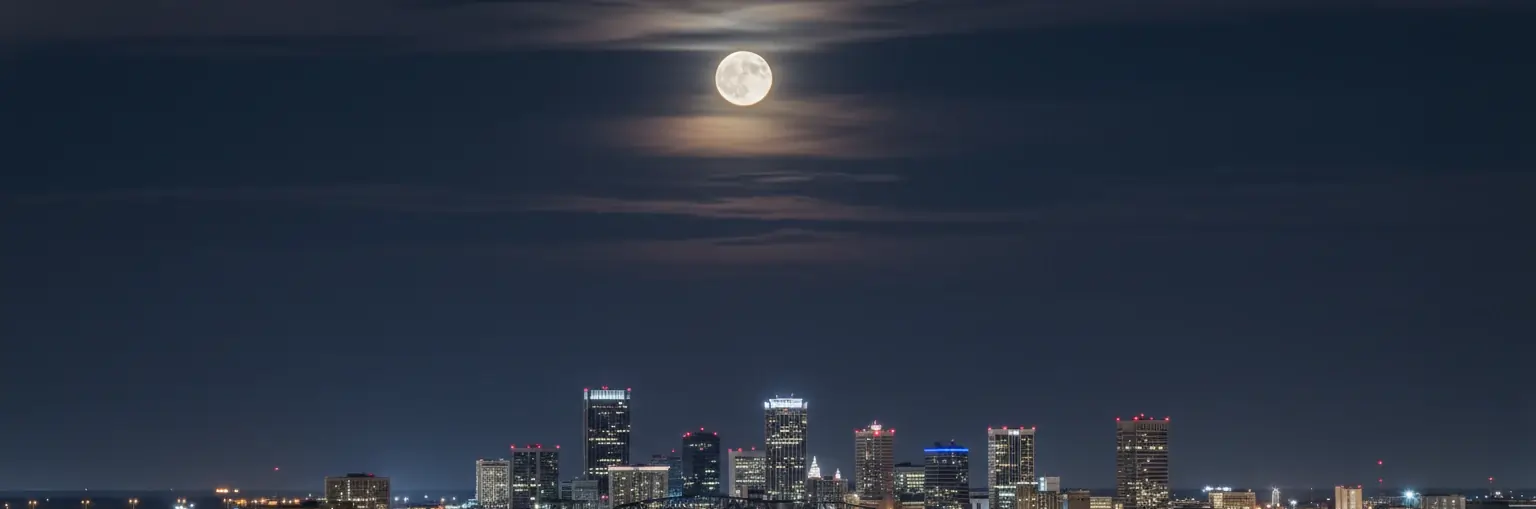
☽ Best Places to View the Moon in Baton Rouge
Baton Rouge — the Red Stick — sits on the eastern bank of the Mississippi River roughly 80 miles upriver from New Orleans, and that geography defines everything about moon photography here. The river bends through the city running roughly south to north, which means the west bank in Port Allen looks directly east across the water at the Baton Rouge skyline — and the moon rises from that same eastern direction, climbing above the city and the Louisiana State Capitol, the tallest capitol building in the United States at 450 feet. The Mississippi itself is the foreground: wide, slow, and on calm evenings capable of reflecting the Capitol's Art Deco tower and the Horace Wilkinson Bridge in a mirror as clean as any lake. Beyond the river, the Atchafalaya Basin to the west offers the opposite of the skyline — a moonrise over one of the largest river swamp ecosystems in North America, with cypress silhouettes and open water stretching to the horizon.
West Bank Levee – Port Allen
The premier Baton Rouge moonrise viewpoint. The elevated Mississippi River levee on the Port Allen side looks directly east across the river at the full downtown skyline — the Louisiana State Capitol's Art Deco tower, the Horace Wilkinson Bridge (locally called the New Bridge), and the downtown cluster all visible above the waterline. On calm evenings the river surface reflects the entire composition below. The levee crest is wide and open, giving photographers room to move and recompose as the moon tracks above the skyline. Free, open 24/7; drive or walk along the levee road for different angles and foreground options.
Louisiana State Capitol – Observation Deck
The Louisiana State Capitol is the tallest capitol building in the United States — 450 feet tall across 34 floors, built in 1932 under Governor Huey P. Long in Art Deco style. The 27th-floor observation deck overlooks the city, the Mississippi River, and the surrounding parishes in all directions. Free entry. Note: the observation deck is currently closed for renovations — check the official website before visiting. When open, this is unmatched for elevated cityscape and river shots; hours are daytime only, making it best suited for moonset rather than moonrise.
LSU Campus – Levee Paths & River Road
Louisiana State University's campus runs along the east bank of the Mississippi, and the levee trails here give open river views with the moon rising to the east behind the campus live oaks and the distant skyline glow. The broad, grassy levee slopes offer low-angle shooting positions that pull in long river reflections at the bottom of the frame. Tiger Stadium and the campus bell tower add recognisable foreground architecture for compositions looking back toward the city. Free access; parking available on campus evenings and weekends.
Baton Rouge River Center – Riverside Promenade
The Baton Rouge River Center sits on the downtown waterfront and its riverside promenade gives street-level access to the Mississippi with the skyline behind you and the USS Kidd — a Fletcher-class destroyer permanently moored as a museum ship — visible in the foreground. The moon rises to the east and tracks above the river; the Kidd's silhouette at anchor makes a dramatic foreground element at low tide. Lively at night with foot traffic from the entertainment district nearby. Free access to the promenade 24/7.
Atchafalaya Welcome Center – Whiskey Bay (I-10 West)
Approximately 20 miles west of downtown on I-10, the Atchafalaya Welcome Center sits elevated on stilts above the edges of the Atchafalaya Basin — one of the largest river swamp ecosystems in North America. The moon rises over open wetlands with cypress trees silhouetted against the eastern sky and the faint glow of Baton Rouge on the horizon behind. Darker skies than anywhere in the city; the swamp foreground is unique in American moon photography. Free, open 24/7; accessible directly from the interstate.
Highland Road Park Observatory – LSU Campus
The Highland Road Park Observatory on the southern edge of Baton Rouge hosts regular public viewing nights through the Baton Rouge Astronomical Society. The hilltop position gives elevated views across the city to the north and east, and the telescope domes add distinctive foreground architecture for moon photography. The moon's detail is extraordinary through the facility's instruments on public nights. Check the BRAS schedule for open evening dates — events are free and family-friendly, held on clear Friday evenings on a seasonal schedule.
◉ Best Times for Moon Photography
📷 Quick Photography Tips
Baton Rouge operates on CST (UTC−6) in winter and CDT (UTC−5) during daylight saving time. Clocks go forward on the second Sunday in March and back on the first Sunday in November. Louisiana observes DST statewide. Apps like PhotoPills or Stellarium set to Baton Rouge apply the correct local offset automatically — useful for planning exact moonrise alignments with the Capitol tower and the Horace Wilkinson Bridge across the seasons.
For the moon phase in any other city worldwide, visit our Dynamic Moon Phase Calculator on our home page for instant lunar data tailored to wherever you are.
The moon phase today in Baton Rouge, LA is shown in detail above — complete with exact illumination percentage, moonrise/set times, and the best local spots to see it. For the moon phase today in any other city or location worldwide, visit our Dynamic Moon Phase Calculator on the home page.
◐ What the Experience Actually Feels Like
There is a particular quality to a moonrise in Baton Rouge that you do not fully understand until you are standing on the Port Allen levee with the Mississippi in front of you and the city across the water. The river is wide here — nearly half a mile — and on a calm evening it is so still that the Capitol tower appears twice: once at 450 feet above the east bank, and once again in the water below, perfectly inverted, the Art Deco spire pointing down into the dark current. And then the moon clears the horizon to the east behind the city, rises above the Capitol's crown, and the river holds all three in one frame: the tower, its reflection, and the moon climbing above both.
Baton Rouge is not a city that announces itself to photographers the way New York or Chicago does. Its skyline is modest and compact, dominated by the one building that Huey Long insisted be taller than anything else in the state. But that building is extraordinary — an Art Deco tower that looks more like a skyscraper than a capitol, built at a 45-degree angle to the grid and visible for miles in every direction — and it gives the moonrise a focal point that rewards photographers who plan their timing carefully. From the west bank levee on a clear October evening, with the river low and glassy and the moon riding directly above the Capitol's lit summit, Baton Rouge earns its place in any serious discussion of Southern moonrise cities.
Whiskey Bay changes the conversation entirely. Driving west on I-10 out of the city, the highway rises on concrete stilts above the Atchafalaya Basin and the landscape opens up — open water, cypress knees, Spanish moss, and a darkness that the city never quite achieves. The moon rises to the east with the faint Baton Rouge glow on the horizon behind it, and in the foreground the swamp stretches in every direction, flat and quiet and vast. It is a Southern Louisiana moonrise: slow, warm, and unlike anything in the city it belongs to.
"The river holds all three in one frame: the Capitol tower at 450 feet, its reflection pointing down into the dark current, and the moon climbing above both — wide, slow Mississippi carrying the whole composition."
✓ Your Baton Rouge Moon Chase Checklist
Before You Go
- Check the moonrise time and phase on this page — the moon's alignment with the Capitol tower from the Port Allen levee shifts seasonally; use PhotoPills to find the exact date when the moon rises directly above the building
- Target the 48–72 hour window before full moon if possible — the moon rises during civil twilight and the warm Louisiana sky above the river makes the Capitol compositions most atmospheric
- Check wind and river conditions before heading to the Port Allen levee — even a light chop on the Mississippi will break the mirror reflection; calm high-pressure evenings are the only conditions that produce the doubled Capitol shot
- If planning the Capitol observation deck, check the official website first — the deck is currently closed for renovations and no reopening date has been confirmed
- For the Highland Road Observatory, check the Baton Rouge Astronomical Society schedule in advance — public nights are seasonal and weather-dependent, and sessions fill quickly on clear evenings
What to Bring
- Sturdy tripod — Mississippi River wind is persistent at the Port Allen levee and the exposed levee crest has no windbreak; heavier tripods hold far better than travel-weight options here
- A lens between 200–400mm for west bank Capitol compositions — telephoto compression from the levee puts the moon directly alongside the Capitol spire in a frame that wide angles cannot achieve
- A wide-angle lens (16–24mm) for the Atchafalaya at Whiskey Bay — the open swamp foreground and big Gulf sky reward environmental shots that include cypress silhouettes, open water, and the full eastern horizon
- Insect repellent year-round, especially at Whiskey Bay — the Atchafalaya Basin is intensely buggy in all seasons and an evening session without repellent is genuinely miserable
- Layers from November through February — river wind at the levee is cold and damp in winter, and the temperature drop after sunset along the Mississippi is sharper than it feels in the city
- A rain jacket even on clear nights — Gulf moisture moves fast in Louisiana and evening squalls can develop quickly, especially from April through October
On the Night
- Arrive at the Port Allen levee 30–45 minutes before moonrise — the eastern sky above the Baton Rouge skyline warms to amber before the moon clears the horizon, and the Capitol tower begins to glow against the darkening blue well before the moon appears
- Position yourself on the levee crest directly opposite the Capitol tower for the tightest telephoto composition — move north or south along the levee to shift the moon's position relative to the building as it rises
- Shoot RAW throughout — the combination of the lit Capitol, the moonrise glow, the dark river surface, and the reflection below requires careful blending in post; plan for at least two exposures per composition
- Stay 20–30 minutes after moonrise — as the moon climbs above the Capitol and the city lights fully activate, the skyline becomes brighter and more detailed, and the river reflection sharpens
- At Whiskey Bay, turn off all vehicle lights and wait five minutes before shooting — true dark adaptation takes time, and the swamp foreground reveals far more detail once your eyes have adjusted to the darker skies away from the interstate
? Baton Rouge Moon Phase — Frequently Asked Questions
Q. What is the moon phase today in Baton Rouge?
The moon phase today in Baton Rouge is a New Moon with 0% illumination. The next full moon is in 17 days, on Oct 25. Moonrise is at 6:07 AM and moonset at 6:08 PM.
Q. Where is the best place to view the moon in Baton Rouge?
The West Bank Levee in Port Allen is Baton Rouge's signature moonrise spot, looking east across the Mississippi River at the Louisiana State Capitol with a mirror reflection on calm evenings. The LSU campus levee paths and the River Center's riverside promenade give easier downtown access, while the Atchafalaya Welcome Center at Whiskey Bay, about 20 miles west on I-10, offers a completely different moonrise over open swamp and cypress silhouettes.
Q. Why does moon visibility change so much in Baton Rouge through the year?
Baton Rouge sits at roughly 30.5° N, so it doesn't see the extreme seasonal daylight swings of far-northern cities. What changes visibility most here is Gulf humidity: summer brings thick, warm haze that softens the moon into a large orange disc low on the horizon, while the drier air from October through March gives sharper, clearer views over the river and the Capitol skyline.
Q. When is the next full moon in Baton Rouge?
The date of the next full moon is calculated live and shown in the "Next Full Moon" card above, already adjusted for Baton Rouge's time zone.
Q. Does Baton Rouge observe daylight saving time?
Yes. Baton Rouge runs on Central Standard Time (CST, UTC−6) in winter and switches to Central Daylight Time (CDT, UTC−5) from the second Sunday in March to the first Sunday in November. All times shown on this page already account for the correct offset.
Q. What's the best time of year for moon photography in Baton Rouge?
October through March offers the clearest air, lower humidity, and the most southerly moon path for tight alignments with the Capitol tower from the Port Allen levee. September and April add mild temperatures and vivid Gulf twilight on top of that clarity, while summer's heat and humidity tend to haze the moon at the horizon.
Q. Does this page work for cities besides Baton Rouge?
This page is set up specifically for Baton Rouge, LA. For the moon phase in any other city or location worldwide, use the Dynamic Moon Phase Calculator on the moonphase.today home page.
✦ Explore Further
Moon Photography Guide
Camera settings, lenses, and techniques for shooting sharp, well-exposed moon shots.
📐Looney 11 Exposure Calculator
Dial in the exact f-stop, ISO, and shutter speed for a full moon — the same rule used in our Port Allen levee tips.
🌫️Sky Clarity Forecast
Check tonight's cloud cover and haze before heading to the levee or out to Whiskey Bay.
🌕When Is the Next Full Moon?
A running guide to upcoming full moons and what each one is traditionally called.
NASA Moon Phase & Libration Gallery
NASA's Scientific Visualization Studio's daily renders of the moon's exact phase, libration, and orientation, straight from official mission data.