
Moon Phase Today Athens
On Saturday, October 10, 2026, the moon in Athens is a New Moon with 0% illumination. Moon age: 28.9 days.
☽ Best Places to View the Moon in Athens
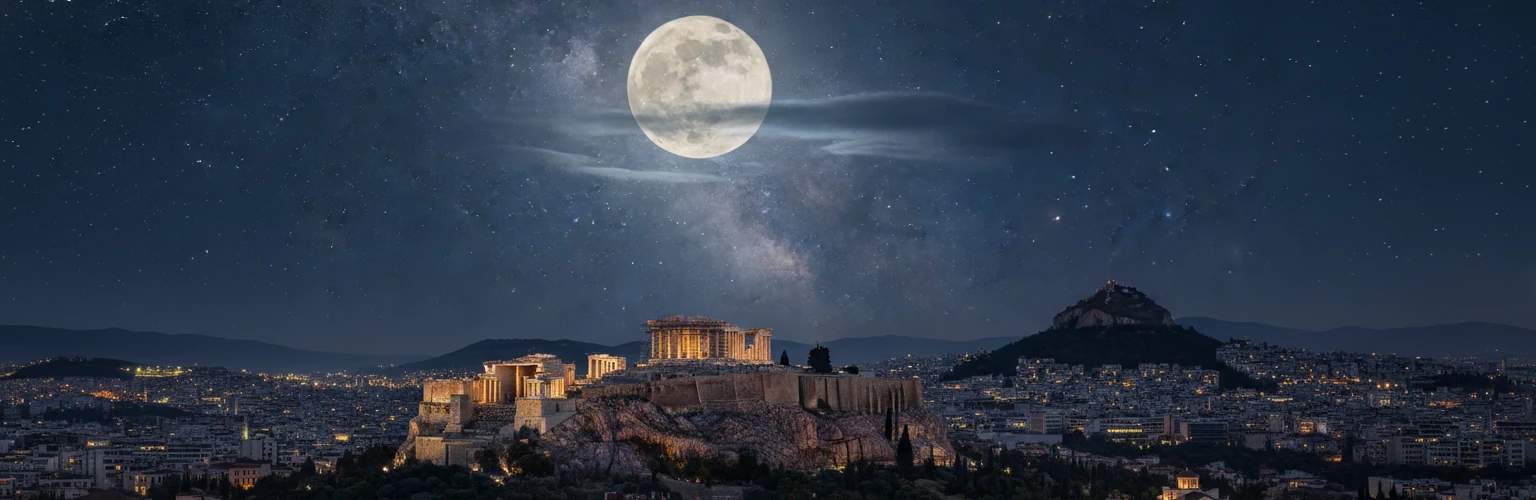
Athens’ ancient ruins, dramatic hills, and the iconic Acropolis create an eternally magical setting for moonrises. The moon often aligns perfectly with the Parthenon, offering breathtaking photographic opportunities that span millennia. The interplay of ancient stone, city lights, and celestial glow provides unique compositions. Use specialized planning apps like PhotoPills to pinpoint the exact alignment for your desired date and location. Here are the top spots for experiencing and photographing the moon in Athens (all free and accessible 24/7 unless otherwise noted, and always check specific venue hours):
Filopappou Hill (Hill of the Muses)
The absolute #1 Athens moonrise view. From this historic hill, the moon often rises dead-centre behind the illuminated Parthenon and Acropolis, beautifully framed by ancient pines. It offers panoramic city views, primarily focused on the Acropolis, providing a classic Athenian spectacle. Accessible via a short walk from Acropolis (Line 2) or Thission (Line 1) metro stations.
Areopagus Hill (Mars Hill – NW of Acropolis)
This rocky outcrop, located right below the Acropolis to its northwest, offers incredibly dramatic, close-up silhouettes of the Acropolis’s western face. The moon rises to the east, separate from the Acropolis profile, allowing for striking compositions with the ancient temples as a prominent foreground. It tends to be less crowded than Filopappou, especially after hours, providing a more intimate viewing experience.
Lycabettus Hill – St. George Chapel Viewpoint
As the highest point in central Athens (~277 m), Lycabettus offers an expansive panorama. From the viewpoint near St. George Chapel, the moon rises over the entire city, with the illuminated Acropolis perfectly centered below. Accessible by cable car or hike, there's also a restaurant at the top which generally closes late. Note that it remains within the urban light pollution environment.
Pnyx Hill
This historic assembly spot, famous as the meeting place of the Athenian democratic assembly, provides a wide open marble platform ideal for photography. The moon rises behind the Acropolis, often aligning beautifully with the Parthenon and the Propylaea gate. It’s perfect for stunning telephoto compression shots that bring the ancient temples into striking proximity.
Anafiotika – Rooftop Paths (Plaka)
This hidden, picturesque neighborhood nestled right below the Acropolis offers a unique, intimate setting. From its charming rooftop paths and narrow alleys, the moon can be framed rising between whitewashed Cycladic-style houses and directly over the Parthenon. It provides a village-like foreground that blends ancient history with traditional Greek island aesthetics.
Stavros Niarchos Cultural Center – Lighthouse (Kallithea)
Located approximately 4.5 km south of central Athens in the municipality of Kallithea, the Lighthouse at the top of the National Library building (part of the SNFCC) offers an elevated, contemporary viewing platform. The moon rises dramatically over the Saronic Gulf, with panoramic views of Athens and the majestic Acropolis in the distance. Access to the Lighthouse is free until late hours, making it a reliable evening spot for a different perspective of the city and sea.
◉ Best Times for Moon Photography
📷 Quick Photography Tips
Athens operates on EET (Eastern European Time, UTC+2) in winter and EEST (Eastern European Summer Time, UTC+3) during daylight saving time. Clocks go forward on the last Sunday in March and back on the last Sunday in October. Apps like PhotoPills or Stellarium set to Athens automatically handle the offset, ensuring accurate moonrise and moonset times for your planning.
For the moon phase in any other city worldwide, visit our Dynamic Moon Phase Calculator for instant lunar data tailored to wherever you are.
The moon phase today in Athens, Greece is shown in detail above — complete with exact illumination percentage, moonrise/set times, and the best local spots to see it. For themoon phase today in any other city or location worldwide, visit our Dynamic Moon Phase Calculator on the home page.
◐ What the Experience Actually Feels Like
There are few places on Earth where a moonrise feels as profoundly historic and magical as in Athens. Imagine standing on Filopappou Hill, the ancient pines silhouetted around you, with the illuminated Parthenon glowing majestically across the valley. As twilight deepens over the Aegean, a vast, amber orb begins its ascent, often appearing to balance perfectly on the columns of the Parthenon. For a few breathtaking minutes, you are connected to millennia of human history, witnessing a celestial spectacle that has inspired countless generations, all bathed in an ethereal, warm Greek light.
Athens offers an unparalleled diversity of viewpoints for this ancient ritual. From the raw, rocky outcrop of Areopagus Hill, you get an intimate, almost sacred perspective, with the moon seeming to rise from beyond the Acropolis. The air is often still, carrying the faint murmur of the city below. From the commanding heights of Lycabettus Hill, the experience is one of vastness, gazing down at a twinkling carpet of urban lights, with the entire Acropolis complex miniaturized beneath the dominant moon. Even from the charming, hidden alleys of Anafiotika, you might catch a glimpse of the moon framed by whitewashed walls, offering a more personal, village-like encounter with the ancient world.
The cooler months, particularly November to February, often deliver the most spectacular views. While evenings are crisp, the air is typically free of the atmospheric haze that can sometimes affect summer views. This allows for incredibly sharp lunar details and crystalline views of the ancient marble structures. The moon's more southerly path during these months can also create more dramatic and precise alignments with the Parthenon from various hilltops. Autumn brings often stable weather and beautiful, soft light before the moon takes center stage. Regardless of the season, a clear evening in Athens promises a moonrise that transcends time itself.
"A vast, amber orb begins its ascent, often appearing to balance perfectly on the columns of the Parthenon. For a few breathtaking minutes, you are connected to millennia of human history, witnessing a celestial spectacle."
✓ Your Athens Moon Chase Checklist
Before You Go
- Check the moonrise time and phase on this page — Athens’ hilly terrain and ancient landmarks demand precise planning
- Use PhotoPills or Stellarium to verify the moon's exact path and alignment with the Parthenon from your chosen hilltop on your specific date
- Target the 48–72 hour window before full moon if possible — the moon rises during civil twilight, bathing the ancient landscape in soft, balanced light
- Check weather forecasts for clear skies and low wind, essential for sharp images and comfortable viewing on exposed hills
- Note that access to the Acropolis site itself closes in the evening; all listed viewpoints are external. Lycabettus cable car has operating hours.
What to Bring
- Sturdy tripod — hill winds in Athens can be strong, especially on Filopappou and Lycabettus, requiring stability for sharp images
- A telephoto lens (200-400mm) for tight compression shots — crucial for making the moon appear large and aligned with the Parthenon
- A wide-angle lens (16-35mm) for expansive city and Acropolis panoramas, especially from Lycabettus or Filopappou
- Layers of warm clothing — evenings on the hills can be cool, even in warmer months, and especially chilly in winter
- Headlamp or flashlight — many paths on the hills (Filopappou, Areopagus, Pnyx) have limited lighting after dark
- Comfortable walking shoes — many top spots require a decent walk or hike on uneven terrain
On the Night
- Arrive at your viewpoint 30–45 minutes before moonrise — the pre-moonrise light over the ancient city and the glowing Acropolis is often breathtaking
- From Filopappou, carefully compose your shot to perfectly align the moon with the Parthenon for the classic Athens postcard view
- Shoot RAW — the extreme dynamic range between the bright moon and the illuminated Acropolis requires the flexibility of RAW files for optimal post-processing
- Stay 20–30 minutes after moonrise — as the moon climbs, the compositions shift, and the interplay of light on the ancient structures continues to evolve
- Consider visiting Lycabettus for a wide, commanding view of the moon over the entire city, with the Acropolis as a key focal point below
? Athens Moon Phase — Frequently Asked Questions
Q. What is the moon phase today in Athens?
The moon phase today in Athens is a New Moon with 0% illumination. The next full moon is in 17 days, on Oct 26. Moonrise is at 7:15 AM and moonset at 6:40 PM.
Q. Where is the best place to view the moon in Athens?
Filopappou Hill is the city's signature moonrise spot, where the moon often rises directly behind the illuminated Parthenon. Areopagus Hill gives a more dramatic, close-up silhouette of the Acropolis, Lycabettus Hill offers the highest panorama over the whole city, and Pnyx Hill or the Stavros Niarchos Cultural Center Lighthouse provide further alignments and coastal views.
Q. Why does moon visibility change so much in Athens through the year?
Athens's hilly terrain keeps most viewpoints clear of obstructions year-round, so the main factor is haze: the cooler months from October through April generally bring clearer air, while summer can carry more atmospheric haze that softens the moon and the Acropolis's outline.
Q. Does Athens observe daylight saving time?
Yes. Athens runs on EET (UTC+2) in winter and switches to EEST (UTC+3) for Eastern European Summer Time, from the last Sunday in March to the last Sunday in October. The times shown on this page are already adjusted for whichever period applies today.
Q. What's the best time of year for moon photography in Athens?
November through February offers the clearest skies and a more southerly moon path that aligns most tightly with the Parthenon from the city's hilltops. The wider cooler-season window of October through April also tends to give sharper lunar and temple detail than the hazier summer months.
Q. Does this page work for cities besides Athens?
This page is set up specifically for Athens, Greece. For the moon phase in any other city or location worldwide, use the Dynamic Moon Phase Calculator on the moonphase.today home page.
✦ Explore Further
Moon Phase Today: Alexandria, Greece
Check tonight's moon phase in Alexandria, in the Macedonian plain about 340 miles northwest.
📷Moon Photography Guide
Camera settings, lenses, and techniques for shooting sharp, well-exposed moon shots.
📐Looney 11 Exposure Calculator
Dial in the exact f-stop, ISO, and shutter speed for a full moon — the same rule used in our Parthenon alignment tips.
🌆Blue Hour Calculator
Find tonight's exact blue hour window to time your Filopappou Hill moonrise shots.
NASA Moon Phase & Libration Gallery
NASA's Scientific Visualization Studio's daily renders of the moon's exact phase, libration, and orientation, straight from official mission data.