
Moon Phase Today Anchorage
On Friday, October 9, 2026, the moon in Anchorage is a New Moon with 0% illumination. Moon age: 28.9 days.
☽ Best Places to View the Moon in Anchorage
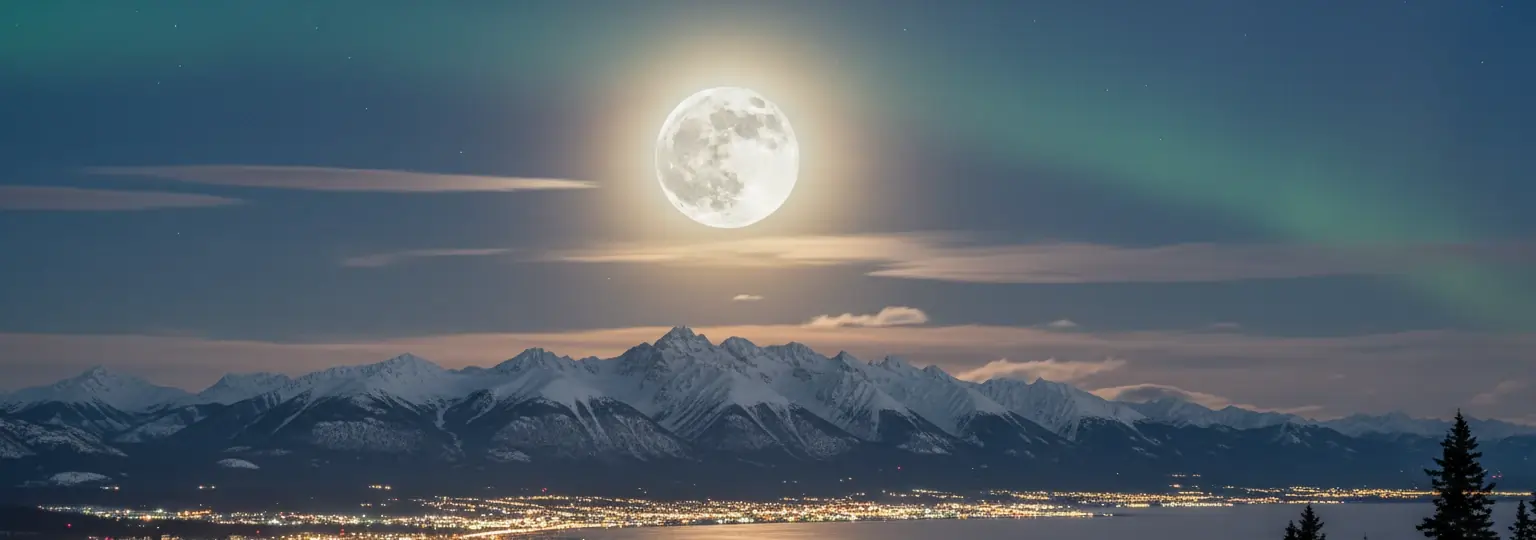
Anchorage sits at sea level on the shores of Cook Inlet, wedged between the water to the west and the Chugach Mountains — rising to over 8,000 feet — immediately to the east. It is one of the most dramatically framed cities in North America: the moon rises over the Chugach, tracks across a sky at 61° North latitude, and sets over Cook Inlet, where the second-largest tidal range in the world reshapes the mudflats every six hours. Winter brings true darkness and temperatures well below freezing; summer brings near-perpetual twilight. Neither is a bad time to photograph the moon here — they are just completely different experiences. Anchorage rewards the photographer who understands which season they are in and plans accordingly.
Earthquake Park / Point Woronzof
Earthquake Park on the western coastal bluff is the premier Anchorage moonrise viewpoint. The park sits above the mudflats of Cook Inlet and looks east over the downtown skyline toward the Chugach Range — the moon rises from behind those peaks and tracks directly above the city lights. In winter, ice pans drift across the inlet below and the mud freezes to a pale glaze. In spring and fall, the tidal mudflats reflect both the city glow and the rising moon. Free, open 24/7; the paved path along the bluff edge gives multiple compositions without moving the car.
Glen Alps Trailhead – Chugach State Park
The Glen Alps Trailhead at approximately 2,200 feet elevation sits in a natural bowl above the city, with panoramic views down across the Anchorage bowl toward Cook Inlet and the Alaska Range beyond. From here the moon rises behind you over the higher Chugach and sets in the west over the water — the full sweep of the city is below. Darker skies than the coastal parks; the Milky Way is visible on moonless nights. Parking fee approximately $5; the road is paved but can ice heavily in winter — carry chains or use a vehicle with AWD.
Kincaid Park – Coastal Bluff Trails
Kincaid Park in the southwest corner of the city offers blufftop paths above Cook Inlet with wide open western and northern horizons. The moon rises over the distant Chugach with the inlet foreground below — at low tide the mudflats extend for miles and catch the light. In winter this is one of Anchorage's premier cross-country ski venues, and a full moon ski on groomed trails through spruce forest is an experience unique to Southcentral Alaska. Free, open daily; the bluff trails are accessible year-round but icy in winter.
Flattop Mountain – Summit
The most-climbed peak in Alaska at approximately 3,510 feet, Flattop Mountain gives a genuine 360° panorama: Cook Inlet and the Alaska Range to the west, Denali visible on clear days to the northwest, the full Chugach to the east, and the entire Anchorage bowl below. The moon rises over the Chugach directly behind the summit and the city spreads 3,000 feet below — the photographic isolation here is complete. A moderate hike; scree and exposure in the final section. Trailhead parking at Glen Alps ($5). Carry microspikes from October through May.
Tony Knowles Coastal Trail – Lyn Ary Park Section
The Tony Knowles Coastal Trail runs 11 miles along the western edge of the city from downtown to Kincaid Park. The section near Lyn Ary Park gives open views across the inlet toward the Alaska Range — on clear days, Denali is visible 130 miles north. At low tide, the mudflats below the trail reflect the moon and city lights simultaneously. The trail is paved and lit near downtown; farther south it becomes darker and more exposed. Year-round access; fatbike trails branch off in winter when the mudflats freeze.
Potter Marsh Bird Sanctuary – Boardwalk
Potter Marsh, at the southern edge of the city on the Seward Highway, is a 565-acre coastal wetland with an elevated boardwalk over open water. The views look east toward the Chugach foothills and north toward the distant city skyline — the moon rises over the mountains with the marsh and its waterfowl below. In spring and autumn, migrating shorebirds and trumpeter swans use the marsh. Free, accessible year-round; the boardwalk can be icy in winter. Best visited at dusk when the light is warmest and the birds are most active.
◉ Best Times for Moon Photography
📷 Quick Photography Tips
Anchorage operates on AKST (UTC−9) in winter and AKDT (UTC−8) during daylight saving time. Clocks go forward on the second Sunday in March and back on the first Sunday in November. Alaska observes DST statewide. Apps like PhotoPills or Stellarium set to Anchorage handle the offset automatically — essential given how dramatically moonrise times shift with latitude across the seasons.
The moon phase today in Anchorage, AK is shown in detail above — complete with exact illumination percentage, moonrise/set times, and the best local spots to see it. For the moon phase today in any other city or location worldwide, visit our Dynamic Moon Phase Calculator on the home page.
◐ What the Experience Actually Feels Like
There is a particular quality to moonlight in Anchorage that is hard to describe to someone who has not stood on the coastal bluff at Point Woronzof in January. The inlet below is moving — always moving, ice pans rotating in the current, the tide dropping fast — and the moon is tracking across a sky that at this latitude in winter never quite gets as dark as you expect. Not pitch black. Something closer to deep blue, with the city glow bouncing off the snow on the Chugach and the whole scene lit from three directions at once: the moon above, the city to the right, and the reflected light coming up off the ice below.
Anchorage is at 61 degrees north, which changes the geometry of everything. The winter full moon does not arc lazily across a southern sky — it climbs high and fast, clearing the Chugach quickly and riding near the zenith for hours. In summer the opposite is true: the moon skims the horizon in a twilight that never fully resolves into night, the sky staying a pale blue-grey long past midnight. Experienced photographers learn to treat these as two completely different subjects. The winter moon is dramatic, high-contrast, ice-lit. The summer moon is subtle, contextual, a subject within a subject against a sky that cannot decide what colour it wants to be.
What Anchorage has that most cities do not is the inlet. Cook Inlet has one of the most extreme tidal ranges in the world — up to 38 feet between low and high tide in some locations — and the mudflats it exposes and covers every six hours are unlike anything in the lower 48. At low tide on a clear winter night, the flats stretch for miles from the coastal trail, pale and smooth, and the moon and the city lights reflect in the thin film of water that remains. You are essentially standing above a natural mirror, the Chugach behind you, Denali somewhere out in the dark 130 miles north, and the moon doing something completely different from whatever you planned when you left home.
"The inlet below is always moving — ice pans rotating in the current, the tide dropping fast — and the moon tracks across a sky that at this latitude never quite gets as dark as you expect. Not pitch black. Something closer to deep blue."
✓ Your Anchorage Moon Chase Checklist
Before You Go
- Check the moonrise time and phase on this page — at 61°N, the exact arc changes dramatically by season and needs to be planned, not guessed
- Target the 48–72 hour window before full moon if possible — the moon rises during civil twilight and the Chugach is still illuminated when it clears the ridge
- Check the Cook Inlet tide chart for Point Woronzof and the coastal trail — low tide reveals the mudflats and maximises reflection shots
- Check road conditions for Glen Alps and Flattop trailhead via the Alaska 511 system — the access road ices heavily from October through April
- Download PhotoPills or Stellarium set to Anchorage — the high latitude means the moon's path changes more between summer and winter than in most cities
What to Bring
- Sturdy tripod — Cook Inlet winds are strong and persistent at the coastal bluffs, especially at Point Woronzof and Kincaid
- A lens between 200–300mm for ridgeline compression shots from Glen Alps or Flattop — the Chugach peaks create a strong horizon at this range
- Serious cold-weather layers in winter — Anchorage winter temperatures regularly fall below 0°F, and waiting for moonrise on an exposed bluff accelerates heat loss fast
- Spare camera batteries in a chest pocket — cold kills lithium batteries quickly and a dead battery at the critical moment on Flattop summit is a particular kind of misery
- Microspikes or Yaktrax from October through May for any trail above the coastal path — the Glen Alps access and Flattop trail ice to glass
- A headlamp for any trails above the city — Glen Alps and Flattop have no lighting and the descent in the dark without one is genuinely dangerous
On the Night
- Arrive at your viewpoint 30–45 minutes before moonrise — the Chugach ridgeline can create a brief alpenglow before the moon clears the peaks
- At Point Woronzof, position yourself on the northern end of the bluff trail to get both the downtown skyline and the Chugach in the same frame
- Shoot RAW — the dynamic range between a bright moon, city lights, and the dark inlet requires separate exposures that are blended in post
- Stay 20–30 minutes after moonrise — the compositions evolve as the moon climbs clear of the mountains and the city lights take over as the primary foreground element
- In summer, accept that true darkness is not coming — expose for the twilight sky, not a dark one, and use the pale blue hour as the mood rather than fighting it
? Anchorage Moon Phase — Frequently Asked Questions
Q. What is the moon phase today in Anchorage?
The moon phase today in Anchorage is a New Moon with 0% illumination. The next full moon is in 17 days, on Oct 25. Moonrise is at 7:36 AM and moonset at 6:31 PM.
Q. Where is the best place to view the moon in Anchorage?
Point Woronzof and Earthquake Park, both on the Tony Knowles Coastal Trail, give wide-open views west over Cook Inlet toward the Alaska Range with little light pollution. For elevation, the Glen Alps trailhead and the trail up Flattop Mountain in Chugach State Park look out over the entire city and Turnagain Arm. Kincaid Park's chalet grounds offer a similar coastal view with easy access.
Q. Why does moon visibility change so much in Anchorage through the year?
Anchorage sits at roughly 61° N, so daylight length swings dramatically with the seasons. In summer, the sky stays bright well past midnight, which makes even a full moon hard to pick out. In winter, nights stretch to nearly 19 hours, giving the moon a long, dark stage — the same conditions that make Anchorage a well-known spot for viewing the aurora.
Q. Does Anchorage observe daylight saving time?
Yes. Anchorage runs on Alaska Standard Time (AKST, UTC−9) in winter and switches to Alaska Daylight Time (AKDT, UTC−8) from the second Sunday in March to the first Sunday in November. All times shown on this page already account for the correct offset.
Q. What's the best time of year for moon photography in Anchorage?
Late September through March offers the darkest, most reliable skies, once the long summer daylight has faded and the sky can go fully dark again. Clear, cold nights around a full moon are especially striking with fresh snow on the Chugach Mountains reflecting the moonlight. Late spring and summer moons are harder to photograph against Anchorage's bright, lingering twilight.
Q. Does this page work for cities besides Anchorage?
This page is set up specifically for Anchorage, AK. For the moon phase in any other city or location worldwide, use the Dynamic Moon Phase Calculator on the moonphase.today home page.
✦ Explore Further
Moon Photography Guide
Camera settings, lenses, and techniques for shooting sharp, well-exposed moon shots.
🌕When Is the Next Full Moon?
A running guide to upcoming full moons and what each one is traditionally called.
🌗Why Does the Moon Rise and Set?
The simple science behind moonrise and moonset, and why the timing shifts every day.
🌑How Can There Be No Moonrise One Day?
An occasional quirk of the lunar cycle that's especially noticeable at high latitudes like Anchorage's.
NASA Moon Phase & Libration Gallery
NASA's Scientific Visualization Studio's daily renders of the moon's exact phase, libration, and orientation, straight from official mission data.