
Moon Phase Today Accra
On Friday, October 9, 2026, the moon in Accra is a New Moon with 0% illumination. Moon age: 28.9 days.
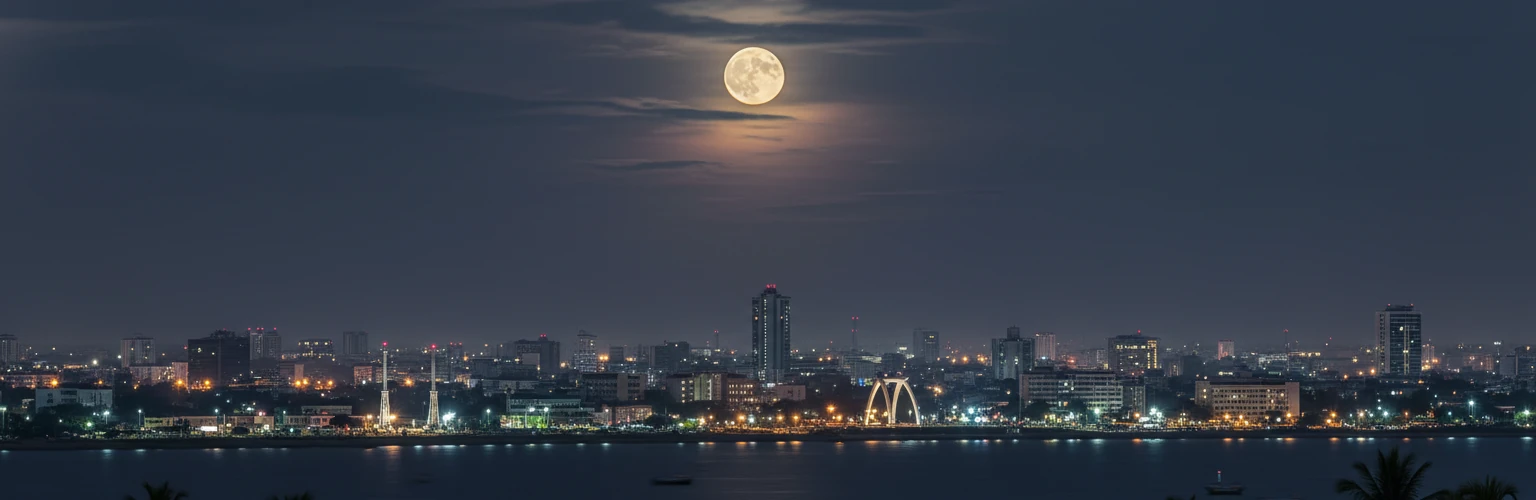
☽ Best Places to View the Moon in Accra
Accra sits at 5.5° North on the Gulf of Guinea, where the city's southern coastline faces open ocean across a flat, unobstructed horizon. The city's light pollution can challenge deep-sky observation, but the moon is bright enough to cut through almost anywhere — and Accra has something most cities can only dream of: a long, south-facing Atlantic coastline where the moon arcs high across the sky and eventually sets directly into the ocean on a flat horizon. The combination of wet sand reflections, palm tree silhouettes, and the warm ambient glow of the city makes moonset here viscerally tropical in a way that photographs rarely prepare you for. Inland, Independence Arch, the Kwame Nkrumah mausoleum, and the Aburi hilltop offer the architectural and elevated alternatives. Accra rewards the photographer who heads to the beach — the south-facing ocean horizon means every moonset ends with the moon sinking into the sea itself, while moonrise happens over the land and cityscape to the east, creating an entirely different but equally dramatic scene.
Labadi Beach (La Pleasure Beach)
Accra's most popular beach and a top moon photography spot. The coast faces south across the Gulf of Guinea, giving you a wide open ocean horizon for moonset — the moon tracks across the sky and drops directly into the Atlantic. Wet sand at low tide mirrors the moon and sky in a near-perfect reflection; palm trees and breaking waves add a foreground unique to this coastline. For moonrise, face east toward the city glow over the land — the contrast of the rising moon against Accra's amber skyline is its own kind of dramatic. Full moons draw crowds and live music, making it the most atmospheric night out in the city. Free to access the beach strip; the main entrance has a small entry fee.
Kokrobite Beach
A quieter escape about 30km west of central Accra, reached in roughly 30–45 minutes by road. The south-facing coast offers open ocean views with noticeably darker skies than Labadi — the difference is immediately visible in photographs. Rock formations along the shoreline give dramatic foreground interest for wide compositions. Far less crowded on full moon nights; a popular base for photographers who want solitude and a longer shooting window without the city lights competing.
Bojo Beach
A secluded lagoon beach reached by a short boat crossing that adds to its atmosphere. The moon reflects over still lagoon water rather than open surf — the reflections here are calmer and more graphic than the wave-disturbed shore at Labadi. Natural vegetation frames the scene on both sides. Entry fee of approximately GHS 50; the boat crossing makes it feel genuinely removed from the city even though Accra is minutes away.
Independence Square (Black Star Square)
One of the largest open plazas in Africa, with the moon rising in the east and eventually setting behind the city skyline to the west. The sheer scale of the space — wider than most European city squares — gives compositions a grandeur that smaller urban spots cannot match. The Independence Arch can be framed against the moon on certain dates in a way that rewards planning with PhotoPills. Free and accessible 24/7; the plaza's open expanse means you can reposition freely to find the framing you want.
Kwame Nkrumah Memorial Park
The historic park surrounding the mausoleum of Ghana's first president offers a lit, architecturally rich environment for moon photography. The moon tracks over the mausoleum dome and the park's central fountain — the fountain pool reflects both the moon and the building in a single frame on calm nights. The grounds are beautifully lit after dark and the surrounding gardens provide a softer, greener foreground than the hard urban surfaces of Independence Square. Entry fee applies; check seasonal evening opening hours.
Aburi Botanical Gardens
About 45 minutes to an hour's drive north of Accra in the Akuapem Hills, these elevated gardens sit at roughly 450m above sea level and offer panoramic views over the coastal plain toward the Gulf of Guinea. The moon rises to the east and arcs across a sky noticeably darker than anything closer to the city — Accra glows on the horizon below as the illuminated backdrop. A reversal of the usual perspective that rewards the drive. Entry fee applies; the gardens generally close around 6PM so an evening visit requires confirming hours in advance.
◉ Best Times for Moon Photography
📷 Quick Photography Tips
Accra operates on GMT (UTC+0) year-round with no daylight saving time. Ghana does not observe DST, so moonrise times are consistent and predictable throughout the year — there is no seasonal clock shift to account for. Apps like PhotoPills, The Photographer's Ephemeris, or Stellarium set to Accra apply the correct offset automatically and can be trusted for precise moonrise calculations any time of year.
The moon phase today in Accra, Ghana is shown in detail below — complete with exact illumination percentage, moonrise/set times, and the best local spots to see it.
◐ What the Experience Actually Feels Like
There is a particular quality to the full moon on the Accra coastline that takes most visitors completely off guard. You expect the city's light pollution to overwhelm everything — Accra is dense and bright and the sky above it glows amber on any clear night. And then you stand at the waterline at Labadi Beach and the moon climbs up from the east, enormous and amber-coloured from the humidity, and the wet sand in front of you stretches out flat and dark and reflects the whole thing back at you like a second sky below your feet. The palm trees move. The waves come in. As the night deepens, the moon tracks south across the sky toward the open ocean and eventually sets straight into the Atlantic on a perfectly flat horizon. The palm trees move. The waves come in. There is no skyline in the way — just the ocean and the moon and the reflection, and the realisation that you are standing five and a half degrees north of the equator, watching something that most of the world's photographers have never seen.
Accra at 5.5 degrees north gives the moon a high, near-vertical arc for most of the year. The full moon in November or December rides almost directly overhead by midnight — the path is so steep that the standard rules about low horizon drama barely apply. What matters here is not height but colour: the warm, humid air over the Gulf of Guinea saturates every moonrise in amber and gold that the dry continental climates further north simply cannot produce. The ocean is the compositional anchor that inland cities do not have — a single unbroken line where sky meets water, and the moon eventually sinks into it at the end of the night.
What Accra has that surprises people is stillness. At Bojo Beach, reached by a short boat crossing from the road, the lagoon behind the dune strip can be so flat on a calm night that the moon's reflection sits on it like a second moon — a perfect vertical pair, one above and one below, with the dark strip of beach between them. The boat crossing adds five minutes and costs almost nothing. What it buys you is silence, and a scene that looks less like coastal West Africa and more like something from a travel magazine that you assumed was shot somewhere further away and far more expensive to reach.
"The moon climbs enormous and amber-coloured from the east, and the wet sand reflects the whole thing back at you like a second sky below your feet — then, hours later, it sets straight into the Atlantic."
✓ Your Accra Moon Chase Checklist
Before You Go
- Check the moonrise and moonset times on this page — moonrise happens over the land and city to the east, while moonset over the open ocean to the south is the signature Accra beach shot
- Check tide times for Labadi and Kokrobite — low tide exposes the widest stretch of wet sand and produces the longest, clearest reflections; high tide narrows the reflective strip significantly
- Target November through February for the clearest, sharpest moonrises — humidity drops noticeably and the horizon sharpens in a way the rest of the year rarely allows
- Use PhotoPills or Stellarium set to Accra (GMT+0, no DST) to identify dates when the moon aligns with Independence Arch — these require planning but produce the most iconic architectural shots
- If heading to Aburi, confirm evening opening hours in advance — the gardens generally close around 6PM and the 45-minute to one-hour drive makes a wasted trip genuinely costly
What to Bring
- Sturdy tripod — the coastal sea breeze at Labadi and Kokrobite is persistent and unpredictable, and wet sand provides no stable surface for improvised resting spots
- A lens between 200–300mm for ocean compression shots — the long flat horizon rewards longer glass and the moon appears much larger against sea or skyline at telephoto distances
- Insect repellent year-round — the beach environments and the Kwame Nkrumah park grounds have significant mosquito activity after dark, particularly in the rainy season months
- A wide-angle lens for the beaches — palm tree canopies overhead, surf foreground below, and moon overhead create a classic tropical composition at shorter focal lengths
- Light, breathable clothing — Accra nights are warm and humid year-round; the beaches feel cooler than inland spots but shooting sessions can last two hours or more
- Extra storage cards — the variety of shooting positions along the Labadi shoreline alone justifies shooting generously throughout the session
On the Night
- Arrive at your beach position 30–45 minutes before moonrise — the sky to the east goes through a warm amber-to-deep-blue gradient as the moon approaches the horizon and this gradient is itself worth shooting
- At Labadi, walk further east along the shoreline away from the main entrance to find quieter stretches of beach with fewer people and cleaner foreground compositions
- Shoot RAW — the dynamic range between the bright moon, the dark ocean, and the reflected city glow in the wet sand requires exposures blended in post for the best results
- Stay for moonset too — as the moon tracks south and west across the sky it eventually drops toward the open ocean horizon, giving you the classic over-water shot that Accra's south-facing coast makes possible
- Accept that tropical humidity will soften the moon at the very horizon — shoot slightly later when it has climbed a degree or two clear of the worst haze, and use the orange warmth as mood rather than fighting it in post
? Accra Moon Phase — Frequently Asked Questions
Q. What is the moon phase today in Accra?
The moon phase today in Accra is a New Moon with 0% illumination. The next full moon is in 17 days, on Oct 26. Moonrise is at 4:45 AM and moonset at 5:06 PM.
Q. Where is the best place to view the moon in Accra?
Labadi Beach is Accra's signature moonrise spot, with the moon coming up straight out of the Gulf of Guinea over open Atlantic water. Independence Square (Black Star Square) offers a wide-open ceremonial plaza right by the coast, Kwame Nkrumah Memorial Park's gardens give a quieter, monument-framed alternative, and Jamestown Lighthouse and Osu Castle's coastal walls add further historic, harborside options.
Q. Why does the moon look the way it does in Accra?
Accra sits at just over 5° N, close enough to the equator that the moon's path across the sky stays fairly consistent through the year and climbs on a notably steep, high arc. Being right on the Gulf of Guinea coast also gives an unobstructed ocean horizon for moonrise at spots like Labadi Beach.
Q. Does Accra observe daylight saving time?
No. Ghana operates on Greenwich Mean Time (GMT, UTC+0) year-round and does not observe daylight saving time. The times shown on this page never need a seasonal adjustment.
Q. What's the best time of year for moon photography in Accra?
Late December through February, Ghana's brief dry Harmattan season, brings the clearest skies of the year, though the same season can bring a hazy dust suspension blown down from the Sahara that softens distant detail. The main rainy season runs roughly April through July, bringing heavier cloud cover.
Q. Does this page work for cities besides Accra?
This page is set up specifically for Accra, Ghana. For the moon phase in any other city or location worldwide, use the Dynamic Moon Phase Calculator on the moonphase.today home page.
✦ Explore Further
Moon Photography Guide
Camera settings, lenses, and techniques for shooting sharp, well-exposed moon shots.
📐Looney 11 Exposure Calculator
Dial in the exact f-stop, ISO, and shutter speed for a full moon over Labadi Beach.
🌆Blue Hour Calculator
Find tonight's exact (and short) equatorial blue hour window to time your Gulf of Guinea moonrise shots.
🌍World Moon Phase Directory
Browse the moon phase today in hundreds of other cities and locations around the world.
NASA Moon Phase & Libration Gallery
NASA's Scientific Visualization Studio's daily renders of the moon's exact phase, libration, and orientation, straight from official mission data.