
L99 Ina Volcanic Caldera
A three-kilometer patch of mottled terrain that may be tens of millions of years old, or three and a half billion — one of the Lunar 100’s smallest and most hotly debated targets.
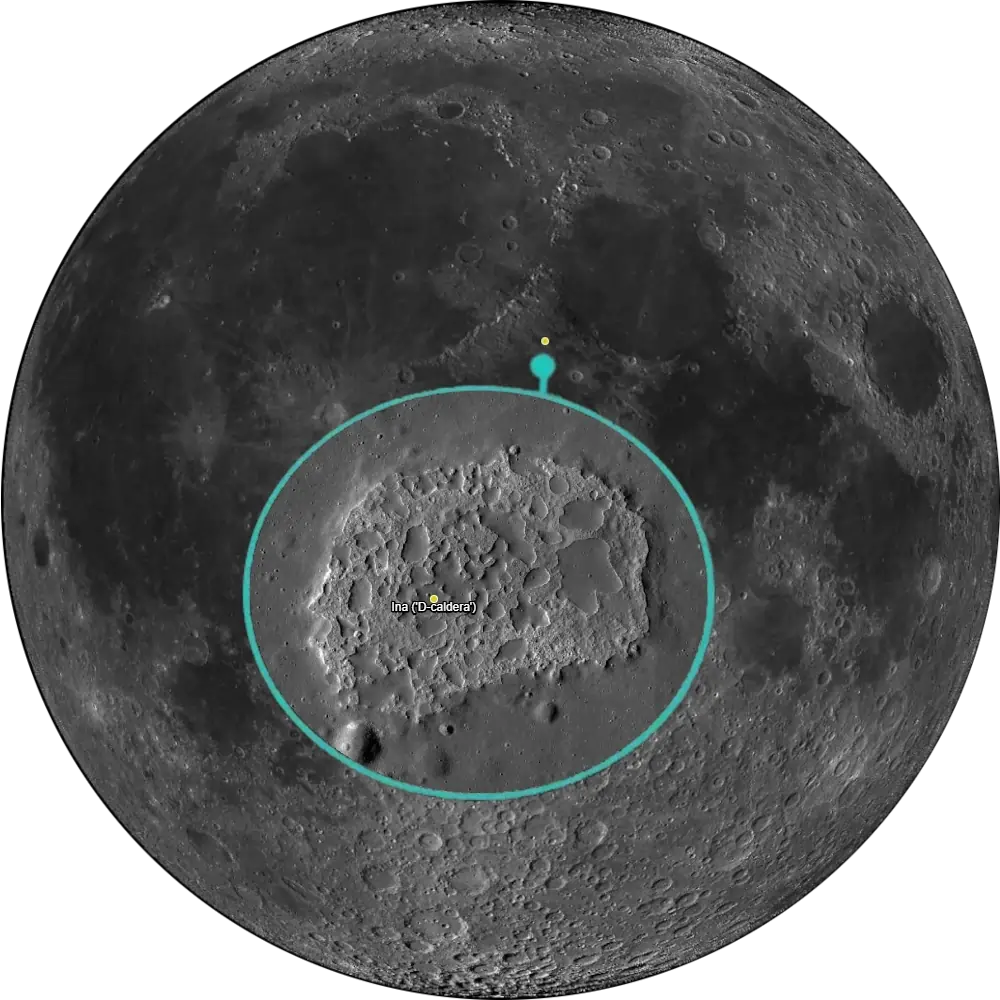
L99 Ina Volcanic Caldera
Lacus Felicitatis · Young Volcanic Feature📉 Vital Statistics
🔭 Field Notes
Ina is small — barely three kilometers across — and asks a lot of a telescope. Its floor relief is only about 64 meters deep across nearly 3 km, too shallow a slope for grazing terminator light to carve out the shadow contrast that reveals craters or domes. Experienced observers report the opposite of the usual rule: Ina’s brighter albedo actually shows up reasonably well under higher sun, once the terminator has moved past it, and the surrounding shield is if anything easier to overlook at that point, not harder. Steady seeing and high magnification matter far more here than lighting angle — visual observers have needed 300x–450x or more, often only catching the shape in brief moments of excellent seeing while letting the Moon drift through the field. What you’re looking for once you find it: a mottled floor made of two distinct textures, smoother rounded hollows set against rougher, blockier mounds.
- ▶ One of the Youngest-Looking Places on the Moon: First recognized in Apollo 15 panoramic imagery in 1971 — noted by lunar cartographer Ewen Whitaker after examining the photographs — Ina’s floor mounds show far fewer superimposed impact craters than the surrounding shield. Crater-count studies using LROC imagery put this at an eyebrow-raising 33 to 100 million years, a tiny fraction of the age of the surrounding mare terrain and dramatically younger than the conventional end of major lunar mare volcanism, roughly one billion years ago.
- ▶ A Volcano That May Be Hiding Its Age: Not everyone agrees Ina is actually young. A 2017 Brown University-led study proposed that the mounds are made of porous “magmatic foam” — a texture that could shed craters and regolith differently than solid rock, making genuinely ancient terrain (~3.5 billion years old, in this model) look deceptively fresh. The question of which picture is right remains open.
- ▶ The First of a Family: Ina was the first recognized irregular mare patch. Similar small, young-looking volcanic patches — collectively called Irregular Mare Patches, or IMPs — have since been catalogued at dozens of sites including Sosigenes, Maskelyne, and the Marius Hills; many of its relatives are identified primarily by their locations or descriptive designations.
📍 Nearby L100 Targets
- L24 Hyginus Rille: A sinuous, craterlet-marked rille roughly 330 km south, in the Mare Vaporum region — a collapse/volcanic feature of its own, offering a useful contrast in how the Moon’s interior can express itself at the surface.
- L63 Imbrium Sculpture: The radial grooves and ridges associated with the Imbrium Basin extend across a huge area of the lunar nearside, including regions west and northwest of Ina — a reminder of how much older impact-driven terrain surrounds this tiny volcanic anomaly.
- L71 Sulpicius Gallus Dark Mantle: A dark pyroclastic deposit roughly 155 km east-northeast, representing an entirely different style of volcanism — explosive fire-fountaining rather than Ina’s debated volcanic formation process.
🚀 Mission Log
Target Acquisition
Find Lacus Felicitatis, then hunt for a tiny “D”
Locate Lacus Felicitatis, the “Lake of Happiness,” a small irregular patch of mare north of Mare Vaporum and south of the Apennines. Ina sits within it, near the crater Yangel — a shallow, D-shaped depression only 2.9 x 1.9 km across, riding atop a broad, low volcanic shield so gentle it’s easy to overlook entirely. At this scale you are not looking for a crater; you are looking for a faint change in surface texture.
Don’t count on grazing light to reveal it
Ina’s floor relief is only about 64 meters deep across nearly 3 km — too shallow a slope for a low sun angle to throw the kind of shadow that works on craters or domes. Experienced observers report the opposite of the usual rule: Ina’s brighter albedo actually shows up reasonably well under higher sun, when the terminator has moved on. Don’t write off a session just because Ina isn’t near the terminator; steady seeing matters far more than lighting angle here.
Push magnification hard and wait for the air to settle
This is one of the most demanding targets in the list — observers reaching it with mid-size and large scopes have needed 300x–450x or more, and even then it typically only resolves in brief moments of excellent seeing. Try letting the Moon drift across the field at high power rather than chasing it, and watch for those instants of stillness. What you’re hunting for is subtle: a mottled floor of two textures, smoother rounded hollows set against rougher, blockier mounds.
From Ina to Hyginus Rille, Imbrium Sculpture, and Sulpicius Gallus
Roughly 330 km south, Hyginus Rille (L24) is a sinuous, craterlet-marked collapse feature in the Mare Vaporum region — a different way the Moon’s interior has expressed itself at the surface. Spanning a huge area west and northwest of Ina, the Imbrium Sculpture (L63) is radial grooves and ridges blasted out by the Imbrium impact — a reminder of how much older, violent terrain surrounds this tiny volcanic anomaly. And roughly 155 km east-northeast, the Sulpicius Gallus Dark Mantle (L71) is a dark pyroclastic deposit from explosive fire-fountaining — an entirely different style of volcanism from whatever produced Ina.
📝 Observation Log — L99 Ina Volcanic Caldera
0/4 CompleteIs Ina visible tonight?
Ina sits within Lacus Felicitatis near 18.6°N, 5.3°E, and this one breaks the usual terminator rule. At only about 64 m deep across nearly 3 km, its floor relief is too shallow for grazing light to help — instead its brighter albedo shows up better under higher Sun, once the terminator has moved on. What you’ll need most is excellent seeing and high magnification, not a particular phase.
Check Moon Phase TodayReturn to the List
Ready to find the next target? Go back to the full map to see what else is visible tonight.
← Back to Lunar 100 Map
When to Observe Ina
Most Lunar 100 targets reward chasing the terminator. Ina largely reverses the rule — its relief is so subtle that grazing light doesn’t provide the dramatic shadow cues that work on most Lunar 100 targets, and what it demands instead is extreme magnification and a long wait for the air to settle.
- Skip the Terminator, Wait for Higher Sun: Ina’s floor relief is only about 64 meters deep across nearly 3 km — too shallow a slope for a low sun angle to throw the kind of shadow that works on craters or domes. Experienced observers report the opposite of the usual rule: Ina’s brighter albedo actually shows up reasonably well under higher sun, once the terminator has moved past it.
- Push Magnification Hard: This is one of the most demanding targets in the list — observers have needed 300x–450x or more, and even then it typically only resolves in brief moments of excellent seeing. Try letting the Moon drift across the field at high power rather than chasing it, and watch for those instants of stillness.
- For Orientation: Locate Lacus Felicitatis, the “Lake of Happiness,” a small irregular patch of mare north of Mare Vaporum and south of the Apennines. Ina sits within it, near the crater Yangel.
What to Look For
Ina is a shallow, D-shaped depression only 2.9 x 1.9 km across, sitting atop a broad, low volcanic shield so gentle it’s easy to overlook entirely. At this scale you aren’t looking for a crater — you’re looking for a faint change in surface texture.
Once resolved, Ina’s floor shows a mottled surface made of two distinct textures: smoother, rounded hollows set against rougher, blockier mounds.
Ina’s floor mounds carry far fewer superimposed impact craters than the surrounding shield. Crater-count studies using LROC imagery put this at 33 to 100 million years — a tiny fraction of the age of the surrounding mare terrain, and dramatically younger than the roughly billion-year age traditionally assigned to the end of major lunar mare volcanism.
Not everyone agrees Ina is actually young. A 2017 Brown University-led study proposed that the mounds are made of porous “magmatic foam” — a texture that could shed craters and regolith differently than solid rock, making genuinely ancient terrain, around 3.5 billion years old in this model, look deceptively fresh. The question of which picture is right remains open.
The Science: An Age Nobody Has Settled
Ina’s real interest isn’t its shape but its age — or rather, the fact that two very different ages, a few tens of millions of years apart from a few billion, both remain on the table.
Vital Statistics
Located at 18.6°N, 5.3°E, on Rükl chart 22, Ina spans roughly 3 km (2.9 x 1.9 km, D-shaped) with a depth of about 64 m — very shallow relative to its width. It’s a D-shaped volcanic caldera, classed as an Irregular Mare Patch, atop a broad, gently-sloped shield volcano. The name is a descriptive designation rather than a person’s; it sits within Lacus Felicitatis, the “Lake of Happiness.” Its age is highly debated: crater counts yield a model age of roughly 33 million years, while the magmatic-foam hypothesis argues Ina’s porous surfaces produce anomalously young crater-retention ages and may actually date to about 3.5 billion years. Its L100 distinction: one of the guide’s most actively debated targets, and one of the hardest to resolve visually.
The First of a Family
Ina was the first recognized irregular mare patch. Similar small, young-looking volcanic patches — collectively called Irregular Mare Patches, or IMPs — have since been catalogued at dozens of sites, including Sosigenes, Maskelyne, and the Marius Hills; many of its relatives are identified primarily by their locations or descriptive designations.
Mission Record
Ina was first recognized in Apollo 15 panoramic imagery in 1971, noted by lunar cartographer Ewen Whitaker — though the feature could have been spotted five years earlier in Lunar Orbiter 4 imagery had a photographic flaw not obscured it. Clementine’s multi-spectral data, analyzed in a 2006 study, showed Ina’s surface had unusually immature spectral properties, adding to the evidence for a very young-looking surface. Lunar Reconnaissance Orbiter, in orbit since 2009, has enabled detailed crater counts on Ina’s mounds and topographic mapping via stereo pairs, forming the basis for both the “extremely young” interpretation and the competing magmatic-foam hypothesis.
Most Lunar 100 targets are chosen for a feature you can see. Ina was chosen for an age nobody can agree on — a debate that, unlike the crater’s own faint outline, no amount of magnification or steady seeing will settle.