
L97 Inghirami Valley
A broad, rectangular scar radial to the Orientale impact, carved in a single violent event roughly 3.8 billion years ago — legible only when favorable western libration tips this stretch of limb into view.
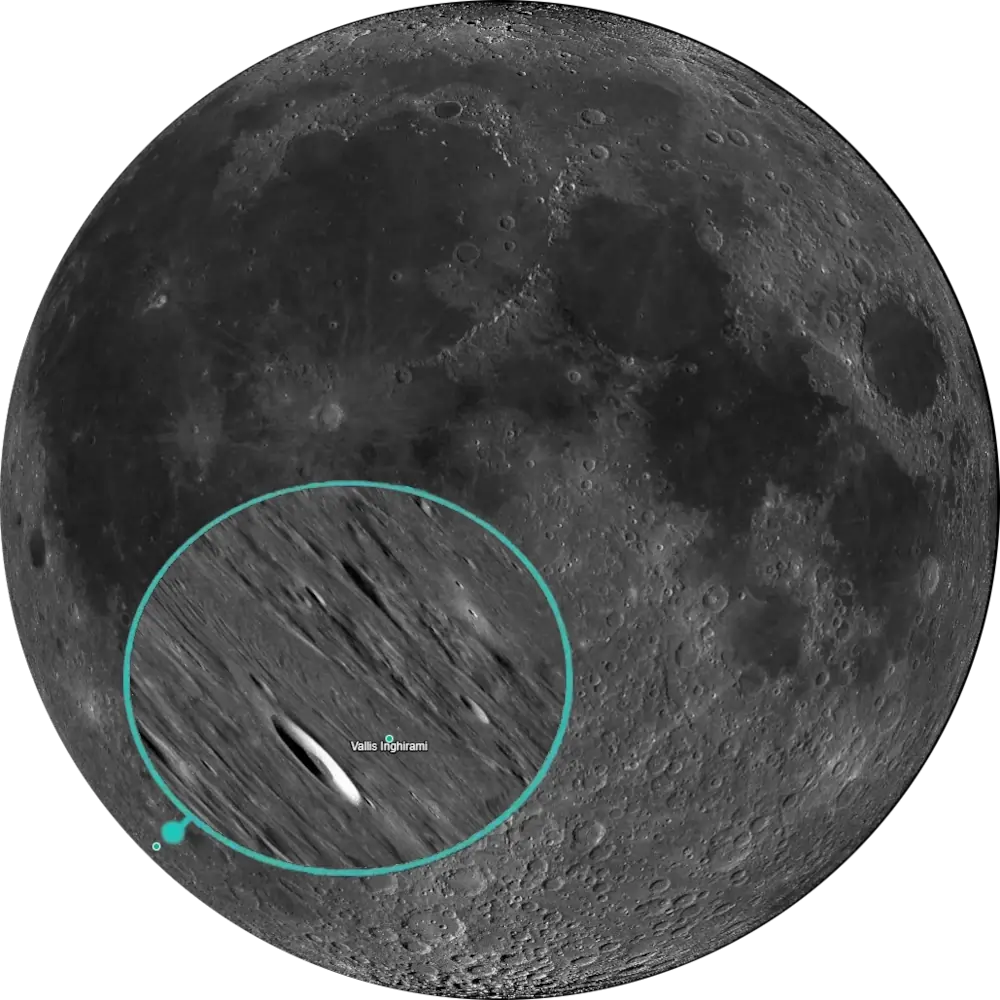
L97 Inghirami Valley
Southwestern Limb · Orientale Basin Ejecta📉 Vital Statistics
🔭 Field Notes
Inghirami Valley sits far enough west that it’s a genuine limb target whose visibility and presentation improve markedly when western libration cooperates. Once found, it doesn’t look like a river valley or a collapse rille — it’s a broad, somewhat rectangular trough, roughly 140 km long, formed by a closely spaced chain of secondary impacts from ejecta thrown out radially from the Orientale basin far to the south. Look for it running toward the crater it’s named for; under the right low-angle light you may also catch the rough, hummocky, and radial textures of the surrounding Orientale ejecta blanket.
- ▶ Written by a Single Violent Afternoon: Inghirami Valley is not an isolated volcanic or tectonic event — it’s a radial secondary-impact structure associated with the Orientale basin-forming event, roughly 3.8 billion years ago, one of the youngest and best-preserved large multi-ring basins on the Moon.
- ▶ One of a Family of Radial Valleys: Inghirami is part of a remarkable group of radial valleys and secondary-crater structures associated with Orientale. Vallis Bouvard (~284 km) and Vallis Baade (~207 km) radiate from the basin’s southeastern side, while Vallis Bohr (80 km) is another Orientale-related radial secondary-crater valley on the opposite side. Together, they’re among the clearest examples on the Moon of large-scale secondary-impact structures preserving the geometry of their parent basin.
- ▶ A Crater Along for the Ride: The valley runs toward the crater Inghirami itself, ending near its northern edge. The crater and surrounding terrain are partly mantled and modified by the rough, hummocky ejecta of Orientale’s Hevelius Formation.
📍 Nearby L100 Targets
- L39 Schickard: The large, lava-flooded walled plain roughly 385 km east, its patchy, mottled floor partly overlain and modified by material emplaced during the Orientale event.
- L43 Wargentin: The unusual, fully lava-filled “plateau crater” roughly 315 km southeast, offering a striking contrast — a crater topped off flat by lava rather than gouged into a valley by ejecta.
- L54 Hippalus Rilles: The concentric graben system roughly 1,220 km northeast, formed by subsidence around Mare Humorum — a very different mechanism from the radial secondary-impact structures seen at Inghirami.
🚀 Mission Log
Target Acquisition
Wait for a good western libration before you even try
Inghirami Valley sits far out on the southwestern limb, around 44.0°S, 73.0°W, near the crater it’s named for. At this distance from disc centre, severe foreshortening can make the valley extremely difficult to resolve, so check a libration calendar first and target a night with favourable western libration, tilting this part of the limb into better view.
Don’t expect a rille — look for a broad, straight valley
Vallis Inghirami is a broad, straight valley about 145 km long, formed as part of the complex of secondary-crater and ejecta-related structures produced by the Orientale basin-forming impact. Scan for a wide, shallow depression running toward the crater Inghirami rather than hunting for a thin winding line.
Use low-angle light to bring out the surrounding texture
Once you’ve located the valley itself, catching it near the terminator pays off twice over — it throws enough shadow to define the trough’s edges, and it also brings out the rough, hummocky, radial texture of the Hevelius Formation, the Orientale ejecta blanket draped across the whole region. That surrounding texture can help confirm you’re looking at the right stretch of terrain.
From Inghirami to Schickard, Wargentin, and the Hippalus Rilles
Roughly 385 km east, Schickard (L39) is a huge, lava-flooded walled plain whose patchy floor was partly overlain by material thrown out during the same Orientale event that carved Inghirami. About 315 km southeast, Wargentin (L43) is an unusual crater filled almost to the rim with lava or ejecta, a striking contrast to a valley shaped by the Orientale impact’s ejecta and secondary craters rather than topped off by flow. And roughly 1,220 km northeast, the Hippalus Rilles (L54) are concentric graben formed by subsidence around Mare Humorum — a completely different mechanism from the radial secondary-impact structures seen here.
📝 Observation Log — L97 Inghirami Valley
0/4 CompleteIs Inghirami Valley visible tonight?
Inghirami Valley sits far out on the southwestern limb near 44.0°S, 73.0°W, radial to the Orientale basin. Severe foreshortening makes it a genuine libration target first: check for favorable western libration before you even try. Once it’s in view, catching it near the terminator adds a second payoff — enough shadow to define the trough’s edges clearly.
Check Moon Phase TodayReturn to the List
Ready to find the next target? Go back to the full map to see what else is visible tonight.
← Back to Lunar 100 Map
When to Observe Inghirami Valley
Inghirami Valley combines two separate observing challenges — it’s a genuine limb target fighting severe foreshortening, and once you’ve found it, it needs the right light to read as a valley rather than a smear of terrain.
- Wait for a Good Western Libration Before You Even Try: Inghirami Valley sits far out on the southwestern limb, around 44.0°S, 73.0°W. At this distance from disc centre, severe foreshortening can make the valley extremely difficult to resolve, so check a libration calendar first and target a night with favourable western libration, tilting this part of the limb into better view.
- Use Low-Angle Light to Bring Out the Texture: Once you’ve located the valley, catching it near the terminator pays off twice over — it throws enough shadow to define the trough’s edges, and it also brings out the rough, hummocky, radial texture of the Hevelius Formation, the Orientale ejecta blanket draped across the whole region.
- For Orientation: Look for the valley running toward the crater it’s named for, Inghirami, near the southern end of its length.
What to Look For
Don’t hunt for a thin, winding line. Inghirami is a broad, somewhat rectangular trough roughly 140 km long, formed by a closely spaced chain of secondary impacts rather than any kind of collapse or flow. Scan for a wide, shallow depression rather than a rille.
Inghirami Valley isn’t an isolated volcanic or tectonic feature — it’s a radial secondary-impact structure carved by ejecta thrown out during the Orientale basin-forming event roughly 3.8 billion years ago, one of the youngest and best-preserved large multi-ring basins on the Moon.
Inghirami is part of a remarkable group of radial valleys and secondary-crater structures associated with Orientale. Vallis Bouvard (~284 km) and Vallis Baade (~207 km) radiate from the basin’s southeastern side, while Vallis Bohr (80 km) is another Orientale-related radial secondary-crater valley on the northern side of the region, near the crater Einstein. Together, they’re among the clearest examples on the Moon of large-scale secondary-impact structures preserving the geometry of their parent basin.
The valley runs toward the crater Inghirami itself, ending near its northern edge. The crater and surrounding terrain are partly mantled and modified by the rough, hummocky ejecta of Orientale’s Hevelius Formation.
The Science: A Basin’s Geometry, Written in Ejecta
Inghirami Valley isn’t valuable for what it is on its own so much as for what it belongs to — a family of radial structures that together let you read the Orientale impact’s geometry directly off the surrounding terrain.
Vital Statistics
Located at 44.0°S, 73.0°W, on Rükl chart 61, Inghirami Valley runs roughly 140 km long. It’s a broad valley formed from a closely spaced chain of secondary impacts, radial to the Orientale impact basin. It’s named from the nearby crater Inghirami, itself honoring Giovanni Inghirami, an Italian astronomer and priest, with the name IAU-approved in 1964. It formed during the Orientale basin-forming event, roughly 3.8 billion years ago, near the end of the Early Imbrian epoch. Its L100 distinction: a textbook example of a basin-ejecta secondary-crater valley, best seen under favorable western libration.
A Family That Preserves Basin Geometry
Inghirami is one of a family of radial valleys produced by the Orientale basin-forming event. Vallis Bouvard and Vallis Baade radiate from the basin’s southeastern side, while Vallis Bohr lies on the northern side of the region near the crater Einstein. Together, they preserve the geometry of the impact that made them, making Inghirami less a curiosity and more a readable piece of one of the youngest large multi-ring basins on the Moon.
Mission Record
Lunar Orbiter IV, in 1967, provided the first systematic photographic coverage used to map the Hevelius Formation and the radial secondary-crater structures associated with Inghirami Valley and related valleys. Clementine’s 1994 multispectral and topographic data added broader compositional and geologic context for the Orientale basin and its ejecta. Lunar Reconnaissance Orbiter, in orbit since 2009, has combined high-resolution WAC and NAC imagery with LOLA altimetry to enable detailed re-mapping of the distinct ejecta facies around Orientale, including the secondary-crater-chain valleys that make up this target.
Most Lunar 100 targets are chosen for a single feature. Inghirami was chosen as one voice in a chorus — a single radial valley that, alongside Bouvard, Baade, and Bohr, spells out the shape of the violence that made them all during the Orientale impact event roughly 3.8 billion years ago.