
L95 Procellarum Basin
The largest impact structure ever proposed on the Moon, or simply a rift-bounded volcanic province — a live scientific argument written across the whole dark expanse of Oceanus Procellarum, not a feature you can frame in an eyepiece.
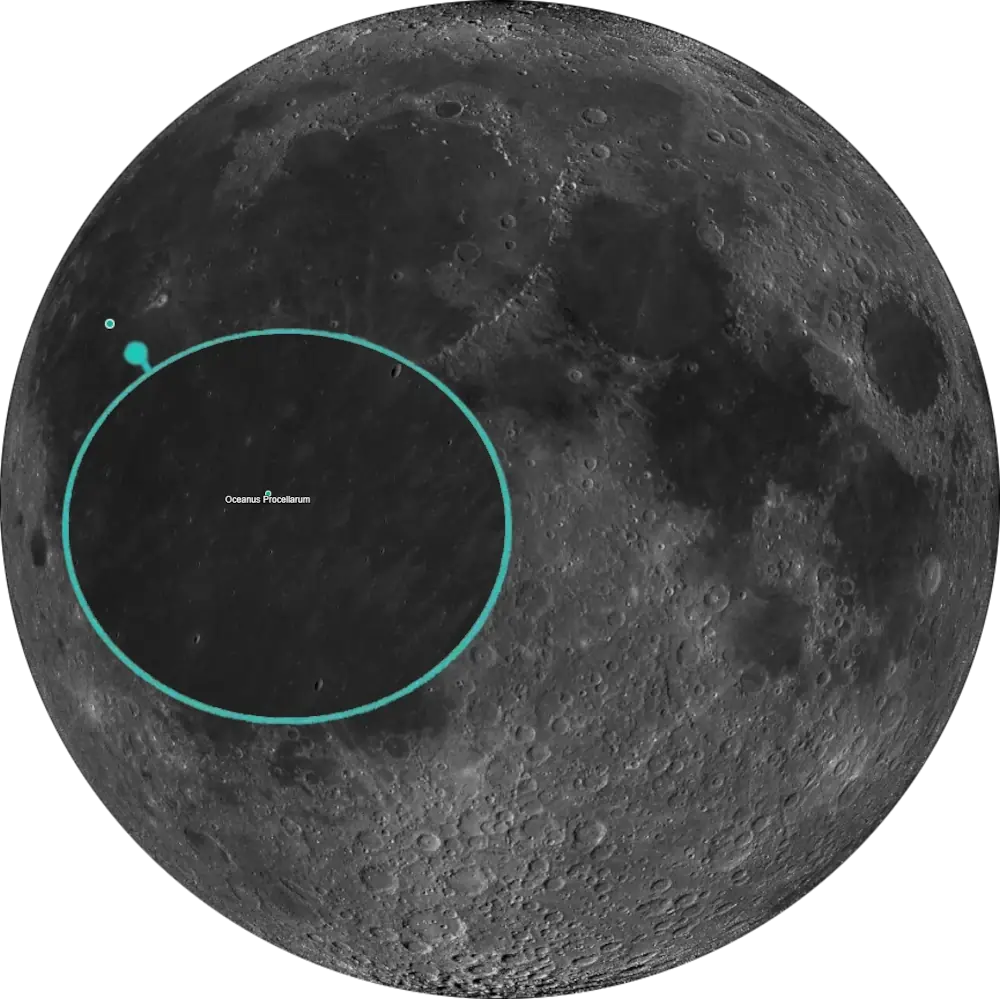
L95 Procellarum Basin
Nearside · The Moon’s Biggest Basin?📉 Vital Statistics
🔭 Field Notes
There is no obvious crater rim to point a telescope at here — Procellarum is too vast and too old to show up as a bowl-shaped feature at all. What draws it into the Lunar 100 is the broad, low-lying, thin-crusted province underlying Oceanus Procellarum itself, the largest dark patch on the nearside. If it really is an impact basin, at roughly 3,200 km across it would be the largest recognized impact structure on the Moon, exceeding even the South Pole–Aitken basin on the far side. The question mark in its L100 title is not decorative: whether Procellarum is a basin at all remains genuinely unsettled among lunar scientists.
- ▶ A Basin Inferred From Geophysics: Unlike younger basins with obvious rings of mountains and hummocky ejecta, Procellarum shows no such surface signature — any rim or ejecta blanket would have been eroded and buried over billions of years. Its case rests instead on a combination of subsurface and remote-sensing evidence: regional patterns of crustal thinning, gravity anomalies, low topography, and geochemical and mineralogical signatures, each cited by different researchers as consistent with an ancient impact origin.
- ▶ What GRAIL Actually Found: NASA’s GRAIL mission mapped a border of linear gravity anomalies around the region, interpreted by Andrews-Hanna and colleagues as frozen lava-filled rifts and feeder dikes rather than the remnants of an impact basin rim. Crucially, these anomalies trace a rough rectangle with angular corners, not the circular or elliptical outline expected of an impact structure — the researchers argued this pattern favors a magmatic-tectonic origin, driven by heat and cooling stresses, over a giant impact.
- ▶ The Case for Impact Isn’t Dead: Other researchers point to compositional evidence — widespread exposures of low-calcium pyroxene ringing the region, interpreted as lower-crust or mantle material possibly excavated by a giant impact — as support for Procellarum being a real impact scar. Some authors have suggested it may even relate to the Moon’s nearside–farside asymmetry, though this remains highly speculative. Skeptics such as P. H. Schultz have argued the supposed basin rings are better explained as later structures related to the Imbrium impact, and the informal name “Gargantuan Basin” appeared in a few papers before “Procellarum Basin” became the more widely used term.
- ▶ The KREEP Connection: Much of the region coincides with the Procellarum KREEP Terrane, an area unusually enriched in potassium, rare-earth elements, and phosphorus — heat-producing radioactive elements that likely kept the underlying mantle warm and prolonged mare volcanism here for hundreds of millions of years longer than elsewhere on the Moon. Whether that enrichment is a cause or a consequence of Procellarum’s origin is itself part of the ongoing debate.
📍 Nearby L100 Targets
- L11 Aristarchus: The brightest large crater on the Moon, sitting on its namesake plateau well within the Procellarum region’s northern reaches. Rather than being merely “nearby,” Aristarchus and its volcanic plateau are themselves part of the terrain this basin hosts.
- L17 Schröter’s Valley: The Moon’s largest sinuous rille, carved into the same Aristarchus Plateau, again squarely inside the Procellarum footprint. Its fire-fountain volcanism is exactly the kind of activity the region’s thin crust and elevated heat flow are thought to have enabled.
- L42 Marius Hills: A dense cluster of volcanic domes and cones further south within Oceanus Procellarum, among the best evidence anywhere on the Moon for sustained, concentrated basaltic volcanism. Whatever Procellarum’s origin turns out to be, the Marius Hills are a direct product of the same magma-rich province.
🚀 Mission Log
Target Acquisition
Stop looking for a rim — this target is the whole dark half of the disc
Center your attention on 23.0°N, 15.0°W, but understand this isn’t a crater you can frame in an eyepiece. Procellarum is best “found” by simply looking at Oceanus Procellarum itself — the Moon’s largest mare region — and recognizing that some researchers have interpreted its footprint as the surface expression of a buried, ancient impact basin roughly 3,200 km across. There’s no bowl, no ring of mountains, and no ejecta blanket left to see; billions of years have erased any surface trace, and whether a basin is really there at all remains unsettled.
Observe the parts, not the whole
Since Procellarum itself has no visible boundary, the practical way to “observe” it is by tracking down the volcanic features scattered across its interior that mark it as an unusually hot, thin-crusted province. Look for the bright ejecta of Aristarchus crater, the dark sinuous scar of Schröter’s Valley nearby, and the crowded dome fields of the Marius Hills — all of it sitting within the broad Procellarum region, and all of it evidence of the sustained volcanism this region’s crust allowed.
Know what’s actually being debated before you go looking
This is one L100 target where the interest is entirely conceptual rather than visual. GRAIL’s gravity mapping revealed a border of linear anomalies around the region — but they trace a rough rectangle with angular corners, not the round or elliptical outline expected of an impact basin, which is why some researchers read them as buried volcanic rifts rather than a basin rim. The impact-basin interpretation hasn’t simply vanished, though — other geological and compositional evidence has been used to argue that a large ancient basin may still be involved. Go in knowing you’re looking at a live scientific argument, not a settled feature.
Aristarchus, Schröter’s Valley, and the Marius Hills — all inside the region
Aristarchus (L11), one of the Moon’s brightest and most reflective large craters, sits on its namesake plateau well within Procellarum’s northern reaches — not merely nearby, but part of the terrain this region hosts. Schröter’s Valley (L17), the Moon’s largest sinuous rille, cuts across that same volcanic plateau and sits within a region famous for its ancient lava flows, vents, and explosive pyroclastic deposits. And the Marius Hills (L42), a dense cluster of volcanic domes and cones further south within Oceanus Procellarum, offer some of the best evidence anywhere on the Moon for sustained, concentrated basaltic activity tied to this same magma-rich province.
📝 Observation Log — L95 Procellarum Basin
0/4 CompleteIs Procellarum Basin visible tonight?
There’s no rim or edge here to catch in favorable light — Procellarum isn’t a libration or terminator target the way most of this list is. What you can time is a look at its constituent features: Aristarchus and Schröter’s Valley show best under low-angle light near the terminator, and the same lighting brings out the subtle relief of the Marius Hills domes further south.
Check Moon Phase TodayReturn to the List
Ready to find the next target? Go back to the full map to see what else is visible tonight.
← Back to Lunar 100 Map
When to Observe Procellarum Basin
There’s no rim to wait for and no libration window that helps. This is one L100 target where the interest is entirely conceptual rather than visual — you’re not observing a feature so much as recognizing one.
- Stop Looking for a Rim: Procellarum is best “found” by simply looking at Oceanus Procellarum itself, the Moon’s largest mare region, and recognizing that some researchers have interpreted its footprint as the surface expression of a buried, ancient impact basin roughly 3,200 km across. There’s no bowl, no ring of mountains, and no ejecta blanket left to see; billions of years have erased any surface trace.
- Observe the Parts, Not the Whole: Since Procellarum itself has no visible boundary, the practical way to “observe” it is by tracking down the volcanic features scattered across its interior that mark it as an unusually hot, thin-crusted province — the bright ejecta of Aristarchus crater, the dark sinuous scar of Schröter’s Valley, and the crowded dome fields of the Marius Hills.
- For Orientation: Center your attention around 23.0°N, 15.0°W, but understand this isn’t a crater you can frame in an eyepiece — it’s a province you recognize by its parts, not a target you resolve in one view.
What to Look For
Unlike younger basins with obvious rings of mountains and hummocky ejecta, Procellarum shows no such surface signature. If an ancient impact basin lies beneath Procellarum, any original rim and ejecta signature has been heavily modified, buried, or overprinted by billions of years of volcanism and later impacts. Its case rests instead on a combination of subsurface and remote-sensing evidence: regional patterns of crustal thinning, gravity anomalies, low topography, and geochemical and mineralogical signatures, each cited by different researchers as consistent with an ancient impact origin.
NASA’s GRAIL mission mapped a border of linear gravity anomalies around the region, interpreted by Andrews-Hanna and colleagues as frozen lava-filled rifts and feeder dikes rather than the remnants of an impact basin rim. Crucially, these anomalies trace a rough rectangle with angular corners, not the circular or elliptical outline expected of an impact structure — the researchers argued this pattern favors a magmatic-tectonic origin, driven by heat and cooling stresses, over a giant impact.
Other researchers point to compositional evidence — including widespread low-calcium pyroxene exposures across the Procellarum region, interpreted by some as possible lower-crust or mantle material excavated by a giant impact — as support for Procellarum being a real impact scar. Some authors have suggested it may even relate to the Moon’s nearside–farside asymmetry, though this remains highly speculative. Skeptics such as P. H. Schultz have argued the supposed basin rings are better explained as later structures related to the Imbrium impact, and the informal name “Gargantuan Basin” appeared in a few papers before “Procellarum Basin” became the more widely used term.
Much of the region coincides with the Procellarum KREEP Terrane, an area unusually enriched in potassium, rare-earth elements, and phosphorus — radiogenic heat-producing elements that likely contributed to the region’s unusually long-lived and intense mare volcanism. Whether that enrichment is a cause or a consequence of Procellarum’s origin is itself part of the ongoing debate.
The Science: The Moon’s Biggest Basin?
The question mark in this target’s own name is not decorative. Whether Procellarum is a basin at all remains genuinely unsettled among lunar scientists, which makes it less a place to look at than an argument to understand.
Vital Statistics
Centered around 23.0°N, 15.0°W, with no Rükl chart designation, Procellarum Basin would span roughly 3,200 km in diameter if the impact interpretation is correct. It’s named for Oceanus Procellarum, the “Ocean of Storms.” Its type is disputed: either a giant impact basin or a rift-bounded volcanic province. Its hypothesized age, if it is an impact structure, is Early Pre-Nectarian, roughly 4.3–4.4 billion years. Its L100 distinction is stated as a question: the Moon’s biggest basin?
Two Explanations, One Province
If it really is an impact basin, at roughly 3,200 km across it would be the largest recognized impact structure on the Moon, exceeding even the South Pole–Aitken basin on the far side. But GRAIL’s rectangular, angular-cornered gravity anomalies read to many researchers as buried volcanic rifts rather than a circular basin rim, favoring a magmatic-tectonic origin instead. Neither side has closed the case: compositional evidence some cite as impact-excavated mantle material keeps the impact hypothesis alive, while skeptics argue the same features are better explained as products of the later Imbrium impact.
Mission Record
The Lunar Orbiter Program’s photography in 1966–67 documented the broad, dark expanse of Oceanus Procellarum, though nothing in the imagery alone hinted at a giant basin underlying it. Clementine’s 1994 multispectral and topographic data, followed by Lunar Prospector’s 1998–99 gamma-ray, neutron, and gravity measurements, established Procellarum as an unusually anomalous geochemical and geophysical province, including its high concentration of heat-producing elements and the distinctive Procellarum KREEP Terrane. The twin GRAIL spacecraft, in 2011–2012, mapped the Moon’s gravity field in unprecedented detail, revealing the rectangular pattern of buried rift structures at the heart of the modern debate over whether Procellarum is an impact basin or a rift-bounded volcanic province.
Most Lunar 100 targets are chosen for a feature you can see. Procellarum was chosen for a feature nobody can point to at all — a province so large and so old that the only evidence for its violent origin, if it has one, is buried in the Moon’s gravity field and crustal chemistry rather than written on its surface.