
L93 Dionysius Rays
An unremarkable-looking young ray crater hiding a genuinely unusual secret: a symmetrical system of dark rays running alongside its bright ones, unnoticed through centuries of telescopic observation — visible only under the high Sun near Full Moon.
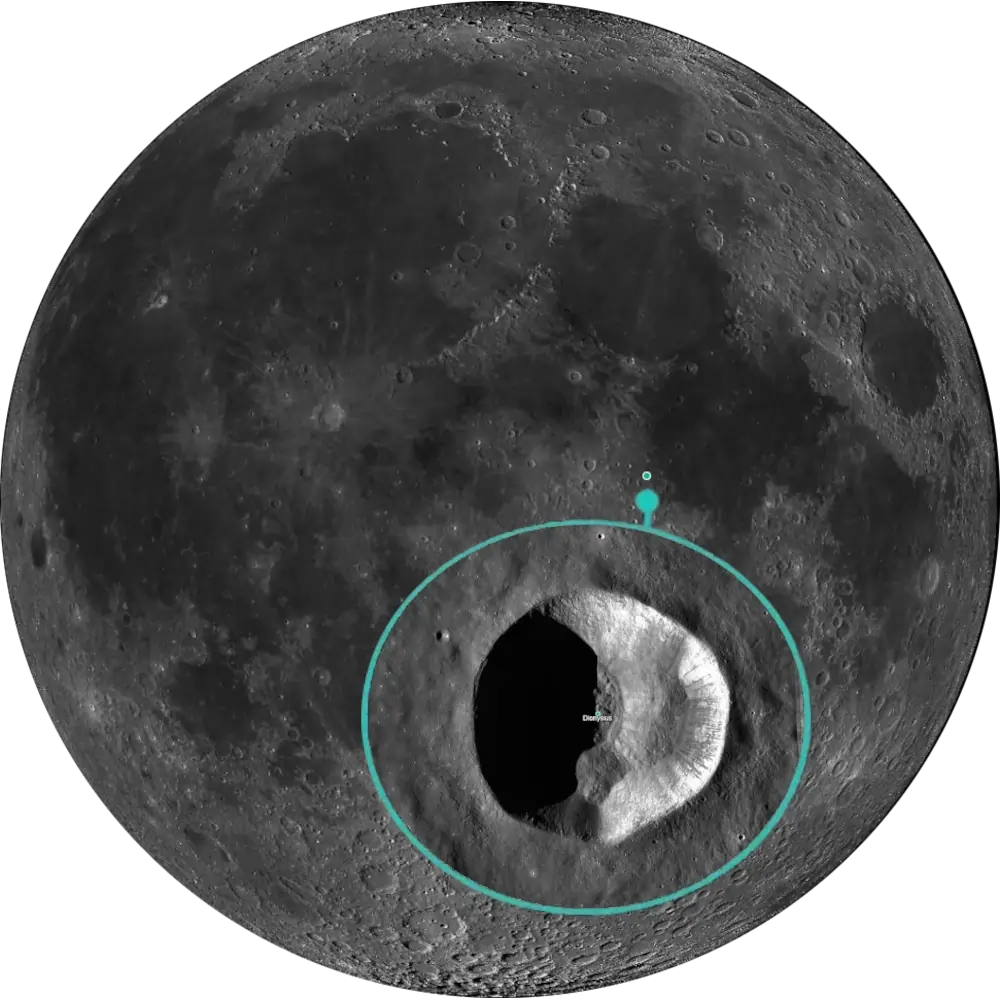
L93 Dionysius Rays
Western Mare Tranquillitatis · Unusual Dark Rays📉 Vital Statistics
🔭 Field Notes
Dionysius is a small, sharp-rimmed crater on the western shore of Mare Tranquillitatis, near the boundary with Sinus Medii — an easy, high-albedo target at Full Moon and, on first glance, an unremarkable young ray crater like countless others. What makes it a Lunar 100 object is what surrounds it: alongside its bright rays, Dionysius throws out a symmetrical system of dark rays, a genuinely rare combination that was overlooked entirely until 1965, despite the crater itself having appeared in lunar maps long before its name was standardized by the IAU in 1935.
- ▶ Hidden in Plain Sight: Dionysius is bright enough to be one of the most conspicuous small craters on the near side under high Sun, yet its unusual dark ray system went unreported for hundreds of years of telescopic observation. It was Vern Smalley’s dedicated photographic study in 1965 that first drew attention to the dark rays running alongside the crater’s brighter ejecta, and dark ray systems of this kind remain among the rarest classes of lunar ray systems.
- ▶ A Decades-Long Composition Debate: Early researchers proposed two competing origins for the dark rays: glassy impact melt thrown out during the collision, or dark primary ejecta excavated intact from the target site. Clementine multispectral data analyzed by Giguere and colleagues in 2006 provided strong evidence that the dark rays consist predominantly of excavated mare basalt debris rather than impact melt. Most lunar impacts excavate brighter material from beneath a weathered surface; Dionysius is unusual because its impact reached a darker basalt layer buried beneath lighter surroundings, reversing the normal brightness pattern.
- ▶ A Window Into Buried Lava: The source of the dark material is believed to be a buried, iron-rich mare basalt layer exposed in Dionysius’s own inner wall — a slice of pre-impact lava flow that the crater excavated and flung outward as ejecta. Small linear clefts, the Rimae Dionysius, run northwest from the crater, and the exposed wall itself offers a rare cross-section through the layered basalt beneath this part of Mare Tranquillitatis.
📍 Nearby L100 Targets
- L38 Sabine & Ritter: A near-twin pair of older, degraded craters roughly 75 km southeast, long used as a textbook comparison pair for studying crater wall slumping and floor infill. They sit close enough to Dionysius to fall in the same field of view at moderate magnification.
- L50 Cayley Plains: The light plains unit that gives the Cayley Formation its name lies roughly 75 km northwest, nearby Dionysius. Ironically, Dionysius’s own dark rays cut directly across this bright plains material, giving observers a direct visual contrast between the two units in a single view.
- L29 Ariadaeus Rille: A long, straight tectonic graben roughly 170 km northwest, cutting across the highlands north of Dionysius. Unlike the sinuous, volcanically carved rilles elsewhere on the Moon, Ariadaeus formed by crustal faulting — a useful contrast to Dionysius’s own volcanically sourced dark rays despite the two features sitting in the same general neighborhood.
🚀 Mission Log
Target Acquisition
Easy to find, easy to dismiss — that’s the trap
Locate Dionysius at 2.8°N, 17.3°E, on the western edge of Mare Tranquillitatis near its boundary with Sinus Medii. This small, sharp-rimmed crater is bright and conspicuous at Full Moon, and at first glance looks like just another young ray crater. Don’t stop at the obvious bright rays — the real target here is what runs alongside them.
Hunt for dark rays layered in with the bright ones
Look for a symmetrical system of dark rays extending outward from the crater to a radius of more than 130 km, running alongside and sometimes crossing the more typical bright ejecta. This combination is genuinely rare among lunar ray systems. It was Vern Smalley’s detailed photographic study in 1965 that first drew focused scientific attention to how unusual the dark rays were. Take your time scanning close to the crater rim rather than expecting the dark rays to jump out at you immediately.
Time it for high Sun, then compare with the Cayley Plains nearby
A high Sun angle brings out both ray systems most clearly, so plan for a session near Full Moon rather than near the terminator. Once you’ve picked out the dark rays, compare them with the bright Cayley-type plains deposits to the northwest — the contrast gives you a side-by-side view of two very different surface materials in the same region.
From Dionysius to Sabine & Ritter, the Cayley Plains, and Ariadaeus Rille
Roughly 75 km southeast, Sabine & Ritter (L38) form a well-known crater pair in the western Mare Tranquillitatis region — an easier, more conventional target to compare with Dionysius’s unusual ray system, close enough to share a field of view at moderate magnification. About 75 km northwest, the Cayley Plains (L50) give the Cayley Formation its name, with Dionysius’s own dark rays running across this bright plains material. And roughly 170 km northwest, the Ariadaeus Rille (L29) is a long, straight tectonic graben formed by crustal faulting — a useful contrast to Dionysius’s own impact-related dark ray system, despite sitting in the same general neighborhood.
📝 Observation Log — L93 Dionysius
0/4 CompleteAre Dionysius’s dark rays visible tonight?
Dionysius sits on the western edge of Mare Tranquillitatis near 2.8°N, 17.3°E, and both its bright and unusual dark ray systems are easy to overlook at the wrong phase. You’ll want a night near Full Moon, when the high Sun brings out the full ray pattern extending past 130 km — under a low terminator, both ray systems lose their contrast against the surrounding terrain.
Check Moon Phase TodayReturn to the List
Ready to find the next target? Go back to the full map to see what else is visible tonight.
← Back to Lunar 100 Map
When to Observe Dionysius
This is one L100 target that hides its real interest behind something ordinary-looking. The trap is stopping at the obvious.
- Easy to Find, Easy to Dismiss: Dionysius sits on the western edge of Mare Tranquillitatis near its boundary with Sinus Medii, at 2.8°N, 17.3°E. This small, sharp-rimmed crater is bright and conspicuous at Full Moon, and at first glance looks like just another young ray crater. Don’t stop at the obvious bright rays — the real target runs alongside them.
- Time It for High Sun: Plan a session near Full Moon rather than near the terminator. A high Sun angle brings out both the bright and dark ray systems most clearly; under a low terminator the rays lose their contrast against the surrounding terrain.
- For Orientation: Center your search around 2.8°N, 17.3°E, and don’t rush past it on the way to something flashier — the crater itself is unremarkable, but what surrounds it is genuinely rare.
What to Look For
Dionysius is bright enough to be highly conspicuous under high Sun, yet its unusual dark ray system attracted little scientific attention until Vern Smalley’s detailed photographic study in 1965, which first drew notice to the dark rays running alongside the crater’s brighter ejecta.
Look for a symmetrical system of dark rays extending outward from the crater to a radius of more than 130 km, running alongside the more typical bright ejecta — an unusual combination among lunar ray systems. Take your time scanning close to the crater rim rather than expecting the dark rays to jump out at you immediately.
Once you’ve picked out the dark rays, compare them with the bright Cayley-type plains deposits to the northwest, where Dionysius’s own dark rays run directly across the lighter plains material — a side-by-side view of two very different surface units in a single field of view.
Look for the dark, iron-rich unit exposed high on Dionysius’s inner wall — probably a buried mare deposit and the source of the mafic debris excavated by the impact. Then scan northwest toward the nearby Rimae Ritter system, whose generally northwest-trending clefts form another notable feature in the surrounding Mare Tranquillitatis terrain.
The Science: A Decades-Long Composition Debate
Most lunar impacts excavate brighter material from beneath a weathered surface. Dionysius is unusual because its impact excavated dark, mafic material from an iron-rich unit probably present at or near the pre-impact surface, producing rays that contrast sharply with the brighter surrounding ejecta — and it took decades of study to work out why.
Vital Statistics
Centered at 2.8°N, 17.3°E on Rükl chart 35, Dionysius is an 18 km crater with a ray system extending past 130 km. It’s named for Dionysius the Areopagite, a 1st-century Athenian judge and Christian saint. Its type is a small, fresh Copernican-age crater, and its L100 distinction is its unusual and rare dark rays.
Two Origins, One Set of Rays
Early researchers proposed two competing origins for the dark rays: glassy impact melt thrown out during the collision, or dark primary ejecta excavated intact from the target site. Clementine multispectral data analyzed by Giguere and colleagues in 2006 provided strong evidence that the dark rays consist predominantly of excavated mare basalt debris rather than impact melt, tracing the material to a buried, iron-rich lava layer exposed in the crater’s own inner wall.
Mission Record
Vern Smalley’s earth-based photographic study in 1965 first drew scientific attention to Dionysius’s unusual dark ray system, work that predates any spacecraft imagery of the crater. Lunar Orbiter 5 provided some of the first detailed orbital views of Dionysius and its surrounding terrain in 1967. Clementine’s multispectral imaging in 1994 later supplied the compositional data behind the 2006 Giguere et al. study that identified the dark rays as mare basalt debris.
Most Lunar 100 ray craters are chosen for a single, obvious signature. Dionysius was chosen for a signature that ran alongside the obvious one for centuries without being noticed — a reminder that the most interesting feature isn’t always the one that catches your eye first.