
L92 Gyldén Valley
A nearly erased ghost crater just north of the Ptolemaeus chain, notable only for the shadow-filled valley cutting its western rim — one visible strand of the vast Imbrium sculpture radiating across the highlands — visible only near First or Last Quarter, before the low Sun climbs too high.
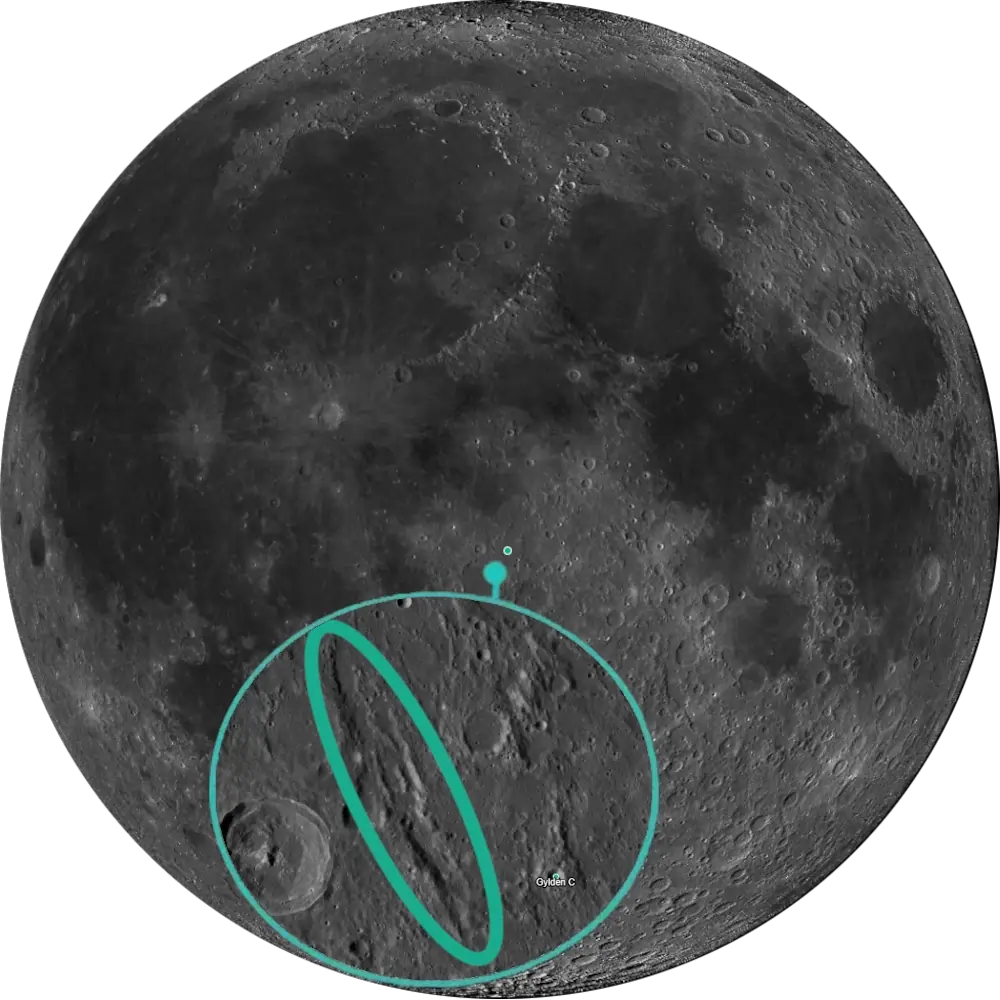
L92 Gyldén Valley
Central Highlands · Imbrium Radial Sculpture📉 Vital Statistics
🔭 Field Notes
Gyldén itself is a modest, lava-flooded remnant crater near the prime meridian, named for the Finland-Swedish astronomer Hugo Gyldén and easy to overlook among the far more famous Ptolemaeus-Alphonsus-Arzachel-Albategnius chain just to its south. What earns it a place on the Lunar 100 is not the crater but a pronounced valley running along its western rim — one visible remnant of a vast radiating pattern of grooves and ridges scored across this entire stretch of highland terrain by the impact that formed the Imbrium basin.
- ▶ A Crater Almost Erased: Gyldén has been so heavily flooded by mare basalt and degraded by billions of years of subsequent impacts that it barely reads as a crater at all in ordinary lighting. The valley cutting across its western rim is informally designated Vallis Gyldén by lunar researcher Danny Caes, a name never adopted by the IAU — most of the radial grooves in this region remain officially unnamed. Under low Sun the valley appears as a narrow, shadow-filled groove running roughly north-south across Gyldén’s western rim, while under higher illumination it nearly disappears into the surrounding highlands.
- ▶ The Imbrium Sculpture: Geologist G. K. Gilbert coined the term “Imbrium sculpture” in 1893 for this radiating pattern of grooves and ridges, which he interpreted as evidence that the Moon’s basins formed by giant impacts rather than some other process. Similar radial texture appears for hundreds of kilometers around Mare Imbrium, and the Ptolemaeus-Alphonsus-Arzachel-Albategnius neighborhood happens to sit squarely within its reach.
- ▶ Grooves With a Debated Origin: Researchers have long argued over whether this radial texture reflects deep fractures in the crust or a shallower, ejecta-related process. A 1976 study by James Head measuring the orientation of crater rim segments across the region found no systematic link between those segments and the Imbrium radial pattern, an argument that the observed grooves are better explained as surface expressions of basin ejecta and secondary cratering than as deep crustal faulting.
📍 Nearby L100 Targets
- L28 Hipparchus: A large, ancient, heavily degraded crater roughly 135 km east, part of the same central highland neighborhood the Imbrium sculpture cuts across. Its worn walls make an instructive contrast with the sharper, younger craters nearby.
- L61 Mösting A: A small, sharp-rimmed simple crater roughly 200 km west, prized as a well-defined reference point close to the center of the visible disk. It offers a useful visual counterpoint to Gyldén’s own worn, nearly erased profile just a short distance away.
- L75 Ptolemaeus B: A “ghost crater” some 145 km southwest, buried beneath later flooding on the floor of Ptolemaeus and visible only as a faint rise under low-angle light. It shares Gyldén’s basic story of a once-sharp crater rim now nearly swallowed by later infill.
🚀 Mission Log
Target Acquisition
Anchor on the Ptolemaeus chain, then look just north
Find the unmistakable Ptolemaeus–Alphonsus–Arzachel–Albategnius chain sitting near the center of the disc — one of the most recognizable landmarks on the Moon. The actual L100 target, Vallis Gyldén, is a valley on the rim of the modest, lava-flooded 47 km crater Gyldén just north of that chain, sitting almost exactly on the prime meridian — use the crater to navigate, but the valley is what you’re after. It’s easy to skip past on the way to somewhere flashier; slow down here rather than sliding straight through to Ptolemaeus.
Time it to First or Last Quarter, not just any low terminator
Gyldén sits close enough to 0° longitude that its local sunrise falls almost exactly at First Quarter, and its local sunset falls almost exactly at Last Quarter — this crater’s terminator crossings are unusually predictable because of where it sits on the globe, rather than something you need to hunt for night to night. Catch it within a day or so of either quarter phase, when the shadow-filled groove along its western rim stands out; under higher sun the valley all but disappears into the surrounding highlands.
Don’t assume the first valley you see is the right one
At 150x–250x, scan Gyldén’s western rim for a shadow-filled valley trending roughly toward Imbrium to the north — this is Vallis Gyldén, an unofficial name, and the surrounding highlands are genuinely riddled with similar gouges, scrapes, and crater chains all radiating from the same direction. Even experienced observers have second-guessed which groove is the intended L100 feature — one visual account describes finding an “obvious” valley on the west rim, then second-guessing it and relocating a different one by coordinates alone — so don’t be surprised if the terrain looks “nicked up” well beyond Gyldén itself. That’s the Imbrium sculpture doing what it does across this entire region.
From Gyldén to Hipparchus, Mösting A, and Ptolemaeus B
Roughly 135 km east, Hipparchus (L28) is a large, ancient, heavily degraded crater in the same central highland neighborhood — its worn walls a useful contrast against sharper, younger craters nearby. About 200 km west, Mösting A (L61) is a small, sharp-rimmed simple crater prized as a well-defined reference point near disc center — the opposite of Gyldén’s nearly erased profile. And roughly 145 km southwest, Ptolemaeus B (L75) is a “ghost crater” buried on the floor of Ptolemaeus, its rim visible only as a faint rise under low-angle light — a different flavor of near-invisibility than the exposed, eroded valley at Gyldén.
📝 Observation Log — L92 Gyldén Valley
0/4 CompleteIs Gyldén Valley visible tonight?
Gyldén sits just north of the Ptolemaeus chain near 5.4°S, 0.2°E, close enough to the prime meridian that its local sunrise falls near First Quarter and its local sunset falls near Last Quarter. You’ll want a night near First or Last Quarter, when the shadow-filled valley along its western rim stands out — under higher Sun it nearly disappears into the surrounding highlands.
Check Moon Phase TodayReturn to the List
Ready to find the next target? Go back to the full map to see what else is visible tonight.
← Back to Lunar 100 Map
When to Observe Gyldén Valley
This is one L100 target you can navigate to using a landmark far more famous than itself. The actual prize is easy to slide right past on the way to somewhere flashier.
- Anchor on the Ptolemaeus Sequence, Then Look Just North: Find the unmistakable Ptolemaeus–Alphonsus–Arzachel sequence near the center of the disc, with Albategnius nearby to the east, then look just north to the modest, lava-flooded 48 km crater Gyldén, sitting almost exactly on the prime meridian. Use the crater to navigate, but the valley on its rim is what you’re after.
- Time It Around First or Last Quarter: Gyldén sits close enough to 0° longitude that its local sunrise falls near First Quarter and its local sunset near Last Quarter. Catch it near either phase, when the shadow-filled groove along its western rim stands out; under higher Sun the valley nearly disappears into the surrounding highlands.
- For Orientation: Center your search around 5.4°S, 0.2°E, but understand this crater is mostly a signpost — the science lives in the faint valley cutting its western rim, not the crater itself.
What to Look For
Gyldén has been so heavily flooded by mare basalt and degraded by billions of years of subsequent impacts that it barely reads as a crater at all in ordinary lighting. Under low Sun the valley cutting across its western rim appears as a narrow, shadow-filled groove running roughly north-south, while under higher illumination it nearly disappears into the surrounding highlands.
At 150x–250x, scan Gyldén’s western rim for a shadow-filled valley — this is the informally named Vallis Gyldén. The surrounding highlands are riddled with similar gouges and crater chains, so double-check by coordinates rather than assuming the first obvious groove is the right one.
Geologist G. K. Gilbert coined the term “Imbrium sculpture” in 1893 for this radiating pattern of grooves and ridges, which he interpreted as evidence that the Moon’s basins formed by giant impacts rather than some other process. Similar radial texture appears for hundreds of kilometers around Mare Imbrium, and the Ptolemaeus-Alphonsus-Arzachel-Albategnius neighborhood happens to sit squarely within its reach.
Researchers have long argued over whether this radial texture reflects deep fractures in the crust or a shallower, ejecta-related process. A 1976 study by James Head found no systematic evidence for deep radial fractures in crater rims, supporting an external, ejecta-related origin for the pattern rather than deep crustal faulting.
The Science: A Valley With No Official Name
The valley has no official IAU name, and most of the grooves in this neighborhood remain officially unnamed altogether. What’s not in question is that Gyldén’s valley is one visible strand of a much larger story written across the highlands north of Ptolemaeus.
Vital Statistics
Centered at 5.4°S, 0.2°E on Rükl chart 44, Gyldén is a 48 km crater roughly 1.8 km deep. It’s named for the Finland-Swedish astronomer Hugo Gyldén (1841–1896). Its type is a remnant, or “ghost,” crater with a radial valley, and its L100 distinction is its place within the Imbrium radial sculpture.
Deep Fracture or Surface Scour?
The valley cutting Gyldén’s western rim, informally called Vallis Gyldén by lunar researcher Danny Caes, is one visible remnant of the radial grooves and ridges G. K. Gilbert named the “Imbrium sculpture” in 1893. Whether that pattern reflects deep crustal fractures radiating from the Imbrium impact, or a shallower process tied to ejecta and secondary cratering, was tested by James Head in 1976: measuring the orientation of crater-rim segments across the region, he found no systematic link to the radial pattern — evidence favoring an external, ejecta-related origin over deep faulting.
Mission Record
Lunar Orbiter 4 photography in 1966–67 captured detailed views of Gyldén and the surrounding Imbrium sculpture terrain, supporting later geologic mapping of the radial groove pattern. Apollo 12’s oblique Hasselblad photography from lunar orbit in 1969, including frames AS12-50-7431 and AS12-50-7432, provided useful oblique views of Gyldén and the surrounding cratered terrain. Apollo 16’s north-looking mapping camera photographed Gyldén under differing sun angles in 1972, including frames AS16-M-0843 and AS16-M-1407, aiding later identification of this otherwise difficult-to-recognize crater.
Most Lunar 100 targets are named for what they are. Gyldén’s valley is named for the person who first singled it out — a reminder that not every feature on this list has been formally claimed by the Moon’s official mapmakers, even the ones with a real scientific debate attached to them.