
L90 Armstrong, Aldrin & Collins
Three tiny satellite craters east of Sabine and Ritter, renamed in 1970 to honor Apollo 11’s crew — among the very few lunar craters ever named for people who were still living.
L90 Armstrong, Aldrin & Collins
South Mare Tranquillitatis · Apollo 11 Landmarks📉 Vital Statistics
🔭 Field Notes
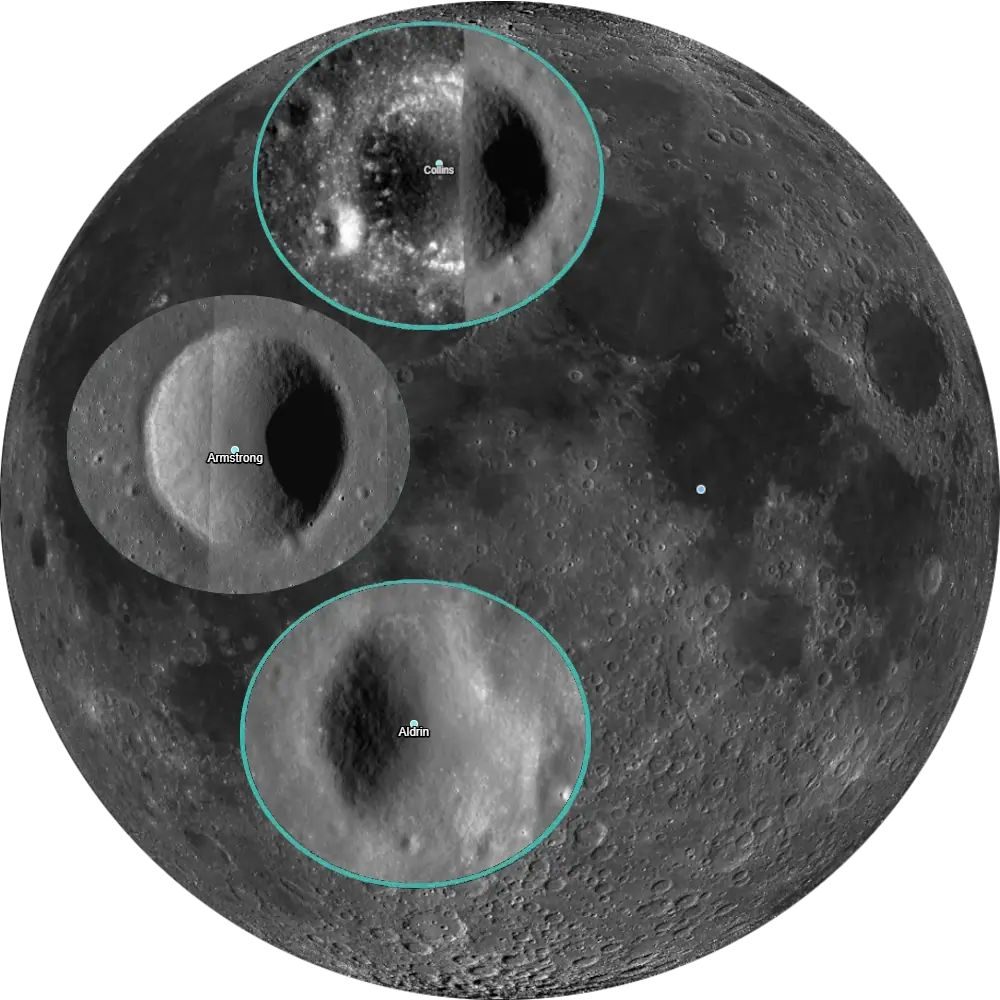
Three tiny craters strung in a row across the southern floor of Mare Tranquillitatis, east of Sabine and Ritter, honor the crew of Apollo 11. Aldrin sits westernmost, Collins in the middle, and Armstrong to the east — all three small enough that a telescope of about 150 mm (6 inches) or larger, under good lighting and excellent seeing, is typically needed to pick them out. Before their 1970 renaming, all three were just lettered satellite craters of Sabine, and rather than naming a single crater after Neil Armstrong, the IAU commemorated the entire crew by assigning their names to this trio of adjacent satellites near the landing site — one of the rare exceptions to the IAU’s long-standing practice of naming lunar craters only after the deceased.
- ▶ From Letters to Names: Armstrong, Aldrin, and Collins were originally designated Sabine E, Sabine B, and Sabine D respectively, before the IAU formally adopted their current names in 1970, honoring the crew barely a year after the mission itself.
- ▶ Part of the Landing Landscape: The three craters weren’t yet named at the time of the mission and were far too small to serve as descent references — Apollo 11’s approach path crossed the Sabine–Ritter region instead, with these craters becoming part of the historic landing landscape only after the fact.
- ▶ Small But Findable: Ritter and Sabine dwarf them, each measuring about 30 km across, yet all three are within reach of a modest amateur telescope under favorable lighting — a rewarding hunt precisely because of how easy they are to overlook.
📍 Nearby L100 Targets
- L32 Arago Alpha & Beta: A pair of low volcanic shield domes to the north, in western Mare Tranquillitatis — confirmed volcanic constructs that make a useful contrast with this trio, whose own craters are impact features rather than anything volcanic.
- L38 Sabine & Ritter: The matched pair of 30 km floor-fractured craters to the west that Armstrong, Aldrin, and Collins were once lettered satellites of, before their 1970 renaming split them off as their own distinct trio.
- L53 Lamont: A buried “ghost” basin further west, visible only as a faint ring of wrinkle ridges under favorable illumination — a feature that can seem almost invisible, much like this trio rewards patient, low-sun observing to pick out.
🚀 Mission Log
Target Acquisition
Start at Sabine and Ritter, then head east
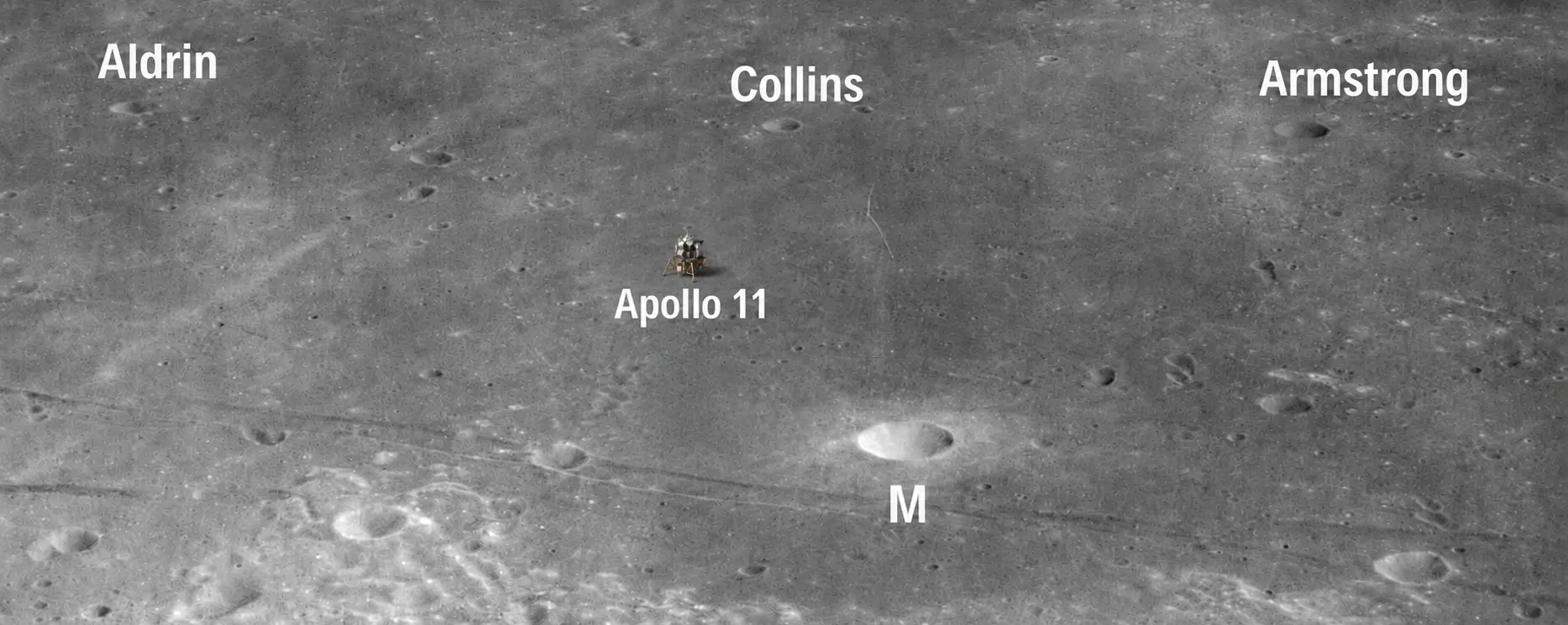
Find the matched pair of 30 km craters Sabine and Ritter on the southern shore of Mare Tranquillitatis — a distinctive, easy-to-spot landmark near disc center. Armstrong, Aldrin, and Collins sit east of that pair, roughly ten times smaller and strung out in a rough line: Aldrin closest to Sabine and Ritter, Collins in the middle, and Armstrong farthest east, nearer the lone crater Moltke.
Time it within a day or two of local sunrise or sunset
These craters are small enough that lighting angle matters as much as aperture. Aim for within a day or two of the terminator crossing this part of Mare Tranquillitatis — either the waxing side (local sunrise) or the waning side (local sunset) works. Under high Sun the trio flattens into the surrounding mare and becomes very difficult to pick out even in larger scopes.
Triangulate off Moltke, then push the magnification up
A 150 mm (6″) scope can theoretically reach all three under good seeing, but don’t expect an easy scan — start at ~150x–200x to pick out Armstrong first (the least difficult of the three), using the small, bright-rimmed crater Moltke just to its south as an anchor point. For Aldrin and Collins, push up toward 300x if seeing allows, and work back west toward Sabine and Ritter — Collins in particular can be the toughest to separate from the surrounding floor.
From the Apollo 11 trio to Arago Alpha & Beta, Sabine & Ritter, and Lamont
To the north, in western Mare Tranquillitatis, Arago Alpha & Beta (L32) are a pair of low volcanic shield domes — confirmed volcanic constructs, a useful contrast with this trio’s impact origin. Just west, Sabine & Ritter (L38) are the matched pair of floor-fractured craters that Armstrong, Aldrin, and Collins were once lettered satellites of, before their 1970 renaming split them off as their own distinct group. And further west still, Lamont (L53) is a buried “ghost” basin visible largely as a faint ring of wrinkle ridges under favorable illumination — another feature, like this trio, that rewards patient, low-sun observing.
📝 Observation Log — L90 Armstrong, Aldrin & Collins
0/4 CompleteAre Armstrong, Aldrin & Collins visible tonight?
These three tiny craters sit east of Sabine and Ritter on the southern floor of Mare Tranquillitatis, near 1.3–1.4°N, 22–25°E. At only 2.4 to 4.6 km across, they need low, grazing light within a day or two of the terminator — under a high Sun they flatten into the mare and vanish, even in larger scopes. Bring at least a 6-inch scope and start with Armstrong, the easiest of the three.
Check Moon Phase TodayReturn to the List
Ready to find the next target? Go back to the full map to see what else is visible tonight.
← Back to Lunar 100 Map
When to Observe Armstrong, Aldrin & Collins
Unlike bright ray systems or albedo features that show up best under a high Sun, these tiny craters demand low-angle lighting. Near the terminator, their shadows reveal them; under a high Sun they almost disappear.
- Time It to the Terminator: Aim for within roughly one to two days of local sunrise or sunset crossing this stretch of Mare Tranquillitatis — either the waxing or waning side works. Miss that window and the trio becomes very difficult to pick out even in larger scopes.
- Bring at Least a 6-Inch Scope: A 150 mm (6″) telescope can theoretically reach all three under good lighting and excellent seeing, though don’t expect an easy scan — this is a real hunt even with the right aperture and timing.
- For Orientation: Find the matched 30 km pair Sabine and Ritter on the southwestern edge of Mare Tranquillitatis, an easy landmark near disc center. The trio sits east of them, roughly ten times smaller, strung out toward the small bright-rimmed crater Moltke.
What to Look For
Aldrin sits closest to Sabine and Ritter, Collins in the middle, and Armstrong farthest east, nearer Moltke. All three were once lettered satellite craters of Sabine — Sabine B, D, and E — before their 1970 renaming split them off as their own distinct group.
Start around 150x–200x and use Moltke, just south of Armstrong, as an anchor point. At 4.6 km, Armstrong is generally the easiest of the three to pick out.
Push toward 300x if seeing allows. Aldrin, at 3.4 km, is a step down in difficulty from Armstrong, but Collins — the smallest of the three at about 2.4 km — is typically the toughest to separate from the surrounding floor.
Although Apollo 11’s descent passed near Sabine and Ritter, these three craters were still anonymous satellite craters at the time and played no role in mission planning or navigation. They became historic landmarks only after receiving their names in 1970, with the landing site itself about 20 km south-southwest of what was then still Sabine D.
The Science: A Crew Honored Together
Armstrong, Aldrin, and Collins aren’t scientifically remarkable as impact features — their interest is entirely historical, rooted in an unusual departure from how the IAU normally names lunar craters.
Vital Statistics
Armstrong is 4.6 km in diameter at 1.4°N 25.0°E; Aldrin 3.4 km at 1.4°N 22.1°E; Collins 2.4 km at 1.3°N 23.7°E. All three were approved by the IAU in 1970 and sit on Rükl chart 35, on the southern floor of Mare Tranquillitatis east of Sabine and Ritter. Their L100 distinction: small craters near the Apollo 11 landing site.
From Satellite Letters to a Crew’s Name
Before 1970, all three were simply lettered satellites of Sabine. Rather than reserving a single crater for Neil Armstrong alone, the IAU chose to commemorate the entire crew together, barely a year after the mission itself — one of the rare exceptions to the IAU’s long-standing convention of naming lunar craters only after the deceased. All three astronauts were still alive at the time, making these among the very few lunar craters ever named for living people.
Mission Record
Ranger 8 flew over this stretch of Mare Tranquillitatis in February 1965 during its final approach, returning some of the highest-resolution pre-Apollo imagery of the region before deliberately impacting farther east. Apollo 11 landed nearby at Tranquility Base in July 1969, with its descent path crossing the Sabine–Ritter region; the three craters were named in the crew’s honor the following year. Lunar Reconnaissance Orbiter, in orbit since 2009, has resolved all three individually with high-resolution LROC imaging, alongside detailed imagery of the historic landing site itself.
Most Lunar 100 targets earn their place through geology. This trio earns it through history — three unremarkable impact scars transformed into enduring memorials for the mission that first put humans on the Moon.