
L83 Plato Craterlets
A scatter of tiny pits on the dark floor of a 101 km walled plain, chased by amateur observers for two centuries — a resolution test as much as an observing target.
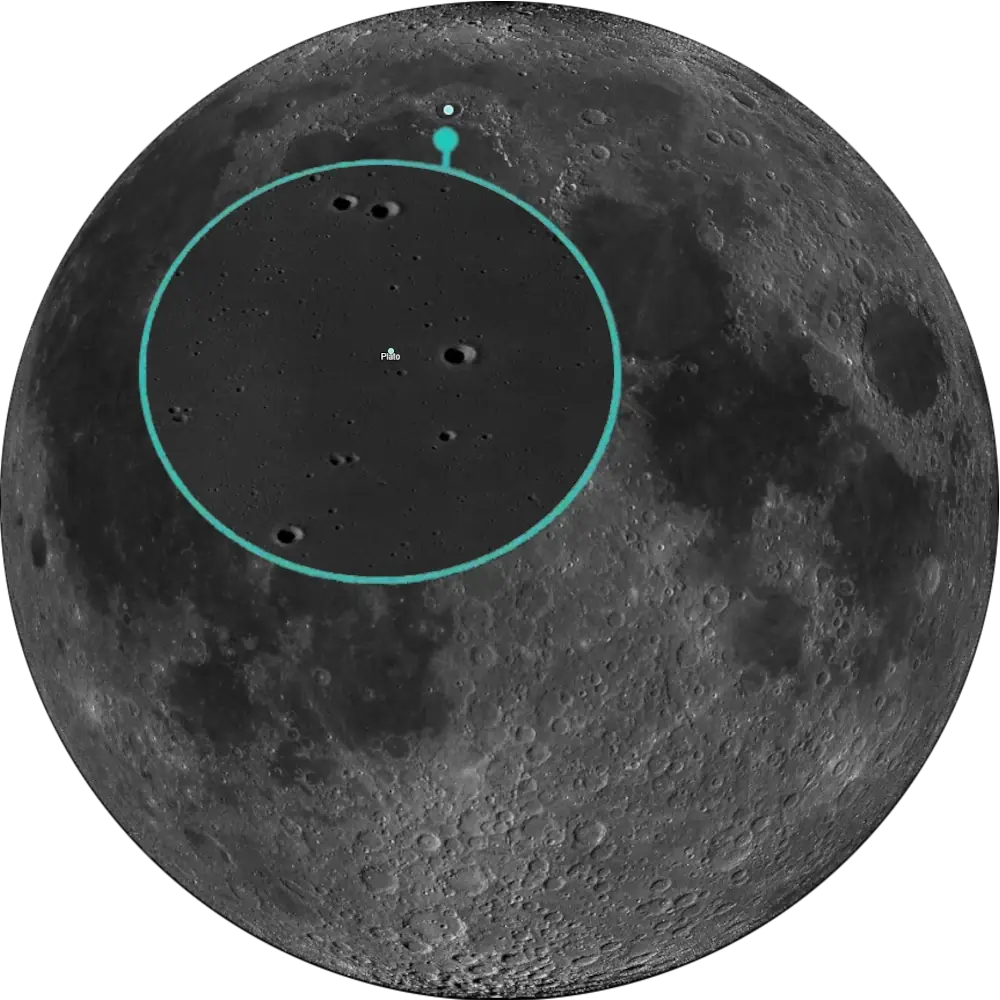
L83 Plato Craterlets
Northern Mare Imbrium · Limits of Resolution📉 Vital Statistics
🔭 Field Notes
Plato’s floor looks featureless at a glance — dark, smooth, and conspicuously missing the central peak a crater this size ought to have. Look closer, ideally near the terminator when a low sun angle throws shadows across the floor, and a handful of tiny craterlets emerge. The four largest — the classic “Big Four,” roughly 2 to 3 km across — are the most consistently accessible targets in moderate amateur telescopes under good seeing, though smaller craterlets can also be caught with larger apertures and exceptional conditions. Smaller craterlets, including features around a kilometer across, become increasingly difficult to resolve from Earth; under high Sun angles, some of the larger craterlets can instead appear as tiny white specks rather than clearly resolved pits.
- ▶ A 200-Year-Old Resolution Test: German astronomer Franz von Paula Gruithuisen spotted the first Plato craterlet in 1824. By 1883, British observer A. Stanley Williams reported that he and other observers had recorded more than 40 “spots” on Plato’s floor over the preceding several years, and in 1892 Harvard’s W.H. Pickering claimed to have mapped 71. When Lunar Orbiter IV photographed Plato in 1967, comparison with these old hand-drawn maps showed the observers had genuinely detected the largest real craterlets — but their counts, sizes, and positions were frequently far off.
- ▶ The Craterlets That Come and Go: Even experienced observers report the same craterlets appearing on one night and vanishing the next, under seemingly identical seeing conditions — one lunar observer recalled a session with the 33-inch Meudon refractor in 1952 where Plato’s floor was completely blank one night and showed several craterlets the very next. These reports helped fuel more than a century of debate over alleged transient lunar phenomena on Plato’s floor; modern explanations largely point to changing illumination and Earth’s atmosphere rather than physical changes to the craterlets themselves.
- ▶ A Buried Mountain: Plato’s missing central peak is probably buried beneath the crater’s exceptionally deep lava fill. Compared with craters of similar size, Plato would be expected to have a central peak about 2.2 km high; classic estimates place the lava fill at roughly 2.6 km deep.
📍 Nearby L100 Targets
- L19 Alpine Valley (Vallis Alpes): The dramatic 166 km graben-like valley slicing through the Montes Alpes, roughly 260 km southeast, discovered in 1727 — a large-scale tectonic feature that makes an interesting contrast with Plato’s tiny, difficult craterlets.
- L23 Mons Pico: An isolated 2.45 km peak roughly 180 km south, part of the surviving inner ring of the Imbrium basin — a solitary mountain standing exposed in the mare, unlike the buried peak thought to lie hidden beneath Plato’s own floor.
- L26 Mare Frigoris: The vast, elongated “Sea of Cold” directly bordering Plato’s northern rim, stretching roughly 1,400 km across the Moon’s far north — a reminder of just how small a target these craterlets are by comparison.
🚀 Mission Log
Target Acquisition
Find the dark floor on the shore of Mare Frigoris
Locate Plato, the 101 km walled plain sitting right on the southern edge of Mare Frigoris in northern Mare Imbrium — its unusually dark, smooth floor makes it easy to spot even in binoculars. On Rükl charts 3 and 4, it’s an unmistakable oval with no central peak. That flat, featureless-looking floor is exactly what you’re here to defeat: it hides a scatter of tiny craterlets that amateur observers have chased for two centuries.
Wait for a low sun angle and steady air
Catch Plato near the terminator, when a low sun angle throws shadow across its floor — under high sun the craterlets lose their shadow relief and may flatten into faint white specks — or disappear altogether as resolved pits. This is as much a seeing test as a lighting one: the craterlets are genuinely at the edge of what backyard telescopes can resolve, so plan for a night of steady atmosphere as much as good timing.
Start with the “Big Four,” then push your aperture
In a moderate amateur scope under good seeing, look for the classic “Big Four” craterlets, roughly 2 to 3 km across — the most consistently catchable targets on the floor. Smaller craterlets, some barely a kilometer wide, demand larger aperture and exceptional conditions to resolve as true pits rather than smudges. Treat every successful sighting as provisional: even experienced observers have reported craterlets appearing one night and vanishing the next under seemingly identical conditions, so don’t be surprised if a repeat session doesn’t match your first.
From Plato to Alpine Valley, Mons Pico, and Mare Frigoris
Southeast, roughly 260 km away, the Alpine Valley (L19) is a dramatic 166 km graben-like slash through the Montes Alpes — a large-scale tectonic feature that makes a striking contrast with Plato’s tiny, difficult craterlets. South, about 180 km off, Mons Pico (L23) is an isolated 2.45 km peak from the Imbrium basin’s surviving inner ring, standing exposed in the open mare — unlike the central peak thought to lie buried beneath Plato’s own floor. And immediately north, bordering Plato’s rim directly, Mare Frigoris (L26) stretches roughly 1,400 km across the Moon’s far north — a sea so vast it puts the scale of Plato’s kilometer-sized targets sharply into perspective.
📝 Observation Log — L83 Plato Craterlets
0/4 CompleteAre the Plato Craterlets visible tonight?
Plato sits near 51.6°N, 9.4°W, on the highland strip between Mare Frigoris and Mare Imbrium — easy to find, but its craterlets are a different story. You’ll want the terminator close by, so a low Sun angle throws shadow across the dark floor, plus excellent, steady seeing to hold the “Big Four” craterlets still at high power. Under high Sun they flatten into faint spots or disappear entirely.
Check Moon Phase TodayReturn to the List
Ready to find the next target? Go back to the full map to see what else is visible tonight.
← Back to Lunar 100 Map
When to Observe the Plato Craterlets
The craterlets are as much a seeing test as a lighting one. Plato itself is unmissable in any telescope, but the tiny pits scattered across its dark floor sit right at the edge of what backyard instruments can resolve — get the timing and the air both right, or you’ll see nothing but a blank grey plain.
- Wait for a Low Sun Angle and Steady Air: Catch Plato near the terminator, when a low sun angle throws shadow across its floor. Under high sun the craterlets lose their shadow relief and may appear only as tiny bright or dark spots rather than distinct pits.
- Start With the “Big Four,” Then Push Your Aperture: In a moderate amateur scope under good seeing, the classic “Big Four” craterlets, roughly 2 to 3 km across, are the most consistently catchable targets. Smaller craterlets, some around 1 km across, are visible only in large telescopes under exceptional seeing.
- For Orientation: Locate Plato, the 101 km walled plain sitting on the strip of highland between Mare Frigoris to the north and Mare Imbrium to the south — its unusually dark, smooth floor makes it easy to spot even in binoculars.
What to Look For
Look for the four largest craterlets, roughly 2 to 3 km across — the most consistently accessible targets in moderate amateur telescopes under good seeing.
Push further, if your aperture allows, toward craterlets around a kilometer across — features that become increasingly difficult to resolve from Earth and demand larger telescopes and exceptional conditions.
Treat every sighting as provisional. Even experienced observers report the same craterlets appearing on one night and vanishing the next under seemingly identical seeing conditions — log what you actually see rather than what you expect to see.
Notice what isn’t there: Plato’s floor is conspicuously missing the central peak a crater of this size might normally be expected to retain — a clue to what lies buried beneath the dark lava fill.
The Science: Two Centuries of Chasing Spots
Plato’s craterlets aren’t scientifically remarkable in themselves — they’re ordinary small impact pits. What makes them a Lunar 100 target is the observing history built around them: one of the longest-running controversies in the story of visual lunar astronomy.
Vital Statistics
Plato, the parent walled plain, sits at 51.6°N, 9.4°W, on Rükl charts 3 and 4, with a diameter of 101 km. The craterlets scattered across its dark, lava-flooded floor range from roughly 3.2 km down to under 1 km, informally lettered rather than named. Plato itself is roughly 3.84 billion years old; the craterlets superimposed on its floor are undated but almost certainly far younger. Its L100 distinction: a nearly 200-year-old test of telescope resolution and atmospheric seeing, and the subject of one of the longest-running observational controversies in lunar history.
A 200-Year-Old Resolution Test
German astronomer Franz von Paula Gruithuisen spotted the first Plato craterlet in 1824. By 1883, British observer A. Stanley Williams reported that he and other observers had recorded more than 40 “spots” on Plato’s floor over the preceding several years, and in 1892 Harvard’s W. H. Pickering claimed to have mapped 71. When Lunar Orbiter IV photographed Plato in 1967, comparison with these old hand-drawn maps confirmed that some of the largest reported craterlets were real, while showing that many historical counts and positions were inaccurate.
The Craterlets That Come and Go
Even experienced observers report the same craterlets appearing on one night and vanishing the next under seemingly identical seeing conditions — one lunar observer recalled a session with the 33-inch Meudon refractor in 1952 where Plato’s floor was completely blank one night and showed several craterlets the very next. These reports helped fuel more than a century of debate over alleged transient lunar phenomena on Plato’s floor; modern explanations largely point to changing illumination and Earth’s atmosphere rather than physical changes to the craterlets themselves.
A Buried Mountain
Plato’s missing central peak is probably buried beneath the crater’s exceptionally deep lava fill. Compared with craters of similar size, Plato would be expected to have a central peak about 2.2 km high; classic estimates place the lava fill at roughly 2.6 km deep.
Mission Record
Lunar Orbiter IV provided the first orbital photography of Plato’s floor in 1967, allowing direct comparison against more than a century of hand-drawn visual observations and revealing which historical craterlet detections corresponded to real features. Orbital photography from the Apollo era added further views of Plato and the surrounding northern Mare Imbrium region. High-resolution LROC imagery from the Lunar Reconnaissance Orbiter has since revealed Plato’s floor in extraordinary detail, resolving craterlets and surface features far below the practical visual limits of Earth-based telescopic observation.
Most Lunar 100 targets are chosen for what they look like. Plato’s craterlets were chosen for how hard they are to pin down — a two-century argument between the eye, the atmosphere, and the telescope, only finally settled by the camera.