
L100 Mare Marginis Swirls
A pale, looping overprint on the mare’s dark basalt, one of the Lunar 100’s most libration-dependent targets — barely emerging from limb foreshortening when a favorable eastern swing finally cooperates.
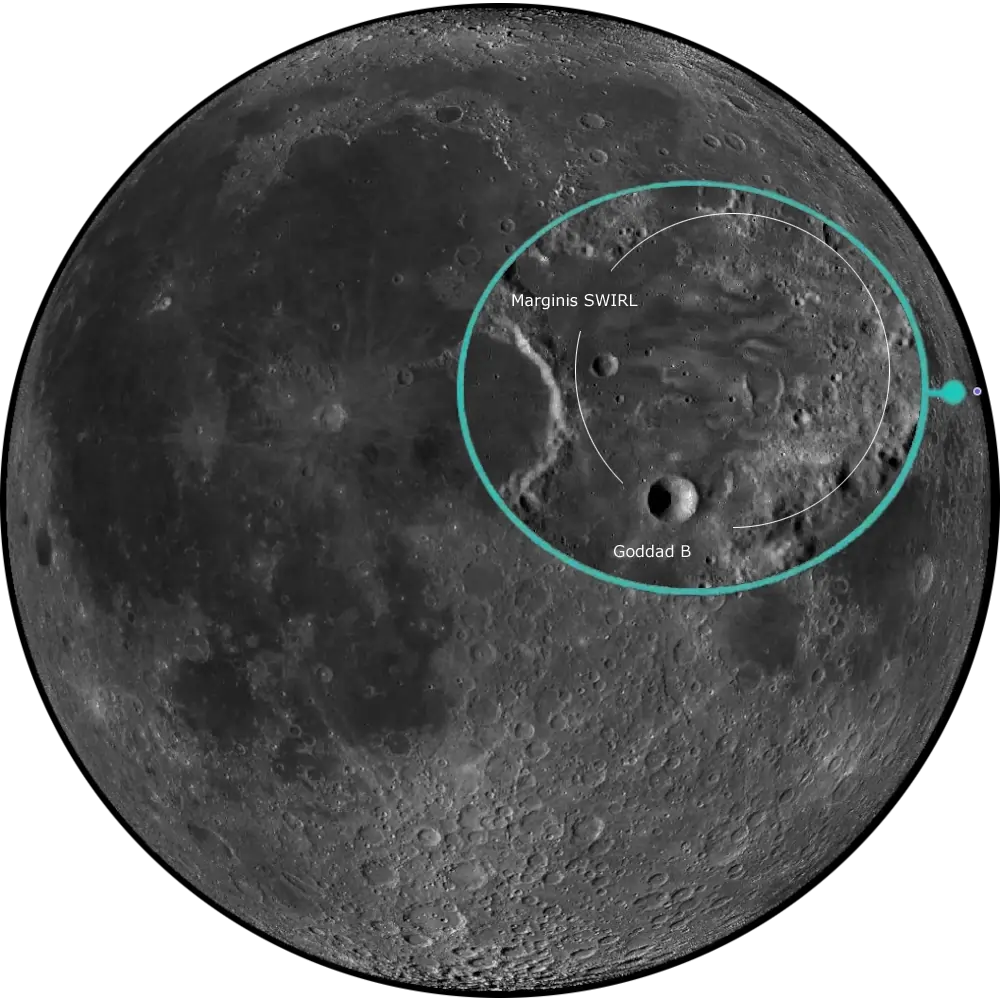
L100 Mare Marginis Swirls
Eastern Limb · Magnetic Anomaly📉 Vital Statistics
🔭 Field Notes
The Marginis swirls show up as pale, looping streaks laid over the mare’s darker basalt, the same style of high-albedo patterning as the far more famous Reiner Gamma. Its extreme eastern-limb position makes the swirls heavily foreshortened from Earth, and favorable eastern libration can significantly improve the viewing geometry. It’s not a target you catch on a whim — it’s one you wait for.
- ▶ Near the Antipode of Orientale: The Marginis swirl region lies near the antipode of the Orientale basin, the youngest major multi-ring basin on the far side. Several other lunar magnetic anomalies show this same broad antipodal pattern, which has contributed to hypotheses that some lunar antipodal anomalies may be related to the effects of major basin-forming impacts.
- ▶ A Puzzle Without a Settled Answer: No single explanation for lunar swirls has won out. Leading ideas include localized magnetic fields shielding the surface from the solar wind and slowing the darkening process, a comparatively recent comet impact or micrometeoroid swarm scouring the ground clean, and electrostatic transport concentrating fine, bright dust. Marginis is one of the principal lunar swirl regions used in studies of the relationship between high albedo, space weathering, and crustal magnetic anomalies.
- ▶ A Harder Catch Than Reiner Gamma: Reiner Gamma sits comfortably on the near-side disc and is a much more accessible target most of the month. Marginis is a limb target first and a swirl second, so favorable eastern libration is highly advantageous before there’s meaningful contrast to see at all.
📍 Nearby L100 Targets
- L10 Mare Crisium: The 555 km circular mare basin roughly 800 km west-northwest, sitting fully on the near side and a prominent naked-eye feature during the appropriate lunar phases — a far easier neighbor than the limb-bound, libration-dependent Marginis swirls.
- L31 Taruntius: A floor-fractured crater roughly 1,210 km west-southwest, its cracked, domed interior shaped by post-impact volcanic intrusion — a confirmed case of igneous modification, unlike Marginis’s still-debated magnetic origin story.
- L73 Smythii Basin: A ~740 km multi-ring impact basin roughly 465 km south, sharing the same eastern-limb foreshortening problem and requiring the same favorable libration window to observe well.
🚀 Mission Log
Target Acquisition
Start from Mare Crisium and read the limb outward
Use Mare Crisium, the unmistakable oval sea near the northeast limb, as your anchor. Mare Marginis lies roughly 800 km due east of it, on the extreme eastern edge of the nearside where favorable libration can reveal more of its foreshortened surface. The swirl itself isn’t a discrete landform; it’s a pale, looping overprint on the mare’s darker basalt, so you’re hunting an albedo pattern rather than a rim or a crater.
Wait for the right libration, not just the terminator
Because Marginis sits almost on the limb, ordinary phase timing won’t save you. Track a favorable eastern (positive) libration in longitude — the condition that brings more of the Moon’s eastern limb into view — using an app like Virtual Moon Atlas to check the current libration values before you plan a session. Once libration is favorable, good seeing and a high-contrast sky matter more than terminator lighting: the swirls are albedo markings with essentially no topographic relief, so they don’t throw the kind of shadow that low sun angles reveal on craters or ridges.
Look for looping streaks, not a bounded shape
On a night of steady seeing, use whatever moderate-to-high magnification your telescope and the conditions support — often 150x or more in a suitable instrument — and trace the pale, sinuous filaments laid over the darker basalt: the same high-albedo style as Reiner Gamma, but fainter and more foreshortened here. There’s no shadow to help you: swirls are optically bright markings with essentially no relief, so contrast against the mare is the only cue you have. Patience with the limb geometry matters more than raw aperture.
From Marginis to Crisium, Taruntius, and Smythii
Roughly 800 km west-northwest, Mare Crisium (L10) is the easy, fully near-side neighbor — a far more forgiving catch than the limb-bound swirls. About 1,210 km west-southwest, Taruntius (L31) is a floor-fractured crater whose uplifted, cracked floor is generally interpreted as evidence of post-impact magmatic modification — a very different kind of lunar mystery from the swirl’s still-unsettled origin. And roughly 465 km south, the Smythii Basin (L73) is another eastern-limb target that benefits from favorable libration — but unlike Marginis’s faint albedo swirls, Smythii’s large dark mare floor is much easier to recognize once the geometry cooperates.
📝 Observation Log — L100 Mare Marginis Swirls
0/4 CompleteIs the Mare Marginis swirl visible tonight?
Mare Marginis sits far out on the eastern limb near 13.3°N, 86.1°E, and this target lives or dies on libration rather than phase. The swirl is a pale, looping albedo marking with essentially no topography, so it casts no shadow for any lunar phase to reveal — what matters is a favorable eastern (positive) libration in longitude, which tips enough of this foreshortened stretch of limb into view to attempt it at all.
Check Moon Phase TodayReturn to the List
Ready to find the next target? Go back to the full map to see what else is visible tonight.
← Back to Lunar 100 Map
When to Observe the Marginis Swirls
Most Lunar 100 targets reward a low sun angle. The Marginis swirls don’t — they have essentially no relief to throw a shadow, so chasing the terminator here won’t help. What actually determines whether you can see anything is libration.
- Chase Favorable Eastern Libration: Mare Marginis sits on the extreme eastern limb, so the swirls are difficult to separate and heavily foreshortened from Earth much of the time. Check current libration values with an app like Virtual Moon Atlas before planning a session, and wait for a favorable eastern (positive) libration in longitude — the condition that tips more of the eastern limb into view.
- Skip the Shadow, Chase the Contrast: Once libration cooperates, terminator position stops mattering — these are optically bright albedo markings with no topography to shade. Steady seeing and a high-contrast sky matter more, at whatever moderate-to-high magnification your instrument supports; higher power can help separate the subtle albedo markings once the region is favorably presented.
- For Orientation: Use Mare Crisium, the unmistakable oval sea near the northeast limb, as your anchor, then move roughly 800 km west-northwest to Mare Marginis on the extreme eastern edge of the nearside.
What to Look For
There’s no rim or crater to find here — look instead for bright, sinuous albedo markings laid across the mare’s darker basalt, the same high-albedo patterning style as the far more famous Reiner Gamma, just fainter and more foreshortened at this limb-hugging location.
The swirl coincides with a crustal magnetic anomaly. Lunar Prospector’s magnetometer data helped characterize the anomalies associated with this region, tying the visible albedo pattern to something happening beneath the surface.
No single explanation for lunar swirls has won out. Leading ideas include a localized magnetic field shielding the surface from the solar wind and slowing the darkening process, a comparatively recent comet or micrometeoroid impact scouring the ground clean, and electrostatic transport concentrating fine, bright dust. Marginis is one of the principal regions used to study the relationship between albedo, space weathering, and crustal magnetism.
The Marginis swirl region lies near the antipode of the Orientale basin, the youngest major multi-ring basin on the far side. Several other lunar magnetic anomalies show this same broad antipodal pattern, feeding hypotheses that some antipodal anomalies may trace back to major basin-forming impacts.
The Science: A Bright Pattern With No Settled Cause
Marginis isn’t a landform you resolve so much as a signature you catch under the right conditions — and even once you catch it, what’s actually causing it remains an open question.
Vital Statistics
Located at 13.3°N, 86.1°E, on Rükl charts 27 and III, the swirl is a diffuse albedo feature with no defined diameter, overlying a host mare that spans roughly 358 km. It sits within Mare Marginis, Latin for “Sea of the Edge.” The host basalt is Late Imbrian in age, though the swirl markings themselves are undated. Its L100 distinction: one of the guide’s most libration-dependent, limb-hugging targets.
Bright Without a Crater
Unlike most Lunar 100 targets, the Marginis swirls aren’t defined by an impact structure at all — they’re a bright, looping overprint on darker mare basalt, in the same style as Reiner Gamma but harder to catch given the extreme eastern-limb position. Clementine’s UV-visible and near-infrared imaging provided important multispectral data on the swirls’ distinctive reflectance signature, building on their earlier recognition in Apollo-era imagery. That brightness, paired with the underlying magnetic anomaly, is the whole basis for the leading explanations — shielding from the solar wind, a scouring impact event, or electrostatic dust transport — none of which has closed the case.
Mission Record
Clementine’s 1994 UV-visible and near-infrared imaging provided important multispectral data on the swirls’ distinctive reflectance signature, building on their earlier recognition in Apollo-era imagery. Lunar Prospector’s 1998–1999 magnetic measurements helped characterize the crustal magnetic anomalies associated with the region. Lunar Reconnaissance Orbiter, in orbit since 2009, has refined high-resolution maps of the swirls’ fine-scale patterns, and comparisons between that imagery and magnetic-field data continue to inform research into how the swirls relate to local magnetism and surface geology.
Most Lunar 100 targets are chosen for a feature you can see. Marginis was chosen for a pattern nobody has fully explained — a bright signature sitting on a magnetic anomaly, at the edge of the visible disc, that multiple lunar missions have mapped in increasing detail without settling exactly how the swirls form.