
Moon Phase Today San Jose
On Friday, October 9, 2026, the moon in San Jose is a New Moon with 0% illumination. Moon age: 28.9 days.
☽ Best Places to View the Moon in San Jose
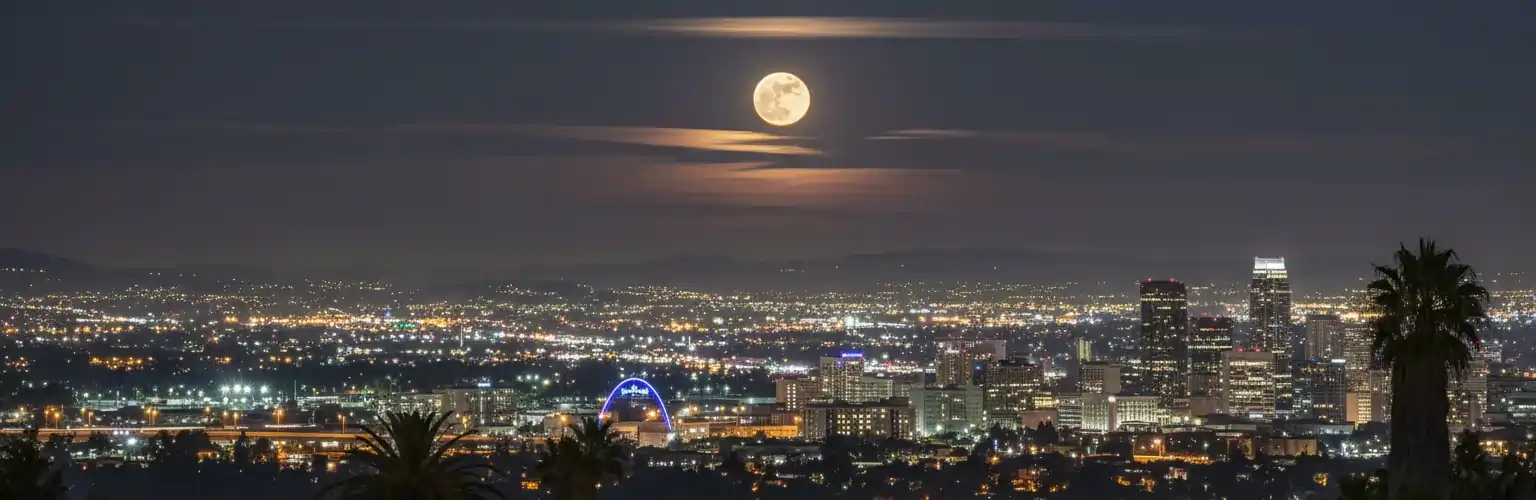
San Jose's geography is dramatically defined by the Santa Clara Valley floor, nestled between the Santa Cruz Mountains to the west and the Diablo Range to the east. Since the moon rises in the East, the most spectacular views are generally found facing the Diablo Range or from elevated spots within the valley that offer expansive eastern horizons. The city offers a unique blend of urban lights against rugged mountain backdrops. Use PhotoPills to plan the exact alignment for your chosen date and location. All spots are free and accessible 24/7 unless otherwise noted.
Communication Hill – Grand Staircase / Vieira Park
The best 24/7 accessible urban vantage point within San Jose. From the top of the "Grand Staircase" or Vieira Park, you get a sweeping view of the city grid. The moon rises over the Diablo Range in the distance, beautifully illuminating the valley fog (if present) and the glittering city lights below. Learn more here.
Public residential area with street parking, open at night — unlike most county parks.
Sierra Vista Open Space Preserve
The "high altitude" favorite for a truly natural moonrise. Located in the eastern foothills, this preserve puts you eye-level with the mountain peaks of the Diablo Range. More info here.
Parking lot closes strictly 30 minutes after sunset — best for golden-hour moonrises, not deep-night sessions.
Mount Hamilton Road (CA-130) – Turnouts
This winding road leads up to the historic Lick Observatory. As you ascend, turnouts offer views back west over Silicon Valley's lights or east into the dark Diablo Range wilderness. Explore the drive.
365 curves, no streetlights — the observatory itself closes to the public around 5pm except for occasional ticketed events.
Evergreen Village Square
A cleaner, community-focused composition for urban moon photography. This "Main Street"-style square in East San Jose's Evergreen district has a fountain and library, with the moon rising over the eastern hills that border the neighborhood.
Accessible 24/7, with ample parking nearby.
Shoreline Lake (Mountain View)
Technically just north of San Jose, this man-made saltwater lake is the region's premier spot for water reflections — a flat mirror surface for the moon rising over the distant hills.
Park generally closes 30 minutes after sundown — a twilight spot, not for deep-night photography.
Alum Rock Park – Overlooks (East San Jose)
A more rugged, canyon-style view within the city's eastern foothills, with various overlooks giving elevated views of the moon rising over the eastern ridges.
Park curfews strictly enforced — check official hours before planning a late-night visit.
◉ Best Times for Moon Photography
📷 Quick Photography Tips
San Jose operates on PST (UTC−8) in winter and PDT (UTC−7) during daylight saving time. Clocks go forward on the second Sunday in March and back on the first Sunday in November.
For the moon phase in any other city worldwide, visit our Dynamic Moon Phase Calculator for instant lunar data tailored to wherever you are.
◐ What the Experience Actually Feels Like
There's a unique sensory blend to a San Jose moonrise that captures the essence of Silicon Valley – a vast, illuminated urban sprawl nestled against the quiet grandeur of the mountains. Imagine standing atop Communication Hill, the hum of the city a distant murmur below, as a warm, luminous orb peeks over the distant ridges of the Diablo Range. The valley lights stretch out like a glittering carpet, and if the marine layer has crept in, the moon might cast a soft glow on the top of a low-hanging fog bank, creating a mystical "sea of clouds" effect that feels both otherworldly and distinctly Californian.
San Jose's geography dictates your moon-chasing strategy. When you climb into the eastern foothills, such as at Sierra Vista Open Space Preserve, you gain an immediate sense of elevation. Here, the moon doesn't just clear a distant horizon; it emerges directly from behind the rugged, rolling peaks, its light illuminating the contours of the landscape before it fully clears the sky. Conversely, from Evergreen Village Square, you get a charming community foreground, where the moon rises above local architecture and the immediate, dark hills.
The seasons play a significant role in the moon's appearance here. Winter, particularly after a good rain, brings the clearest air to the Santa Clara Valley, offering crisp views of the moon and potentially even snow-dusted peaks on Mount Hamilton. Summer evenings, however, are famous for the marine layer — a low-lying fog that rolls in from the coast. While this might obscure some views, from higher vantage points like Communication Hill it transforms the valley into a spectacular, illuminated cloudscape, with the moon often rising above it like a solitary beacon.
"A warm, luminous orb peeks over the distant ridges of the Diablo Range. The valley lights stretch out like a glittering carpet, and if the marine layer has crept in, the moon might cast a soft glow on the top of a low-hanging fog bank, creating a mystical 'sea of clouds' effect."
✓ Your San Jose Moon Chase Checklist
Before You Go
- Check the moonrise time and phase on this page — critical for aligning the moon with San Jose's diverse backdrops
- Use PhotoPills or Stellarium to verify alignment with a mountain peak, the skyline, or a fountain on your chosen date
- Target the 48–72 hour window before full moon for softer light, or the full moon itself for maximum brightness
- Check park curfews for Sierra Vista and Alum Rock — plan for twilight shooting rather than deep night
- Check air quality and marine layer forecasts, especially in summer
What to Bring
- Sturdy tripod — essential for balancing exposures between a bright moon and city lights below
- A telephoto lens (200mm+) — the eastern mountains are distant and reward compression
- Layers of clothing — elevated hills and mountain roads get cool even in summer
- A wide-angle lens (16–35mm) for expansive shots from Communication Hill
- Headlamp or flashlight for dark trails and mountain turnouts, especially on Mount Hamilton Road
- Water and snacks for trips up Mount Hamilton Road — amenities are sparse
On the Night
- Arrive 30–45 minutes before moonrise to set up and catch the pre-moonrise light over the Diablo Range
- At Communication Hill, position yourself at the top of the Grand Staircase for the widest view
- Shoot RAW — the dynamic range between the moon, city lights, and dark mountains needs blending in post
- Stay 20–30 minutes after moonrise as the light and composition options keep changing
- Be mindful of surroundings on Mount Hamilton Road turnouts and in parks after dark
? San Jose Moon Phase — Frequently Asked Questions
Q. What is the moon phase in San Jose, CA today?
The current moon phase for San Jose, updated automatically for today's date, is shown in the widget at the top of this page along with the exact illumination percentage and moon age in days. San Jose's coordinates (37.3382° N, 121.8863° W) and its Pacific Time zone are already factored in, so the phase and times shown are accurate for the city without any adjustment needed.
Q. What time does the moon rise in San Jose today?
Moonrise time changes daily and is calculated live for San Jose in the info grid above. Tap any date on the calendar to see the phase and moonrise time for that specific day.
Q. Where is the best place to view the moon in San Jose?
Communication Hill is San Jose's most accessible signature viewpoint, with the moon rising over the Diablo Range above the full city grid. Sierra Vista Open Space Preserve and Mount Hamilton Road put you closer to the mountains themselves, Evergreen Village Square gives a charming neighborhood-level composition, and Alum Rock Park offers a more rugged, canyon-style alternative.
Q. Why does moon visibility change so much in San Jose through the year?
San Jose sits at roughly 37.3° N, a moderate latitude with a modest seasonal swing in the moon's path. What changes visibility most here is the marine layer: summer evenings often bring low coastal fog, though from elevated spots it turns into a dramatic "sea of clouds" beneath the moon. Winter, especially after rain, tends to bring the clearest air of the year.
Q. When is the next full moon in San Jose?
The date of the next full moon is calculated live and shown in the "Next Full Moon" card above, already adjusted for San Jose's time zone.
Q. Does San Jose observe daylight saving time?
Yes. San Jose runs on Pacific Standard Time (PST, UTC−8) in winter and switches to Pacific Daylight Time (PDT, UTC−7) from the second Sunday in March to the first Sunday in November. All times shown on this page already account for the correct offset.
Q. What's the best time of year for moon photography in San Jose?
October through March, especially after rain, gives the clearest air and sharpest views of the Diablo Range and the city lights below. Keep in mind that several of San Jose's best foothill viewpoints, including Sierra Vista Preserve and Alum Rock Park, close their gates around sunset, so plan around twilight moonrises rather than deep-night sessions at those spots.
Q. Does this page work for cities besides San Jose?
This page is set up specifically for San Jose, CA. For the moon phase in any other city or location worldwide, use the Dynamic Moon Phase Calculator on the moonphase.today home page.
✦ Explore Further
Sky Clarity Forecast
Check tonight's marine layer and cloud cover before heading up to Communication Hill or Mount Hamilton Road.
📷Moon Photography Guide
Camera settings, lenses, and techniques for shooting sharp, well-exposed moon shots.
📐Looney 11 Exposure Calculator
Dial in the exact f-stop, ISO, and shutter speed for a full moon — the same rule used in our San Jose tips.
🌆Blue Hour Calculator
Find tonight's exact blue hour window — key for shooting around San Jose's early park closures.
NASA Moon Phase & Libration Gallery
NASA's Scientific Visualization Studio's daily renders of the moon's exact phase, libration, and orientation, straight from official mission data.