
Moon Phase Today Phoenix
On Friday, October 9, 2026, the moon in Phoenix is a New Moon with 0% illumination. Moon age: 28.9 days.
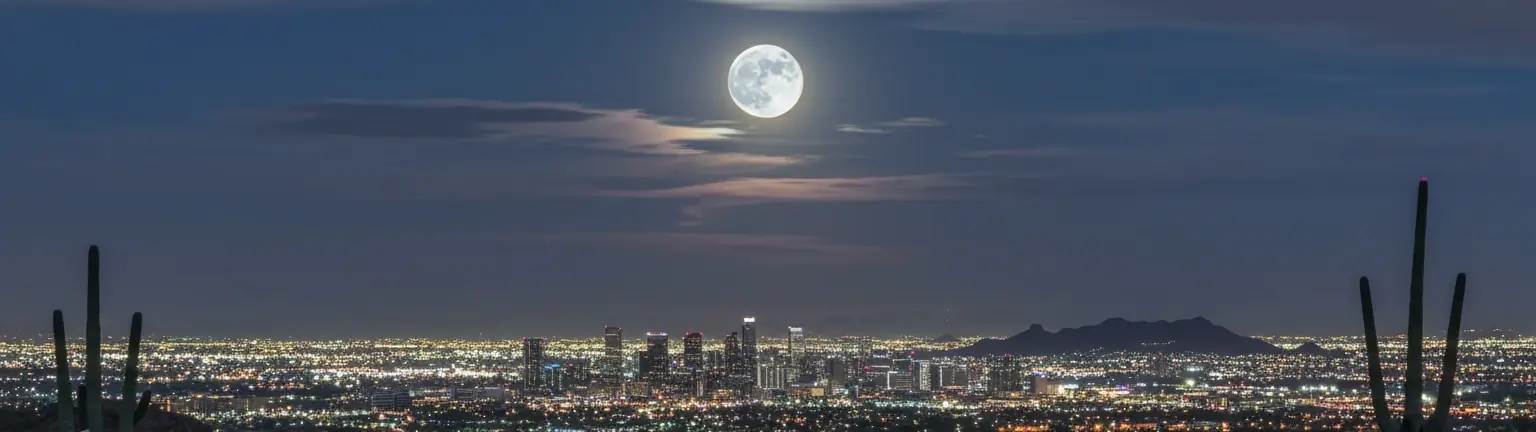
☽ Best Places to View the Moon in Phoenix
Phoenix sits at 33° North in the heart of the Sonoran Desert, ringed by mountain preserves — the Phoenix Mountains to the north, South Mountain to the south, the Superstitions to the east — and blessed with over 300 days of sunshine a year that translates directly into exceptionally clear moonrise skies. It is one of the best cities in North America for lunar photography: the desert air is dry and transparent, the saguaro cactus silhouettes are unlike anything found elsewhere, and the compact downtown skyline glows against a dark desert horizon in every direction. Phoenix also has a unique advantage that no other major American city shares: it does not observe daylight saving time, so moonrise times stay consistent relative to sunset throughout the year, and planning is simpler. The mountains surrounding the city provide elevated viewpoints that compress the moon against the skyline in ways the flat valley floor cannot.
Piestewa Peak – Summit Trail
The premier elevated Phoenix viewpoint at approximately 2,600 feet (800 m). The 2.4-mile Summit Trail in the Phoenix Mountains Preserve reaches a true 360° panorama — the moon rises dead-centre over downtown Phoenix and Camelback Mountain to the east, and the entire valley spreads below in every direction. The most iconic full moon hike in the city; arrive at least an hour early on full moon nights as the trailhead fills fast. Parking at Echo Canyon Recreation Area; the trail is rocky and steep in the final section — wear proper footwear.
South Mountain Park – Dobbins Lookout
Dobbins Lookout at approximately 2,330 feet (710 m) is the highest drive-up viewpoint in the Phoenix park system and gives a sweeping north-facing panorama across the entire city. The moon rises over the Superstition Mountains to the east and tracks above the glowing downtown skyline — a wide-angle composition that takes in the full scale of the valley. Drive-up access via Summit Road, which closes at 7 pm in winter and 11 pm in summer; arrive before closing and stay. Free entry to South Mountain Park.
Papago Park – Hole-in-the-Rock
The Hole-in-the-Rock trail at Papago Park reaches a natural sandstone opening in the red buttes with an unobstructed eastern horizon and the downtown skyline — including Chase Tower — directly in view. The moon rises through or above the rock window depending on the date, framed by warm red sandstone on both sides. One of the most photogenic natural foregrounds in any American city. Easy, short hike; free entry, open 24/7. Located off Galvin Parkway near the Desert Botanical Garden.
Desert Botanical Garden – Papago Park
The Desert Botanical Garden offers something no other spot on this list can: the moon rising over a curated landscape of towering saguaro cacti, ocotillo, and desert wildflowers, with the city glow behind. The silhouette of a saguaro against a full moon is one of the defining images of the Sonoran Desert. The Garden hosts dedicated "Moon Hike" events on full moon evenings — guided walks through the lit trails that are worth booking in advance. Admission approximately $33–$40 depending on day and season; open until 8 pm with extended hours for moon events. Bus 32 or drive.
Shaw Butte Trail – North Mountain Preserve
The Shaw Butte Trail is a steep 3.1-mile hike to a summit overlook in North Phoenix with noticeably darker skies than the central city viewpoints. The moon rises over the urban sprawl to the east with the distant McDowell Mountains on the horizon — the city-to-desert contrast is stronger here than at Piestewa or South Mountain because the surrounding development thins quickly to the north. Free; trailhead parking off 29th Drive and Northern Avenue. Carry a headlamp for the descent.
Usery Mountain Regional Park – Wind Cave Trail
Usery Mountain Regional Park in the East Valley sits at the edge of the Tonto National Forest and offers the darkest skies of any spot on this list — the Phoenix skyline glow is faint on the western horizon rather than directly below. The moon rises over the Goldfield Mountains and open desert with wildflowers in season (February through April). Best for telephoto compositions with desert vegetation in the foreground and the distant city as context. Entry $10 per vehicle; gates close at 8 pm Sunday–Thursday and 10 pm Friday–Saturday — plan your exit time carefully.
◉ Best Times for Moon Photography
📷 Quick Photography Tips
Phoenix operates on MST (UTC−7) year-round — Arizona does not observe daylight saving time, making it one of only two contiguous US states that stays on standard time all year (the Navajo Nation within Arizona does observe DST). This means moonrise times in Phoenix shift more gradually across the seasons than in cities that change clocks, and apps like PhotoPills or Stellarium set to Phoenix will always reflect the correct offset without seasonal adjustment.
For the moon phase in any other city worldwide, visit our Dynamic Moon Phase Calculator for instant lunar data tailored to wherever you are.
The moon phase today in Phoenix, AZ is shown in detail above — complete with exact illumination percentage, moonrise/set times, and the best local spots to see it. For the moon phase today in any other city or location worldwide, visit our Dynamic Moon Phase Calculator on the home page.
◐ What the Experience Actually Feels Like
There is a particular quality to moonrise in Phoenix that has no equivalent anywhere else in the United States. You are standing on a mountain in the middle of a major city — a real mountain, rocky and steep, with rattlesnakes in the crevices and cactus wrens in the saguaros — and below you the entire valley glows in every direction, four million people spread across a flat desert basin ringed by more mountains. And then the moon comes up over the Superstitions to the east, enormous and orange at the horizon, and the saguaros on the ridge in front of you go black against it, and for a few minutes the scene looks like something from a science fiction film set on another planet. It is, in the most literal sense, a desert moonrise.
Phoenix at 33 degrees north gives the moon a strong, high arc across the sky for most of the year. In winter the full moon rides particularly high and the desert air is at its clearest — the monsoon humidity of July and August has been gone for months, and the visibility from the mountain summits extends to the horizon in every direction. Photographers who know the city target the winter months for the sharpest, most detailed moonrises; the summer moon is warmer in colour but softer in definition, hazy at the horizon from the heat still radiating off the desert floor. Both are worth shooting. They just require different expectations.
What Phoenix has that no other major American city offers is the saguaro. The giant cactus — some of them forty feet tall, arms raised like figures caught mid-gesture — silhouettes against a rising moon in a way that is immediately, unmistakably the Sonoran Desert. From the right position on the Hole-in-the-Rock trail or the slopes below Piestewa Peak, you can frame the moon between two saguaro arms and the downtown skyline and produce a photograph that could only have been taken in one place on earth. That specificity is what makes Phoenix worth planning for. The moon rises everywhere. Here, it rises over something genuinely singular.
"The saguaros on the ridge go black against the rising moon, and for a few minutes the scene looks like something from another planet — because in a sense, it is."
✓ Your Phoenix Moon Chase Checklist
Before You Go
- Check the moonrise time and phase on this page — the moon's exact alignment with the downtown skyline and the mountain ridgelines changes significantly by date and requires planning
- Target the 48–72 hour window before full moon if possible — the moon rises during golden hour and the warm desert light gives the saguaro silhouettes their best colour contrast
- Check park closing times before heading out — South Mountain's Summit Road closes at 7 pm in winter, and Usery Mountain gates close at 8 pm Sunday–Thursday (10 pm Friday–Saturday); plan your exit carefully
- Use PhotoPills or Stellarium to identify dates when the moon rises aligned with Chase Tower or between specific saguaros on your chosen ridge
- Book Desert Botanical Garden moon hike events in advance — they sell out, particularly for full moon evenings in spring when the wildflowers are also in bloom
What to Bring
- Sturdy tripod — summit winds at Piestewa Peak and Shaw Butte are fierce, particularly in winter when cold fronts push through; lightweight tripods will vibrate and blur long exposures
- A lens between 200–400mm for skyline compression shots from the mountain summits — the distance to downtown from the peaks rewards longer glass significantly
- At least two litres of water per person in summer — desert heat lingers well after sunset and summit hikes in July and August remain physically demanding even at dusk
- A headlamp for any summit trail — Piestewa, Shaw Butte, and the Hole-in-the-Rock all have sections that are genuinely dangerous to descend in the dark without one
- Proper trail footwear — the final sections of Piestewa and Shaw Butte are rocky scrambles; sandals and flat-soled shoes are not adequate
- Warm layers for winter summit sessions — Phoenix valley temperatures feel mild but mountain summits at 2,500–2,600 feet drop quickly after sunset, especially with wind
On the Night
- Arrive at your viewpoint 30–45 minutes before moonrise — the sky behind the Superstition Mountains goes through a vivid amber-to-pink gradient as the moon approaches the horizon
- At Papago Park's Hole-in-the-Rock, position yourself far enough back from the opening to frame the rock window around the rising moon — getting too close loses the silhouette effect
- Shoot RAW — the dynamic range between a bright full moon, the dark desert sky, and the warm city glow below requires separate exposures blended in post
- Stay 15–20 minutes after moonrise — the moon climbs quickly above the horizon haze and its colour shifts from deep orange to gold to white; each phase produces a different composition
- In summer, shoot later than you think — the heat haze at the horizon softens the moon significantly in the first few minutes after rise; waiting until it clears produces sharper results
? Phoenix Moon Phase — Frequently Asked Questions
Q. What is the moon phase today in Phoenix?
The moon phase today in Phoenix is a New Moon with 0% illumination. The next full moon is in 17 days, on Oct 25. Moonrise is at 5:36 AM and moonset at 5:31 PM.
Q. Where is the best place to view the moon in Phoenix?
Piestewa Peak's summit trail is the classic pick, with a full 360° view and the moon often rising dead-centre over downtown. Dobbins Lookout in South Mountain Park is a drive-up alternative with an equally wide panorama, and Papago Park's Hole-in-the-Rock frames the moon through a natural sandstone window with the skyline behind it.
Q. Why does the moon look so clear over Phoenix?
Phoenix gets over 300 sunny days a year, and the Sonoran Desert's dry air keeps haze to a minimum, which is why moonrises here are noticeably crisp compared to more humid cities. The mountain preserves ringing the city also let you get above the valley floor, and the saguaro cactus silhouettes that show up in photos here are unique to this part of the country.
Q. Does Phoenix observe daylight saving time?
No. Arizona stays on Mountain Standard Time (MST, UTC−7) year-round and does not observe daylight saving time, so moonrise, moonset, and transit times on this page keep a consistent offset from UTC throughout the year — unlike nearby Las Vegas, which does change its clocks.
Q. What's the best time of year for moon photography in Phoenix?
November through March brings the clearest winter skies and the most southerly moon path, which makes lining the moon up with Chase Tower or the downtown skyline much easier to plan. Just bring water and start early if you're hiking to a summit viewpoint in the warmer months.
Q. Does this page work for cities besides Phoenix?
This page is set up specifically for Phoenix, AZ. For the moon phase in any other city or location worldwide, use the Dynamic Moon Phase Calculator on the moonphase.today home page.
✦ Explore Further
Moon Phase Today: Flagstaff
Check tonight's moon phase in Flagstaff, about 145 miles north up I-17.
📷Moon Photography Guide
Camera settings, lenses, and techniques for shooting sharp, well-exposed moon shots.
🌵Sky Clarity Forecast
Check conditions before the hike up to Piestewa Peak or Shaw Butte.
🔭Photography Field of View Calculator
Work out the focal length you'll need to line the moon up with Chase Tower.
NASA Moon Phase & Libration Gallery
NASA's Scientific Visualization Studio's daily renders of the moon's exact phase, libration, and orientation, straight from official mission data.