
Moon Phase Today Manila
On Saturday, October 10, 2026, the moon in Manila is a New Moon with 0% illumination. Moon age: 28.9 days.
☽ Best Places to View the Moon in Manila
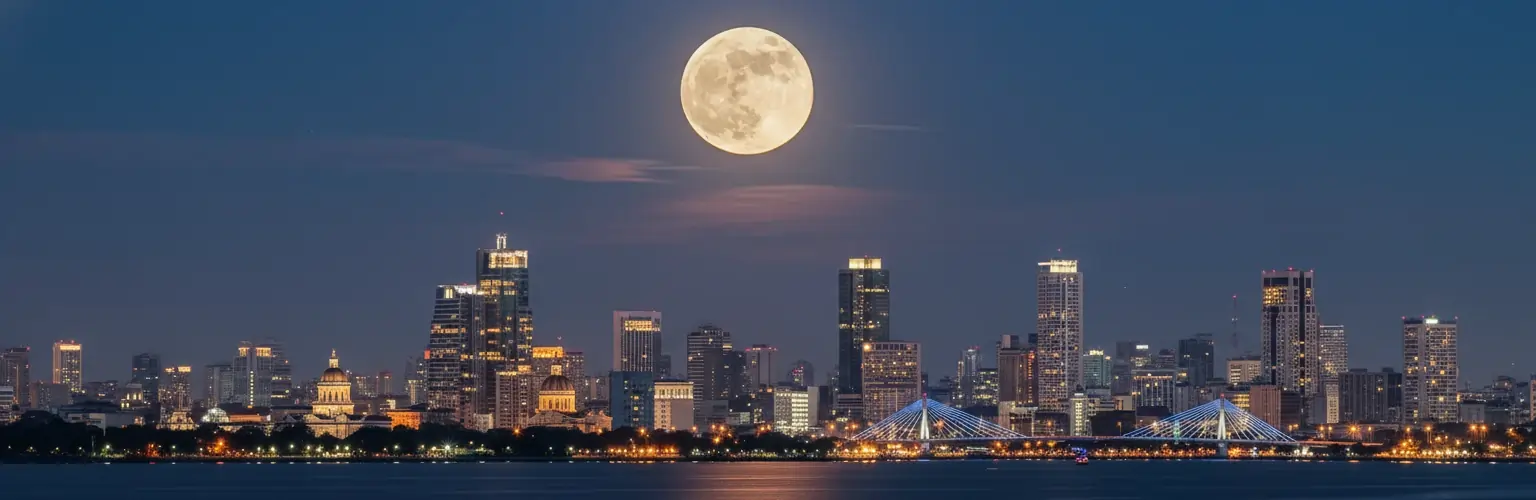
Manila’s vibrant energy and stunning bayfront create incredibly romantic moonrises, even amidst urban light pollution. The moon is bright enough to punch through almost anywhere, but for truly spectacular views and the best moonrise-over-skyline photographs, understanding the city's unique geography is key. The vast expanse of Manila Bay is your canvas, offering unobstructed eastern horizons for dramatic lunar appearances. Depending on the season, the moon can rise to align perfectly with iconic landmarks like the Mall of Asia Globe or the historic walls of Intramuros — use PhotoPills to plan the exact alignment for your chosen date. All spots are free and accessible 24/7 unless otherwise noted.
Manila Baywalk / Roxas Boulevard
The absolute #1 Manila moonrise spot. This long seaside promenade offers the moon rising straight out of Manila Bay – an iconic “Baywalk sunset to moonrise” transition. Expect classic silhouette shots with swaying palm trees and distant skyline lights. Very popular for evening strolls, it provides an expansive, unobstructed view. Best visited on or around the full moon for maximum impact.
SM Mall of Asia – Seaside Boulevard & Globe
This massive seaside complex offers open bay views. The moon rises over the water with the giant MOA Globe and the city skyline, creating a dynamic foreground of modern architecture and reflections. The MOA Eye Ferris wheel adds a playful glow, making for vibrant and contemporary moonrise compositions. The area is well-lit and bustling, providing a lively atmosphere.
Cultural Center of the Philippines (CCP) Complex – harborfront
Located in an arts district on reclaimed land, this spot offers the moon rising over Manila Bay with the distinct CCP buildings and the modern skyline. The cultural architecture provides unique framing opportunities. It's often quieter after performances, offering a more serene experience for capturing the moon's ascent against an elegant backdrop.
Intramuros – Fort Santiago walls & ramparts
Experience history under the moonlight within the historic walled city of Intramuros. From the elevated Fort Santiago walls and ramparts, the moon rises dramatically over the bay and the modern skyline, creating a stunning contrast between old stone walls and cannons in the foreground and the contemporary city beyond. This location requires entry to Intramuros, which may have specific operating hours.
Rizal Park (Luneta) – bay side
This open national park provides an expansive view of the moon rising over Manila Bay. The wide horizon allows for spectacular moon illusion effects, making the moon appear enormous when low on the horizon. The Rizal Monument and flagpole offer patriotic foreground elements, adding historical significance to your moonrise photos. It's a popular public space, accessible for all to enjoy.
Quezon Memorial Circle – high points (Quezon City)
Located in Quezon City, this circular park features elevated paths and monuments. The moon rises over the city lights, offering open space and monument framing against a backdrop that is slightly darker than the bay areas, allowing for more visible stars on clear nights. This provides a different perspective of Manila's moonrise, away from the immediate bayfront bustle.
◉ Best Times for Moon Photography
📷 Quick Photography Tips
Manila operates on PHT (Philippine Standard Time, UTC+8) year-round, with no daylight saving. Apps like PhotoPills, The Photographer’s Ephemeris, or Stellarium automatically apply the correct offset, ensuring accurate moonrise and moonset times for your planning. Moonrise times shift by several minutes daily, so precise timing is essential for capturing specific alignments.
For the moon phase in any other city worldwide, visit our Dynamic Moon Phase Calculator for instant lunar data tailored to wherever you are.
The moon phase today in Manila is shown in detail above — complete with exact illumination percentage, moonrise/set times, and the best local spots to see it. For the moon phase today in any other city or location worldwide, visit our Dynamic Moon Phase Calculator on the home page.
◐ What the Experience Actually Feels Like
There’s an electrifying energy to a Manila moonrise, a feeling that something grand is about to unfold over the vast expanse of Manila Bay. Picture yourself on the Baywalk, the tropical air warm, the sounds of the city a constant hum. As the sun dips below the horizon in a blaze of orange and purple, the sky to the east begins to deepen. Then, slowly, majestically, a glowing orb emerges from the horizon of the bay. For a few perfect minutes, it appears impossibly huge, suspended above the twinkling lights of the city skyline, framed by palm trees. It’s a transition from the famous Baywalk sunset to an equally enchanting moonrise, a quintessential Manila experience.
Manila’s bayfront offers expansive, unobstructed views that make for truly dramatic lunar appearances. From the bustling SM Mall of Asia Seaside Boulevard, the moon rises over the water, reflecting in the bay alongside the illuminated MOA Globe and the modern towers. This blend of nature and contemporary urban development creates a unique and vibrant photographic canvas. Stepping back in time to Intramuros, the moon rises against ancient stone walls and cannons, casting its light over a city steeped in history, juxtaposed with the distant glow of the modern metropolis. The sheer scale of the bay ensures that the moon has ample space to reveal itself in all its glory, often creating an optical illusion that makes it appear larger than life.
The dry season (November to May) is arguably the best time for moon photography in Manila. During these months, humidity is at its lowest, leading to clearer skies and less atmospheric haze, which is crucial for sharp lunar details. The moon's path also tends to be higher and more southerly during the winter months (November-February), offering optimal alignments with city landmarks. While the city's light pollution is a constant, the moon's brilliance usually punches through, especially when it's low on the horizon and appears larger. The calmer evenings often turn Manila Bay into a breathtaking mirror, reflecting both the moon and the city's glittering lights.
"For a few perfect minutes, it appears impossibly huge, suspended above the twinkling lights of the city skyline, framed by palm trees. It’s a transition from the famous Baywalk sunset to an equally enchanting moonrise, a quintessential Manila experience."
✓ Your Manila Moon Chase Checklist
Before You Go
- Check the moonrise time and phase on this page — precise timing is crucial for aligning the moon with Manila's landmarks
- Use PhotoPills or a similar app to verify whether the moon will rise near your chosen landmark (e.g., MOA Globe, Intramuros walls)
- Target the 48–72 hour window before full moon if possible — the moon rises during civil twilight for balanced light conditions
- Check weather forecasts for clear skies and low humidity, especially during the dry season (December-May) for optimal visibility
- Scout your chosen location during the day for parking, access points, and potential obstructions, particularly around busy areas like Baywalk or MOA
What to Bring
- Sturdy tripod — the Manila Bay breeze can be significant, requiring a stable setup for sharp long exposures
- A telephoto lens (200–300mm) for tight compression shots of the moon against the skyline or specific landmarks
- Bug repellent — essential for outdoor locations, especially near the bay or parks in the evening
- Wide-angle lens for Rizal Park or Quezon Memorial Circle — to capture the expansive horizons and environmental compositions
- Lens cloth and a rain cover — tropical humidity and sudden showers can affect camera gear
- Power bank for your phone/camera — extended evening shoots can drain batteries, and power outlets may not be readily available
On the Night
- Arrive at your viewpoint 30–45 minutes before official moonrise — to capture the beautiful transition from sunset glow to lunar emergence
- At Baywalk, position yourself to frame the moon with palm trees, the distant skyline, and reflections in the calm bay waters
- Shoot RAW — the high dynamic range between the bright moon and city lights necessitates exposure blending in post-production
- Stay 20–30 minutes after moonrise — as the moon climbs, compositions shift, and the "moon illusion" effect is often strongest when it's low
- Be mindful of crowds — popular spots like Baywalk and MOA can be very busy, especially on clear evenings or weekends
? Manila Moon Phase — Frequently Asked Questions
Q. What is the moon phase today in Manila?
The moon phase today in Manila is a New Moon with 0% illumination. The next full moon is in 17 days, on Oct 26. Moonrise is at 5:15 AM and moonset at 5:23 PM.
Q. Where is the best place to view the moon in Manila?
Manila Baywalk along Roxas Boulevard is the absolute #1 spot, with the moon rising straight out of Manila Bay in a classic sunset-to-moonrise transition framed by swaying palm trees. SM Mall of Asia's Seaside Boulevard gives a dynamic modern foreground with the MOA Globe and city skyline, Intramuros' Fort Santiago walls contrast centuries-old stone with the contemporary skyline behind, and the Cultural Center of the Philippines complex, Rizal Park, or Quezon Memorial Circle add further quieter, patriotic, or elevated alternatives.
Q. Are there access notes worth knowing for these spots?
Yes — Intramuros requires entry to the walled city, which may have specific operating hours, so it's worth checking current times before an evening visit to Fort Santiago. The Baywalk, MOA Seaside Boulevard, and Rizal Park are all free and open around the clock.
Q. Does Manila observe daylight saving time?
No. Manila operates on PHT (Philippine Standard Time, UTC+8) year-round — the Philippines does not observe daylight saving time. The times shown on this page never need a seasonal adjustment.
Q. What's the best time of year for moon photography in Manila?
The dry season, roughly December through May, brings the lowest humidity and clearest skies, with the moon's path also sitting higher and more southerly from November through February for tighter landmark alignments. Calm evenings turn Manila Bay into a genuine mirror, reflecting both the moon and the city's lights.
Q. Does this page work for cities besides Manila?
This page is set up specifically for Manila, Philippines. For the moon phase in any other city or location worldwide, use the Dynamic Moon Phase Calculator on the moonphase.today home page.
✦ Explore Further
Moon Phase Today: Taipei
Check tonight's moon phase in Taipei, about 685 miles north across the Luzon Strait.
🌊Tide Charts
Check tide times for the calmest, most mirror-like Manila Bay reflections.
📷Moon Photography Guide
Camera settings, lenses, and techniques for shooting sharp, well-exposed moon shots.
📐Looney 11 Exposure Calculator
Dial in the exact f-stop, ISO, and shutter speed for a full moon over the bay.
NASA Moon Phase & Libration Gallery
NASA's Scientific Visualization Studio's daily renders of the moon's exact phase, libration, and orientation, straight from official mission data.