
Moon Phase Today Bali
On Saturday, October 10, 2026, the moon in Bali is a New Moon with 0% illumination. Moon age: 28.9 days.
☽ Best Places to View the Moon in Bali
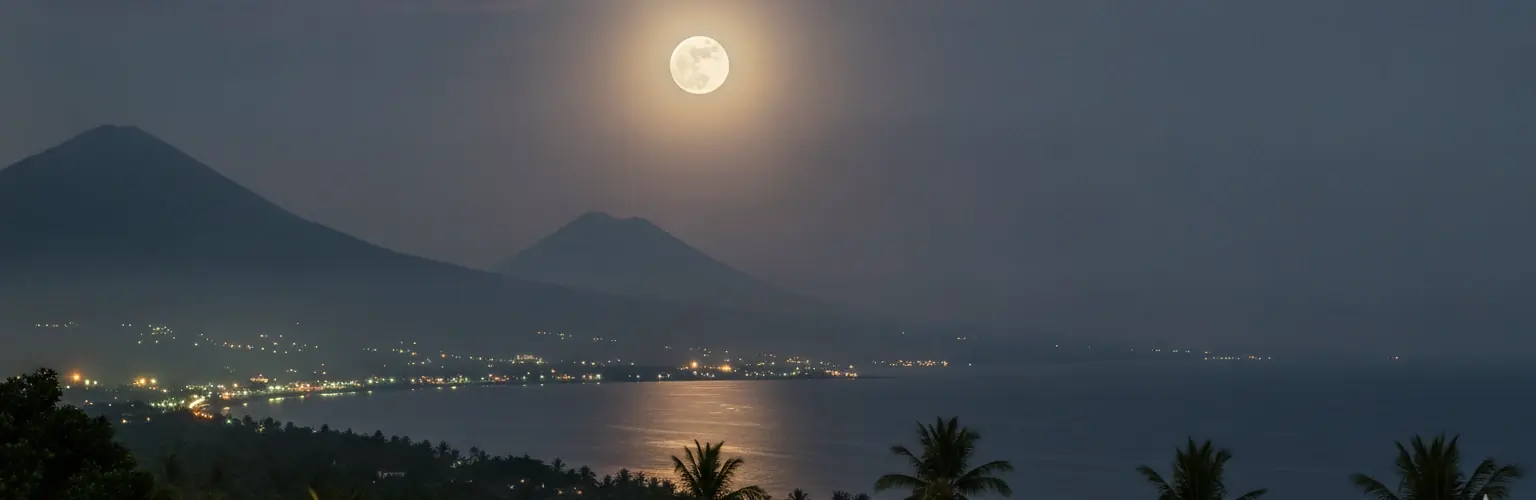
Bali sits at 8.4° South latitude, a tropical paradise where the moon follows a steep, near-vertical path through the zenith. On the "Island of the Gods," the lunar cycle is a sacred calendar, culminating in Purnama (the full moon), when temples are draped in yellow and white cloth and the air is thick with incense. From the sheer 70-meter cliffs of Uluwatu to the volcanic black sands of Amed, Bali offers a mystical stage where the moon rises over the Indian Ocean and sets behind the jagged silhouettes of the Agung and Batur volcanoes. Bali rewards the photographer who respects the island's spiritual pace and captures the silver glow reflecting off high-altitude caldera lakes.
Sanur Beach Promenade
The premier east-coast location. The moon rises straight out of the Indian Ocean, casting a silver path across calm, reef-protected waters. Traditional jukung fishing boats provide the perfect silhouette. Free and accessible 24/7; the flat path is ideal for easy tripod setups and expansive, clear horizons.
Uluwatu Temple (Pura Luhur)
Perched on a 70m cliff, this ancient sea temple is a world-class spot for silhouetting multi-tiered meru towers against the lunar disc. International adult entry is IDR 60,000. Logistics: Grounds close at 7:00 PM; while late night entry is restricted, the surrounding cliff-side paths offer incredible views of the moon clearing the ocean mist.
Lempuyang (Gate of Heaven)
Located on the eastern slopes, the gates face directly West toward Mount Agung. This is the ultimate location for moonsets, where the moon descends behind the volcano’s summit. Note: The "water reflection" in photos is a mirror optical illusion used by local staff. Combined entry and shuttle costs approx. IDR 105,000. Grounds close at 7:00 PM.
Ulun Danu Beratan – Lake Bratan
The "Floating Temple" sits at ~1,239m in the central highlands. The moon reflects in the still lake water, with the 11-tiered meru towers providing a hauntingly beautiful foreground. High-altitude mountain mist often creates an ethereal, diffused lunar glow. Cooler temperatures here (dropping significantly at night) reward those who bring thermal layers.
Tanah Lot – SW Coastal Paths
A legendary sea temple on a rocky outcrop. As the moon touches the western horizon, it silhouettes the offshore temple while waves crash against the volcanic rocks. For moonrises, position yourself at beach level to see the moon emerge from behind the temple’s dark profile. Best at low tide for beach access.
Amed – Jemeluk Bay
Located on the northeast tip, this spot offers a double feature: the moon rising over the deep blue Lombok Strait and the towering silhouette of Mt. Agung to your west. The black volcanic sand and traditional boats provide a gritty, authentic texture. It is one of the darkest coastal spots in Bali, offering superior clarity for lunar craters.
◉ Best Times for Moon Photography
📷 Quick Photography Tips
Bali operates on WITA (Central Indonesia Time, UTC+8) year-round. Indonesia does not observe daylight saving time. At 8° South, twilight is very short (approx. 25 mins); you must be ready at least 30 minutes before moonrise to catch the transition from sunset colors to silver light.
The moon phase today in Bali is shown in detail below — complete with exact illumination percentage, moonrise/set times, and the best local spots to see it. For the moon phase today in any other city worldwide, visit our Dynamic Moon Phase Calculator on the home page.
◐ What the Experience Actually Feels Like
There is a sensory, heavy warmth to a moonrise in Bali. Standing on the cliffs of Uluwatu as the sun dips into the Indian Ocean, the experience begins with the distant rhythmic boom of the surf 70 meters below. The air smells of salt, frangipani, and clove incense. As the moon breaks the horizon, it doesn't just rise; it pushes through the thick tropical haze, often appearing as a massive, golden-copper orb before turning to brilliant silver.
During Purnama, the experience is profoundly spiritual. You aren't just a spectator; you are part of an island-wide ritual. The temples glow with oil lamps, and the white parasols reflect the moonlight. From the heights of Lempuyang, the silence is absolute, broken only by a priest's bell. You watch the moon track over Mount Agung, the "Great Mountain," and the entire landscape feels like it is holding its breath under a silver light.
On the black sand beaches of Amed or the still shores of Lake Bratan, the mood is more elemental. The water creates a perfect duplicate of the moon on its surface, a "silver path" that connects the volcanic peaks to the present. It is a cinematic experience where the "sacred geometry" of the temples meets the math of the solar system—a reminder that in Bali, the moon is a living presence in every home and heart.
"The moon pushes through the thick tropical haze as a massive, golden orb. It is a cinematic experience where the sacred geometry of the temples meets the math of the solar system."
✓ Your Bali Moon Chase Checklist
Before You Go
- Check moonrise times on this page — equatorial moonrises are punctual and the twilight window is very narrow
- Verify Tide Charts: Essential for reflection shots at Sanur and avoiding salt spray at Tanah Lot
- Check the haze forecast; humidity or agricultural burning can make the moon appear blood-red at the horizon
- Download PhotoPills or Stellarium to track the vertical arc relative to the temple meru towers
- Note temple hours: Most major sites close at 7:00 PM; for late-night viewing, use beach promenades or public paths
What to Bring
- A telephoto lens (200mm+) to "compress" the moon behind the temple towers or Mount Agung
- Sarong and Sash: Mandatory for entry into any temple area, regardless of the time of day
- Insect repellent — tropical mosquitoes are highly active near highland lakes and rainforest temples
- Lens cleaning cloth — tropical humidity and sea salt will create a film on your glass within minutes
- Spare camera batteries — long exposures and heat can drain lithium-ion power faster than expected
- A remote shutter release or use a 2-second timer to avoid tripod shake in the coastal trade winds
On the Night
- Arrive at your viewpoint 45 minutes early; the transition from tropical dusk to moonrise is extremely fast
- Focus manually on the moon’s edge; the flickering oil lamps can often confuse autofocus systems
- Bracket your exposures — take one for the bright lunar disc and one for the darker shadows of the masonry
- At Sanur beach, stay near the water's edge for the best low-angle "Moon Illusion" perspective
- Stay for 20 minutes after moonrise; the composition sharpens as the moon clears the lower horizon humidity
? Bali Moon Phase — Frequently Asked Questions
Q. What is the moon phase today in Bali?
The moon phase today in Bali is a New Moon with 0% illumination. The next full moon is in 17 days, on Oct 26. Moonrise is at 5:30 AM and moonset at 6:03 PM.
Q. Where is the best place to view the moon in Bali?
Sanur Beach Promenade is the premier east-coast location, with the moon rising straight out of the Indian Ocean across calm, reef-protected waters. Uluwatu Temple's 70m clifftop silhouettes multi-tiered meru towers against the lunar disc, Lempuyang's "Gate of Heaven" is the ultimate spot for moonsets behind Mount Agung, and Ulun Danu Beratan, Tanah Lot, or Amed's Jemeluk Bay add further highland-lake, sea-temple, or volcanic-black-sand alternatives.
Q. Do I need to dress a certain way to shoot at the temples?
Yes — a sarong and sash are mandatory for entry into any temple area regardless of the time of day, and it's a sign of respect for Balinese ritual. Most major temple sites, including Uluwatu and Lempuyang, also close at 7:00pm, so late-night viewing is generally limited to the surrounding public paths and beach promenades instead.
Q. Does Bali observe daylight saving time?
No. Bali operates on WITA (Central Indonesia Time, UTC+8) year-round — Indonesia does not observe daylight saving time. The times shown on this page never need a seasonal adjustment.
Q. What's the best time of year for moon photography in Bali?
May through September is the peak dry season, bringing the sharpest mountain horizons and lowest cloud cover. Purnama, the full moon, is the most culturally significant night in the Balinese calendar, when temples are draped in yellow and white cloth for island-wide ritual.
Q. Does this page work for locations besides Bali?
This page is set up specifically for Bali, Indonesia. For the moon phase in any other city or location worldwide, use the Dynamic Moon Phase Calculator on the moonphase.today home page.
✦ Explore Further
Moon Phase Today: Kuala Lumpur
Check tonight's moon phase elsewhere in Southeast Asia, in Kuala Lumpur.
📷Moon Photography Guide
Camera settings, lenses, and techniques for shooting sharp, well-exposed moon shots.
📐Looney 11 Exposure Calculator
Dial in the exact f-stop, ISO, and shutter speed for a full moon over the temples.
🌍World Moon Phase Directory
Browse the moon phase today in hundreds of other cities and locations around the world.
NASA Moon Phase & Libration Gallery
NASA's Scientific Visualization Studio's daily renders of the moon's exact phase, libration, and orientation, straight from official mission data.