
L34 Lacus Mortis
A pre-Imbrian impact structure later uplifted, fractured, and flooded by mare basalt, its western floor cut by a graben system and a prominent normal-fault scarp — a large collapse pit nearby is considered a candidate skylight into a subsurface void, possibly a lava tube.
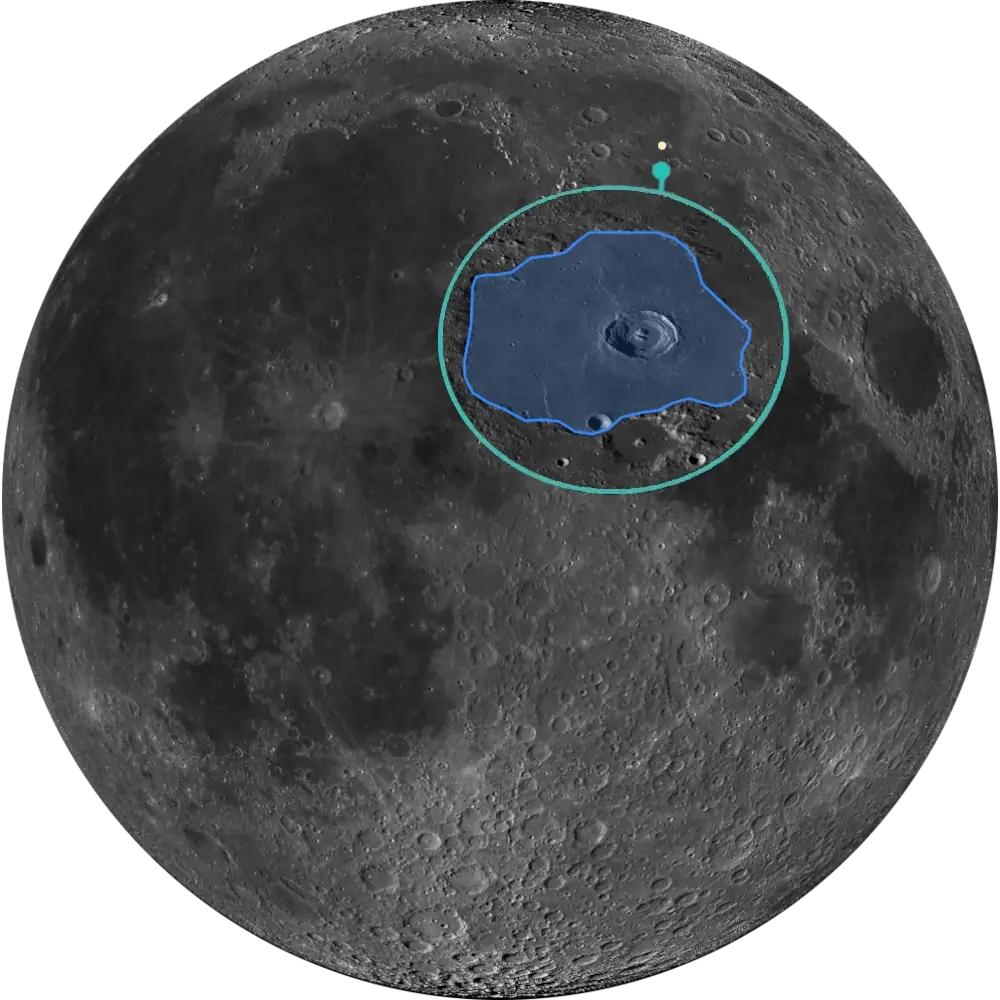
L34 Lacus Mortis
Northeastern Near Side · Floor-Fractured Lake📉 Vital Statistics
🔭 Field Notes
Lacus Mortis — the “Lake of Death,” named by Giovanni Riccioli in his 1651 Almagestum Novum and adopted by the IAU in 1935 — is a roughly hexagonal, lava-flooded plain thought to have originated as a large pre-Imbrian impact crater whose floor was later uplifted, fractured, and flooded by mare basalt during the Imbrian period. It sits between Mare Frigoris to the north and Lacus Somniorum to the south, and its western half is cut by a dense network of rilles and a prominent fault scarp, in contrast to the comparatively featureless eastern floor.
- ▶ Bürg Crater: A sharp, young complex crater sitting just east of center, with terraced inner walls, a bifurcated central peak, and a continuous ejecta blanket sloping down to the mare floor — a striking contrast against the otherwise smooth basaltic plain.
- ▶ Rimae Bürg & the Lacus Mortis Fault: The western floor is crossed by a graben-like rille system and by one of the Moon’s best-exposed normal fault scarps — its relief gradually decreasing northward before merging into the surrounding rille system.
- ▶ The Big Pit: A collapse pit west of Bürg was recognized as one of the largest known mare pit craters at the time of its discovery — a candidate skylight into an underlying lava tube, with a collapsed ramp on its eastern wall.
📍 Nearby L100 Targets
- L72 Atlas Dark-Halo Craters: Explosive volcanic pits on the fractured floor of the crater Atlas, to the northeast toward Mare Frigoris — another floor-fractured feature showing the same style of post-impact volcanism seen at Bürg’s pit, but expressed as dark pyroclastic haloes rather than a lava-tube skylight.
- L20 Posidonius Crater: The 95 km floor-fractured crater on Mare Serenitatis’s northern shore, south of Lacus Mortis across the strip of highland separating the two mare regions — a useful comparison pairing for floor-fracturing and internal rille systems on two very different scales.
- L33 Serpentine Ridge: The long compressional wrinkle-ridge system (Dorsum Nicol / Dorsa Smirnov / Dorsa Lister) winding south from near Posidonius through eastern Mare Serenitatis — a tectonic counterpart to Lacus Mortis’s extensional rilles and fault, both features tracing the same regional stress history around the Serenitatis basin margin.
🚀 Mission Log
Target Acquisition
Find the gap between two mare regions, then look for the hexagon
Lacus Mortis sits in the strip of highland separating Mare Frigoris to the north from Lacus Somniorum to the south — at 158.78 km across, it’s large enough to hold at low power once you know to look for a roughly hexagonal patch of mare rather than a round basin. The sharp, young crater Bürg, sitting just east of center with a bright, terraced rim, is the easiest first fix — find that and you’ve found Lacus Mortis around it.
Two lighting conditions, two different targets within the same lake
Under a low terminator, with the shadow line crossing near eastern Mare Frigoris — timing shifts with libration and solar colongitude, so treat this as a guide rather than a fixed date — the western floor comes alive: the rille network and a prominent normal-fault scarp throw crisp shadows against the flat mare. Under higher Sun, those same features wash out, but the lake’s overall hexagonal outline and the contrast between its rille-cut western half and smoother eastern floor become easier to read as a whole. If you only get one session, favor the terminator — the western floor is the more rewarding half of this target.
Work up in power to trace the rilles, then hunt for the pit
At 75x–100x, confirm Bürg’s terraced walls, bifurcated central peak, and the ejecta blanket spilling onto the mare floor, then trace Rimae Bürg — a graben system on the western floor — and follow the nearby scarp, one of the Moon’s clearest examples of a normal-fault scarp, as its relief fades northward into the rilles. Push to 150x+ near the terminator and look just west of Bürg for the large collapse pit on that floor, recognized upon its discovery as one of the largest known mare pit craters — a candidate collapse skylight into a subsurface void, possibly a lava tube, with a collapsed ramp visible on its eastern wall in good seeing.
Compare the fracturing and volcanism against nearby L100 targets
Roughly 200 km northeast toward Mare Frigoris, the Atlas Dark-Halo Craters (L72) sit on another floor-fractured crater, but express their post-impact volcanism as dark pyroclastic haloes rather than a pit — a useful contrast to Bürg’s lava-tube candidate. To the south, across the highland strip, Posidonius (L20) is another floor-fractured crater on a very different scale, offering a comparison of how internal rille systems develop in a smaller crater versus the lava-flooded floor of Lacus Mortis. And winding south from near Posidonius through eastern Mare Serenitatis, Serpentine Ridge (L33) is a compressional counterpart to the extensional rilles and fault here — illustrating compressional versus extensional tectonics in nearby volcanic terrains, even if their fracturing isn’t traced to the exact same cause.
📝 Observation Log — L34 Lacus Mortis
0/4 CompleteIs Lacus Mortis visible tonight?
Rimae Bürg and the western fault scarp need low terminator light to show clearly — aim for Waxing Gibbous (Day 6) or Waning Gibbous (Day 20–21) when the terminator crosses the lake’s longitude (~27°E). Under high Sun the rilles and scarp wash out, though the lake’s hexagonal outline and its rille-cut western half versus smoother eastern floor are easier to read as a whole. The western floor detail is most rewarding near the terminator.
Check Moon Phase TodayReturn to the List
Ready to find the next target? Go back to the full map to see what else is visible tonight.
← Back to Lunar 100 Map
When to Observe Lacus Mortis
Lacus Mortis rewards two different sessions rather than one perfect night — the western floor’s rilles and fault scarp need raking light, while the lake’s overall hexagonal shape reads better under flatter illumination.
- Best Window (Fine Detail): Roughly Day 5–7 after New Moon (morning terminator, waxing) or the mirror window around Day 19–21 (evening terminator, waning). At 27.32°E, this is when the shadow line is near enough to throw crisp relief on the western rilles and fault scarp — treat these as rough guides, since exact timing shifts with libration and solar colongitude.
- Best Window (Overall Shape): Under higher Sun, once the western floor’s shadows have washed out, the hexagonal outline of the lake and the contrast between its rille-cut west and smoother east become easier to take in as a whole.
- If You Only Get One Night: Favor the low-terminator session — the western floor, with Rimae Bürg and the fault scarp, is the more rewarding half of this target.
What to Look For
At 75x–100x, start with Bürg itself, a sharp ~40 km Copernican-age crater sitting just east of center. Look for its terraced inner walls, a bifurcated central peak, and a continuous ejecta blanket sloping down onto the mare floor — a striking contrast against the flat, ancient basalt surrounding it. This is the easiest fix in the field and the natural anchor for everything else here.
Push to 150x+ near the terminator and trace Rimae Bürg, a graben-like rille system reported at roughly 60–140 km across the western floor. Follow it toward one of the Moon’s better-exposed normal-fault scarps nearby, and watch how its relief gradually fades northward as it merges into the surrounding rilles — a nice example of how a fault’s visible signature can taper off rather than end abruptly.
Just west of Bürg, under good seeing near the terminator, look for a large collapse pit — recognized on its discovery as one of the largest known mare pit craters. It’s considered a strong candidate for a skylight into a subsurface void, possibly a lava tube, and a collapsed ramp is sometimes visible on its eastern wall in favorable conditions.
Widen out and compare this floor’s extensional rilles and fault against two very different neighbors: the Atlas Dark-Halo Craters (L72) to the northeast, where post-impact volcanism shows up as dark pyroclastic haloes instead of a pit, and Posidonius (L20) to the south, another floor-fractured crater but on a smaller scale with its own internal rille system. If you can extend the session, Serpentine Ridge (L33), winding through eastern Mare Serenitatis beyond Posidonius, offers a compressional counterpart to the extensional structures here.
The Science: A Crater Modified From Below, Then Flooded
Lacus Mortis is thought to have started as a large pre-Imbrian impact crater, later modified by subsurface magmatic intrusion that uplifted and fractured its floor, before mare basalt flooded it during the Imbrian period — a multi-stage history that shows up clearly in the split character of its floor today.
Floor-Fracturing Before the Flood
The fracturing here follows a pattern seen at other floor-fractured craters across the Moon: magmatic intrusion beneath the original crater floor is thought to have driven uplift and cracking, producing the graben-like rille network later exposed on the western half. The eastern floor’s comparative smoothness suggests the mare basalt flooding that followed was uneven, more fully burying fractures on one side of the crater than the other.
A Basalt Composition That Differs Somewhat From Its Neighbors
Global multispectral surveys have found that the basalt filling Lacus Mortis differs somewhat from typical mare basalt elsewhere on the Moon — not a dramatic anomaly, but a measurable spectral difference. That distinction adds a useful data point for comparing this lake’s volcanic history to neighboring Mare Frigoris, though it isn’t fully clear what it implies about the timing or source of the eruptions that filled Lacus Mortis specifically.
A Pit That’s Still Being Investigated
The large collapse pit west of Bürg remains a candidate skylight into a subsurface lava tube rather than a confirmed one. High-resolution LROC imaging has resolved its morphology, including the collapsed ramp on its eastern wall, in useful detail, but establishing what lies beneath a lunar pit — an open void, a rubble-filled cavity, or something else — generally requires more than surface imaging alone.
What ties Lacus Mortis together is that split personality: a crater old enough to have been named “the Lake of Death” by a 17th-century astronomer, still showing an active-looking fault and a candidate lava-tube entrance on one half, and a quiet, fully resurfaced plain on the other.